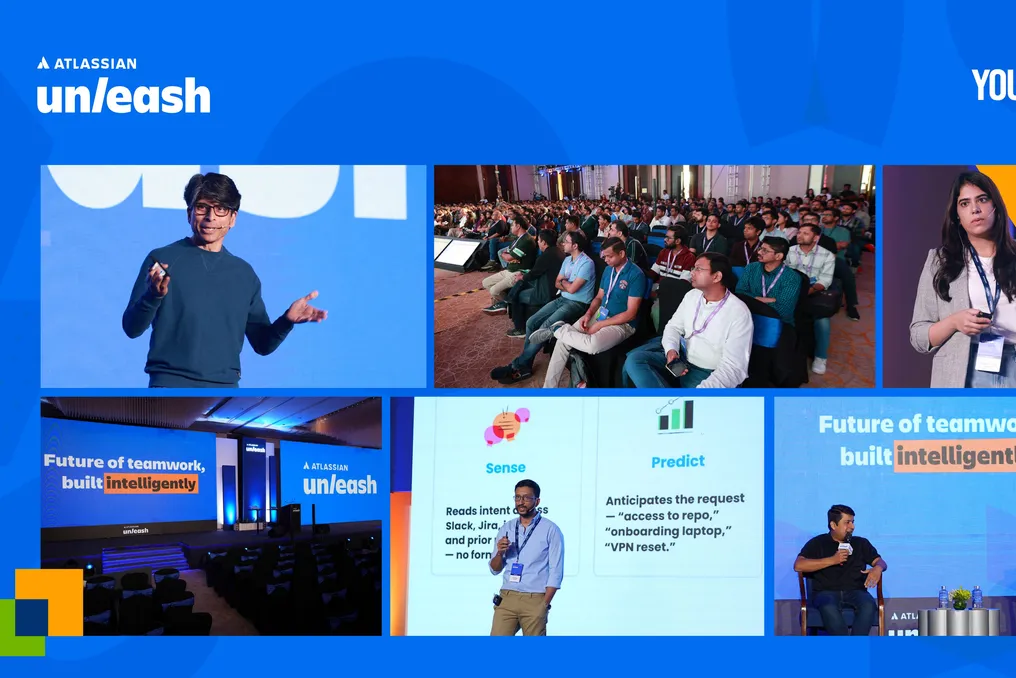
At the Unleash technology summit, organized by Atlassian in collaboration with YourStory, the discussion focused on transitioning from impressive artificial intelligence demonstrations to its reliable use in production settings. While demonstrations often showcase successful task completion by an agent—such as answering complex questions or generating code—the summit concentrated on a more intricate problem: how to make AI dependable in operation.
Requirements for Production AI
The system must ensure result accuracy, operate within established permissions, possess visibility, security, and the ability to recover actions. Furthermore, it must function stably not only on stage but continuously across various products, among users, and within complex enterprise environments.
The journey from prompt to workflow was presented through engineering masterclasses, product presentations, and practical workshops. Atlassian teams detailed systems around Rovo and its extended AI stack, including limited contexts, durable workflows, incident analysis, intelligent security, and the infrastructure required to ensure AI reliability at scale.
Boundaries over Big Prompts
Kartik Chandrasekaran, Senior Software Engineer at Atlassian, demonstrated an agent system for handling reporting requests. Previously, such requests required the involvement of support engineers who would locate necessary APIs and database structures, write and execute code, and then implement changes based on customer feedback. This process could take hours or days and was estimated to cost around $500,000 in engineering hours annually.
However, the Atlassian system allows an engineer to describe a report in natural language. The agent generates executable code, which is validated before execution via a durable workflow mechanism. The final result is compiled into a report and delivered to the client. A key engineering decision was not merely using an LLM to write code, but restricting the model's access and the content it generates. Instead of giving the agent broad API specifications, the team created narrowly specialized tools in a controlled environment, applying automated checks that establish deterministic boundaries around probabilistic output. The conclusion was clear: industrial-grade agents often require stricter operational environments rather than larger prompts. A similar principle applies to failure diagnostics.
Supporting Root Cause Analysis
Satish Kumar, Senior Lead Engineer at Atlassian, discussed how AI can assist in root cause analysis during software incidents. Investigations may involve code changes, feature flags, metrics, logs, traces, service dependencies, and historical knowledge. Without a clearly defined scope, an agent can quickly lose signals in general noise or draw weak conclusions. The presented AI SRE approach combined the cognitive capabilities of code, observability data, and service topology to form and verify hypotheses based on available evidence. The goal was not to replace engineers in incident response but to help them reach the correct issue faster.
Security at Scale
As software creation accelerates with AI, security teams face pressure from another side: more changes, more services, and more solutions compete for limited attention. Lohit Mehta, Senior Lead Product Security Engineer at Atlassian, and Achyuta Anti Srinivasan, Senior Product Security Engineer at Atlassian, described the company's transition from manual review queues to an AI-powered security assessment platform. Atlassian has over 6,000 engineers working on more than 1,000 microservices, and approximately 3,000 projects pass through the organization each quarter. The platform uses signals from business priorities, service health, customer exposure, and engineering activity. AI is then applied to this grounded information to generate summaries and accelerate assessment workflows. However, the model is not treated as the source of truth; deterministic service data and human judgment remain central to security-related decisions.
Protecting the Third-Party Developer Ecosystem
As AI speeds up application development and updates, another factor arises: the volume of code entering the market, which in turn increases the risk surface. Sundar Chakraborty, Senior Product Security Engineer at Atlassian, showed that the same multi-layered approach applies to the partner ecosystem and marketplace. He detailed the company's strategy to enhance security in the Data Center Marketplace through partner verification, application signing, and an automated scanning pipeline covering software composition analysis, static testing, secret detection, and malware analysis. This pipeline runs over 10,000 scans daily and has identified over 6,700 vulnerabilities, more than 5,100 of which are classified as critical or high priority. This underscored that marketplace security cannot rely on a single control; trust must be built on multiple layers—from partner identity to the origin and content of the application itself.
Infrastructure for Machine Speed Operation
Several sessions were dedicated to systems that must continue functioning after visible interaction with AI concludes. Since agents begin generating code, tasks, and documentation at machine speed, the underlying infrastructure must handle a large volume of automated activity without degrading performance, correctness, or recoverability.
Priyansh Jain, Senior Software Engineer at Atlassian, and Ammi Reddy Chirla, Atlassian Lead Engineer, shared how the company addressed bottlenecks when migrating large Jira Data Center customers to the cloud. Changes in the migration pipeline led to a sixfold increase in throughput. However, this speed revealed another limitation: data errors that could force customers to clean their source systems and restart lengthy migrations. The team reworked the process to classify and correct specific errors during data transfer without altering the source data. This approach aims to reduce migration failures by 50–60% and can save an enterprise customer between 22 and 30 days.
Kartikeyan Murthy, Lead Engineer for Jira Problem Search at Atlassian, deeply explored the architecture serving over 1.5 billion Jira Query Language requests daily for more than 350,000 tenants. The system breaks down queries into an intermediate representation and routes them through specialized services, allowing new clauses and fields to be added without destabilizing the core search path. For the largest tenants, Atlassian's architecture provided twice the performance while continuing to support a high volume of users, issues, and concurrent queries. These examples highlighted that enterprise AI is defined not just by visible features; if agents increase the speed and volume of work, then the underlying search, system, and migration systems must also evolve.
Using AI for Decision Making
The product track examined how the process itself must change when AI shortens the distance between idea and working prototype. Tulasi Menon, Head of AI Strategy in Atlassian Product, stated that while routine tasks in the product decrease, the responsibility for defining what is 'good' becomes more crucial. She described an AI-based product lifecycle based on perception, formation, validation, release, and continuous learning. AI can compress market research and competitive analysis, and modern tools can turn ideas into working prototypes within hours or days. However, speed alone does not make a product better. Product managers must still define the right problem, set the quality bar, and decide what evidence justifies a release or rejection of an idea. Menon also warned against using AI to create polished but empty artifacts—whether long product documents or impressive prototypes that do not aid teams in making decisions. Nevertheless, release is not the end of the lifecycle. Teams need evaluations, real traces, quality criteria, and feedback loops that identify failures and improve the product over time.
This was demonstrated by Alok Agrawal, Atlassian Product Manager, and Abhinaya Singh, Group Product Manager for Jira Service Management at Atlassian. This pair showed how product managers use Rovo and Rovo Dev to gather customer feedback, synthesize information, prepare updates, and create early prototypes. The more important question was not how many tasks AI could perform, but what product managers could do with the freed-up time. Participants used Rovo Studio to configure agents for specific product workflows, moving from one-off requests to repeatable, context-aware tools. Other sessions extended this production-oriented approach across the entire Atlassian stack, from schema-defined persistence to agent analysis of long-running business processes and AI-driven product reviews. Together, they unveiled Atlassian's broader vision for enterprise AI. The company does not view the agent as a model placed atop an existing workflow; it builds the context, permissions, validation mechanisms, orchestration, security, and recovery needed for the agent to be useful in practice. A demonstration can show what an agent is capable of doing. Production shows whether an organization can trust it.
{