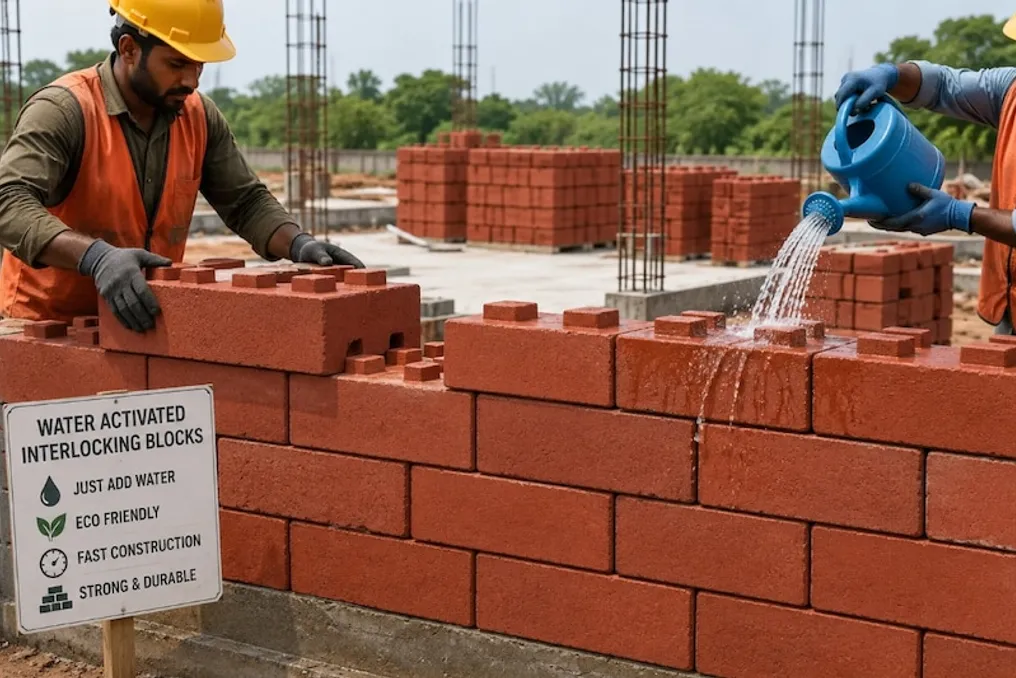
Housing construction requires significant expenditure on building materials, with a large portion of these costs attributed to cement. A new methodology exists that allows bricks to be joined without the need for cement or sand. Instead of the traditional mixture of cement and sand, it is sufficient to simply spray the bricks with water so that they bond securely.
These technologies are already available on the market. The principle is that water-activated bricks allow walls to be erected without using cement and sand. One simply lays one brick on top of another and sprays it with water, after which the wall gains hardness and strength comparable to concrete. Experts believe this is the future of construction.
These water-activated bonding bricks are designed so that the construction process is faster and more precise compared to conventional methods. When working with them, there are no issues with leveling the bricks, and no thick layer of mortar needs to be applied between each block. The bricks are simply stacked on top of each other, fixed, and the wall is ready, requiring only a spray of water to make them firmly adhere.
The use of such bricks significantly speeds up construction and reduces completion times. Furthermore, it lowers the demand for large amounts of labor and materials like cement and sand. Cement, sand, and gravel are still only necessary for creating support columns, beams, and slabs, which substantially saves the funds usually spent on building walls.
This approach represents not just a new type of brick, but an entirely different perspective on the construction process. As cities continue to grow and the demand for affordable housing increases, innovations that reduce construction time are attracting global attention. Changing a single building block has the potential to transform the entire industry, allowing houses to be built in days instead of weeks, which is generating widespread resonance around this technology.