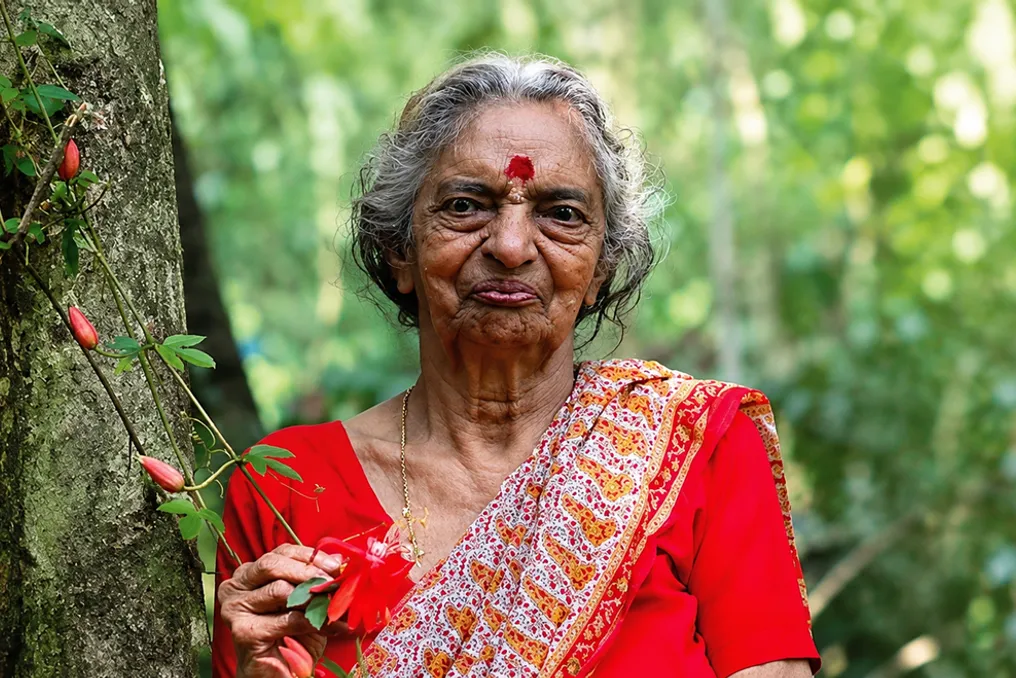
For years of her life, Devaki Amma spent time in the paddy fields of Mutukulam, a coastal village in the Alappuzha district of Kerala. Agriculture was an integral part of her existence, a work she knew since childhood and continued to do with her husband, Gopalakrishnan Pillai, a retired school principal.
Injury and the start of a new venture
However, at the age of 46, a car accident suddenly interrupted this familiar rhythm. The injury severely limited her mobility, and doctors advised her to avoid physical exertion for almost three years. For someone accustomed to working outdoors from dawn, the long period of forced rest seemed unbearable, and the fields she had cultivated for decades became inaccessible.
Life changed overnight. Restricted mainly to her home space, Devaki Amma began planting individual saplings in a sandy patch near her house, which was previously only used for post-harvest activities. This gave her something to do while recovering her health. She planted one, then another, and then another. Initially, there were no plans to create a forest; it was simply a way to pass the days without doing her usual work.
A family project and its development
This small, repetitive act did not stop after her recovery. Friends and relatives brought seeds and cuttings during visits, and her husband and children joined the effort. Her daughter, Tankamani, who later headed the department of environmental engineering at Tiruvannanthapuram College, watched this quiet, constant labor.
What started as a way to distract herself from boredom gradually turned into a shared family endeavor, and then became Devaki Amma's life mission.
Turning sand into a living forest
Over more than four decades, Devaki Amma's saplings spread across nearly five acres of coastal sandy soil, a plot she named Tapovanam. She worked without formal training, relying on careful observation of the soil and local climate. The use of mulching, organic manure from domestic livestock, and careful preservation of fallen leaves gradually improved the land, which was never supposed to support a forest.
As the monsoon patterns in Kerala changed over the decades, with longer dry spells alternating with intense downpours, Devaki Amma adjusted her methods instead of abandoning them. Her family periodically adapted mulching techniques to prevent waterlogging and protect root systems, using solutions based solely on years of experimentation and observation, rather than textbooks.
Two ponds within Tapovanam never dry up. They help replenish groundwater, assist in preventing seawater intrusion into the coastal soil, and sustain aquatic life year-round. The forest also includes an Indian banyan tree, estimated to be about 200 years old, which is significantly older than Tapovanam itself, which now exists in an ecosystem that grew around it.
Over 3000 trees in an acid-free area
Alappuzha is the only district in Kerala that lacks natural forest cover, making Tapovanam particularly remarkable. Today, the forest comprises over 3000 registered trees, plants, shrubs, and vines, including rare and medicinal species that are becoming increasingly difficult to find elsewhere in the state. It serves as a sanctuary for peacocks, owls, emerald doves, and migratory birds, as well as butterflies and other small wildlife, functioning as a repository of Kerala's endangered native plant species due to habitat loss.
Everything is maintained organically, without the use of chemical fertilizers, using methods developed by Devaki Amma through decades of trial and error. She achieved all of this without institutional funding or a team of specialists, working for most of these four decades with little public recognition. Now, her methods are attracting the attention of a new generation of gardeners, including Krishnakumar S, who helped create over 40 dense urban forests to cool Indian cities.
From one sapling to the Padma Shri award
Devaki Amma, now 91 years old, is widely known in Kerala as 'Vanammattassi', or grandmother of forests. Her work attracted national attention long before this year, including the Indira Priyadarshini Vrikshamitra Award in 2003 and the Nari Shakti Award in 2018, as well as mention by former President Ram Nath Kovind in his Republic Day address. This year, she received the Padma Shri, India's fourth-highest civilian award, in the category of Unsung Heroes, becoming the only recipient from Kerala.
Tapovanam is visited by students, researchers, and nature lovers studying biodiversity conservation in situ, and Devaki Amma encourages schools, colleges, and households across the state to grow local and medicinal plants, often providing seeds and saplings herself. Her daughter, Tankamani, now cares for her full-time, while the rest of the family continues to help maintain the forest. Devaki Amma still tends to her plants daily, urging everyone she meets to plant at least one tree. Her four decades of quiet, repetitive labor stand as proof of what patience, family support, and a single sapling can achieve.