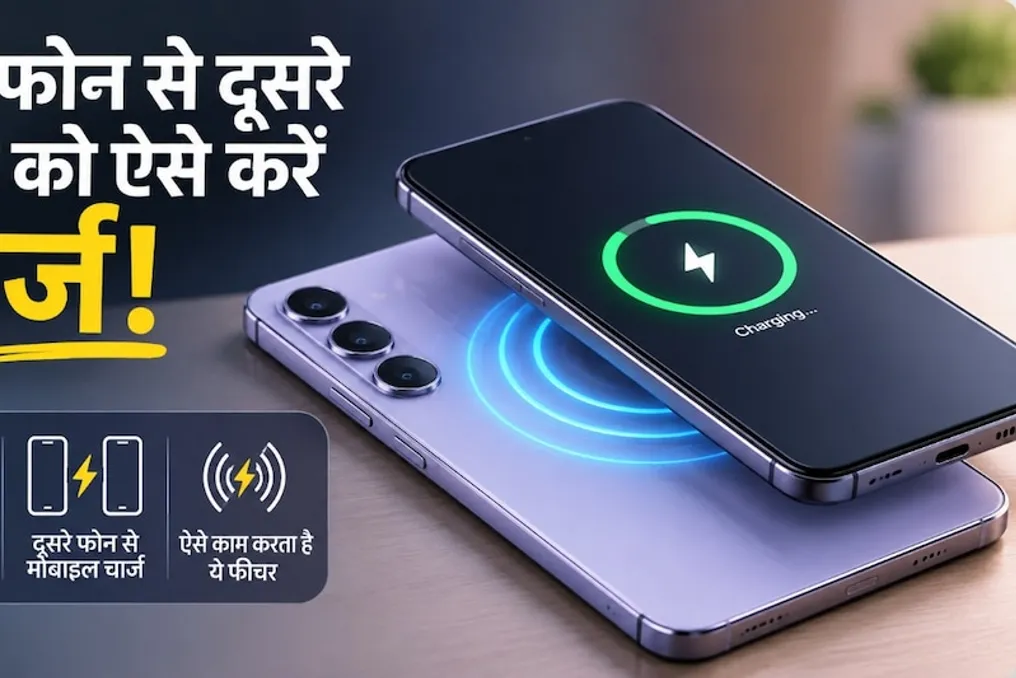
A situation arises when your phone is almost dead, and there is no charger or power bank nearby. In such cases, a second smartphone can be useful. Modern phones are equipped with a function that allows one device to charge from the battery of another. Thanks to this, the demand for external batteries decreases, as many manufacturers now install smartphones with batteries ranging from 7000 to 9000 mAh, which can function as portable chargers.
The process of charging one smartphone from another is called reverse charging. In this process, one phone transfers energy from its battery to another. This function can work both wirelessly and using a cable. However, it should be noted that not all phones support this capability, and even among those that do, they may charge other devices differently.
There are two main ways to charge a phone from another phone. The first method is wireless charging, where one phone transfers energy to another without using any connecting wires. This technology is known as Power Sharing and is implemented in smartphones with large batteries.
The second method is carried out via a charging cable. In this case, both phones are connected by a cable, and one can supply power to the other. The implementation of this function depends on the phone model and the technologies used in it. Some smartphones call this feature Battery Share, while some Samsung models use the term Wireless PowerShare.
The most important condition is that the phone that will charge the other must have the reverse charging function. If wireless charging is intended, the second phone must also support wireless charging; simply having wireless charging in one phone is not enough. Both devices must be capable of interacting with each other. For example, Google Pixel phones have the Battery Share function, which allows charging other wireless devices or phones.
Some Samsung Galaxy smartphones have the Wireless PowerShare function, allowing them to charge other devices or phones compatible with this technology.
Suppose you have a phone with Wireless PowerShare support. First, you need to activate this function in the phone's settings. Then, place the second phone on the back panel of the first phone. The function only works if the back panels of both smartphones are in close contact.
It is important that the charging zones of both phones are directly opposite each other. If the placement is incorrect, charging will either not start or will proceed very slowly. A case can also cause problems. If charging does not start, it is recommended to remove the case and reposition both phones correctly.
In Google Pixel, the Battery Share function is used for this purpose, which can be enabled in the settings. After that, the second phone, which supports wireless charging, can be placed on the back of the Pixel.
No, it cannot be compared to fast charging from a regular adapter. The main advantage of charging from phone to phone is the ability to give a little charge to the second device when there is no access to a charger or power bank. It is not recommended to use this method for fast charging to 100%.
The charging speed depends on the phone models, temperature, and the correct positioning of both devices. Regarding battery consumption, the battery of the phone that is charging will deplete, as it is the one transferring the energy. Furthermore, during wireless charging, some energy can dissipate as heat. Therefore, it is better to use reverse charging only when necessary, not daily. Google Pixel also allows setting a limit for Battery Share so that the function automatically turns off when the battery reaches a certain level.
Yes, the phone can heat up during charging, especially with wireless reverse charging, when both devices are in close proximity to each other. If the phone gets too hot, the charging speed may slow down, or the phones themselves may automatically stop the process. In such a case, it is better to stop charging.
This depends on the specific phone models and the method used. If an Android phone supports reverse wireless charging, and the second phone supports wireless charging, they can work together. However, having a USB-C port on both devices does not guarantee that one can charge the other, as the ability to supply and receive energy is determined by the technology built into the phone itself, not just the port type.