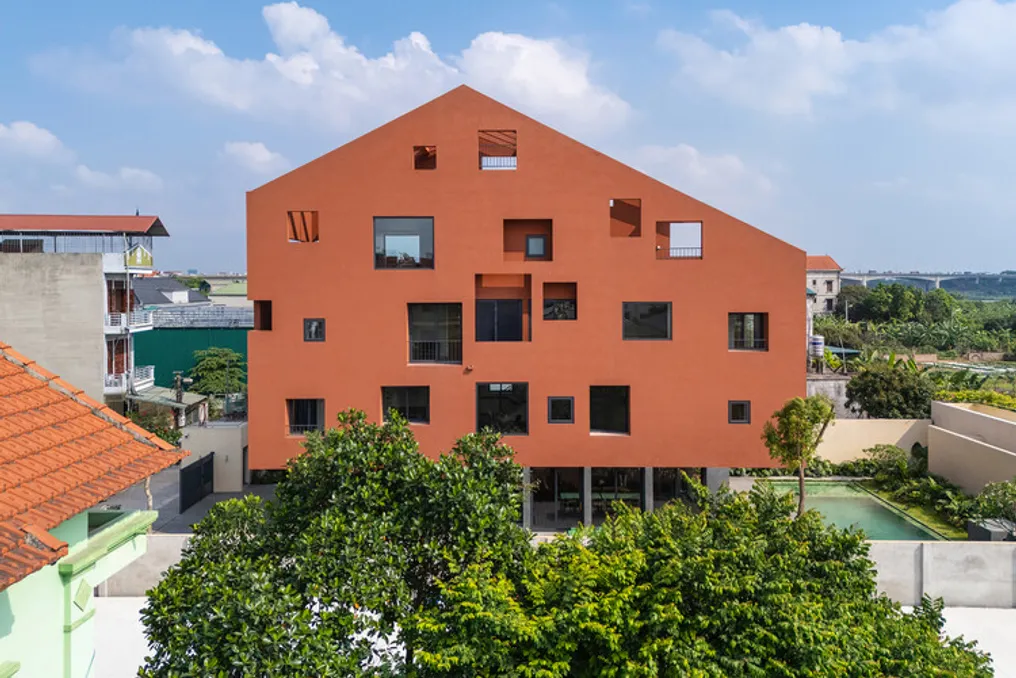
The 'Casa das 100 Janelas / Inrestudio' project is a residential building designed for two generations and three family units—a couple of parents and the families of their two children who share the same structure.
The 'Casa das 100 Janelas / Inrestudio' project is a residential building designed for two generations and three family units—a couple of parents and the families of their two children who share the same structure.
The plot is located along a river in the suburbs of Hanoi. The area was previously agricultural but is now transforming into a small town where residential plots and industrial warehouses for rent are mixed. It is expected that this transitional state will significantly change in the coming decades.
The main concept of the building is to accept the uncertainty of the environment as a long-term design condition and maintain a deliberate distance from it. Unlike dense urban areas, the relationship between the building and its surroundings in the suburbs is not fixed. Such places require a spatial composition capable of regulating the degree of involvement with the surroundings as circumstances change.
In this house, this role is played by a 'flexible double envelope' surrounding the upper floors. Sections of this envelope vary: in some places, it acts as a completely independent double wall, while in others, it functions as a single thick wall incorporating closets and other functions. In Hanoi's hot and humid climate, this two-layered contour also serves as a thermal buffer against direct solar heat.
This double envelope is irregularly pierced with openings of various sizes. Since openings of different depths and orientations are distributed across all facades, some of them continue to let in light, air, and views regardless of how the surroundings change. This composition, which does not depend on a single opening, gives the building resilience in the face of environmental transformations.
Deep openings formed within the thickness of the envelope can be opened or closed depending on the climate, daily circumstances, and changing lifestyles over the years. Their irregular placement also makes the interior organization unreadable from the outside; this unreadability protects the privacy of the residents in a building visible from afar.
On the upper floors, the bedrooms of each family unit and various common areas are protected by the double envelope, maintaining an appropriate distance from the surroundings. Circulation on each level forms a ring without final exits, ensuring flexibility for future changes in family composition. The floors are made of pressed bamboo, pleasant to the touch, and the ceilings are made of exposed concrete—both materials were chosen for long-term use in a hot and humid climate.
The exterior walls are finished with terracotta-colored plaster, reminiscent of the red roofs of neighboring houses. The ground floor is a communal space that occasionally hosts many guests. While the upper floors are oriented towards the constantly changing environment, the ground floor opens onto an enclosed garden. Designed with minimal walls, it visually and spatially integrates with the garden when its large sliding doors are fully open.
Both inside and out, the floors have a continuous covering of Vietnamese basalt, and the walls bordering the plot are clad in dark washed concrete, softening their lines. In the context of a transforming environment, the ground floor maintains its tranquility within the enclosure.
The mention of Mathura peda whets the appetite of many people due to their characteristic brown color, cardamom and nutmeg aroma, and grainy texture, making them one of India's most beloved sweets. However, the traditional method of preparing these pedas requires a lot of time and effort, as the milk needs to be dried and evaporated for hours.
Nevertheless, here is the recipe from the renowned chef Pankaj Bhadauria, which allows you to make equally delicious brown pedas like those in Mathura in just 15 minutes without long labor. This quick homemade recipe is so exquisite that it is impossible to distinguish it from store-bought ones.
For the tagar:
2 cups of sugar
½ cup of water
1 tablespoon of ghee
For the peda:
2 cups of milk powder
4 tablespoons of ghee
½ cup of milk
To begin preparing the peda, you need to make the syrup. In one pan, mix the sugar and water and boil until it boils, stirring constantly. As soon as bubbles start forming in the syrup, add the ghee and mix thoroughly. Then remove from the heat and continue stirring intensely until the tagar dries completely and crystallizes.
In another pan, take the milk powder and ghee. On low heat, stir constantly until the milk turns golden-brown, but does not burn. Transfer the resulting mass to a separate container. Add 1 cup of tagar and mix well.
Balls the size of a walnut are formed from the resulting mass, which are then rolled in the tagar for a sugary coating. These pedas can be stored for a month.
This Wednesday (the 12th) will feature one of the most significant solar eclipses of the decade. In addition to marking the return of total solar eclipses to the European continent after more than 20 years, it will be the first such event in continental Spain in over a century.
More than 15 million people will be in the path of totality, while about 980 million will be able to observe the phenomenon partially. Unfortunately, Brazil's sky will not be the stage for this astronomical spectacle this time, but all details are available to view in real-time via Olhar Digital.
During the event, the Sun will be completely obscured in the Arctic, Greenland, Iceland, northern Spain, and a small part of Portugal. The partial phase will be visible across the rest of Europe, North Africa, and the eastern part of North America.
The event will begin at 12:34 Brazilian time in a remote point of the Arctic Ocean, north of Siberia, when the Moon's shadow first touches Earth, starting the partial eclipse phase. The spectacle will conclude just over four hours and 20 minutes later, at 16:55, in the Mediterranean Sea area, west of Italy.
The most impressive moment is expected near the western coast of Iceland, where totality may last up to two minutes and 18 seconds. In Spain, which has not recorded a total solar eclipse on its mainland territory since 1905, the total darkness will be shorter, lasting about a minute.
For those in the path of totality, this is a rare opportunity to view and photograph the solar corona—the Sun's outer atmosphere, which is usually hidden by the star's intense glare. However, special precautions are required to capture the moment. Pointing a camera, mobile phone, binoculars, or telescope directly at the Sun without proper protection can lead to equipment damage and, more importantly, vision damage.
According to EarthSky.org guidelines, the primary rule is to use specialized solar filters for astronomical observations at all stages until the Moon completely covers the Sun. This applies to cameras, lenses, telescopes, and other optical instruments.
It is also important to remember that zooming in with a camera or telescope does not mean the equipment protects your eyes. Observing the Sun directly, even for a short time, can cause serious retinal damage.
The only phase when it is safe to remove the solar filter from optical equipment is during totality, when the Moon completely covers the solar disk. As soon as the bright sunlight reappears, the filter must be immediately put back on.
With necessary safety measures observed, there are several ways to capture the eclipse. A smartphone is the simplest option for those without specialized equipment. A tripod helps stabilize the device and simplifies framing.
An alternative is using a wide-angle lens to combine the eclipse shot with the surrounding landscape. During totality, zoom can be used to get a closer view of the Sun. A mobile phone can also record video and create time-lapse sequences demonstrating the evolution of the event.
However, during partial phases, it is essential to use an appropriate solar filter to protect the camera. Standard cameras with wide-angle lenses allow for images combining the eclipse with the environment; depending on the composition, trees, buildings, mountains, and other landscape elements can help give the photo context.
It is advisable to prepare the composition before the eclipse begins so as not to waste time setting up the camera during the fastest stages of the event. A tripod also contributes to equipment stability.
For those planning to record the eclipse in greater detail via video, a telephoto lens with a focal length of 300mm to 500mm can significantly bring the image of the Sun closer. In this case, using a tripod is especially important.
Low ISO settings help reduce image noise. Aperture and shutter speed should be adjusted according to the eclipse phase and desired result. During the partial phase, a solar filter remains mandatory.
A telephoto lens is also good for obtaining more detailed eclipse photographs. The greater the focal length, the larger the Sun in the picture, but this also increases the need for stability and a carefully planned frame.
Exposure time depends on which moment is planned to be captured. A fast speed, such as 1/1000 of a second, can help capture the details of the solar disk and the surrounding area during certain phases. Those with a compatible camera are recommended to shoot in RAW format, as this format retains more information for subsequent image processing.
To get even closer shots, a telescope equipped with a tracking system can be used. This mechanism tracks the apparent movement of the Sun across the sky, keeping the celestial body in the frame longer. This technique requires extensive knowledge and specialized equipment, as well as a correctly installed solar filter. Consequently, the investment is also higher. However, the system allows for detailed recordings of the eclipse, especially during totality.
Regardless of the equipment chosen, safety must be the priority over photography. The eclipse may last only a few minutes, but improper exposure to the Sun can cause irreversible eye damage. Therefore, the best shot is the one that allows you to enjoy the event without risking equipment and, above all, your vision.
In astrology, the conjunction of the Sun and Rahu is considered an extremely significant and sensitive aspect, also known as the Rahu eclipse. When this aspect forms in the fifth house of a person's chart, its influence is particularly noticeable in areas related to intellect, education, offspring, and romantic relationships. The fifth house is traditionally considered the domain of the Sun, so a weakening of the Sun here can affect a person's mental, intellectual, and emotional balance.
The formation of the Rahu eclipse with the Sun in the fifth house leads to a non-traditional way of thinking for the individual. They tend to seek solutions to problems using unconventional or improvised methods. Such people possess a sharp mind, but their attention is often scattered, which makes it difficult to maintain continuity in education. Sometimes, frequent obstacles arise during studies, or interest changes.
If this eclipse forms in the sign of Aries, which is a high sign for the Sun, some positive aspects may be observed in the results. In this case, the person becomes self-confident, brave, and capable of making decisions. They clearly see their goals and move towards them with firm determination. Nevertheless, due to their unconventional view, they may face difficulties within the framework of the traditional education system.
If Jupiter casts a favorable gaze upon this eclipse, this aspect can turn into a blessing for the person. Such individuals become deeply understanding, knowledgeable, and influential speakers. They may achieve recognition in politics, education, or social spheres. Even without high positions, they gain respect in society due to their knowledge and personality.
Conversely, if the Sun participates in this eclipse in its low position, negative consequences manifest more clearly. The person's egoism may increase, and they will not hesitate to use dishonest means for their own benefit. Difficulties with offspring or anxiety related to children may arise. Instability, distrust, and suspicion also increase in romantic relationships, causing relationships not to last long.
Regarding love life, due to this aspect, the person often encounters either betrayal from others or becomes a deceiver themselves. Tension persists due to a lack of transparency in relationships and mental imbalance. Such people often feel emotionally insecure, which affects their decision-making.
It is impossible to completely eliminate the negative effects of this aspect, but they can certainly be balanced. To do this, the person should apply discipline, positive thinking, and spiritual practices. Regular offering of water (Arghya) to the Sun, meditation and yoga practice, as well as charity help in achieving peace of mind. Furthermore, when making decisions, it is crucial to show patience and prudence. Experts advise people with this aspect to avoid hasty actions and maintain openness in their relationships.