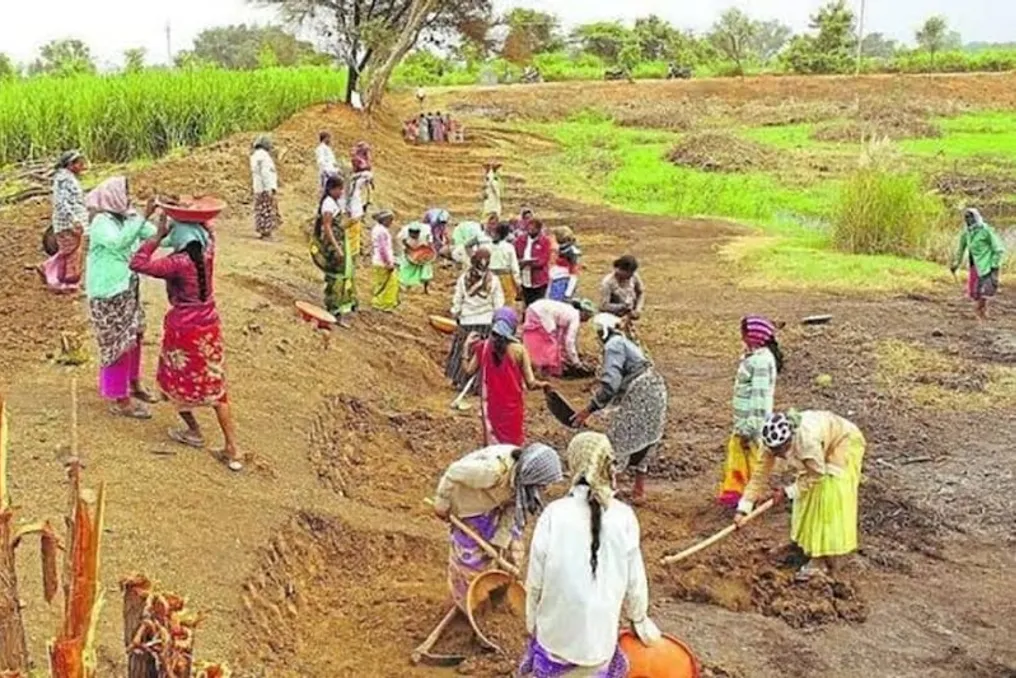
In July 2026, under the new program for developed India—Guarantee of Employment and Livelihood in Rural Areas (VB-G RAM G)—7.67 billion man-days of employment were registered. This figure is significantly lower than the 15.33 billion man-days recorded in July of last year under Mahatma Gandhi National Rural Employment Guarantee Act (MGNREGS).
According to official statistics, this signifies a decline in rural job creation of approximately 49.94% year-on-year. This fact is significant because the VB-G RAM G program was implemented on July 1, 2026, replacing the MGNREGS program, which had been in effect for about two decades.
The government presented the new program as an enhanced version of the rural employment system, providing for an increase in the employment guarantee from 100 to 125 days. The first full month of operation for VB-G RAM G was July, and the man-day figures for this period reflect the initial dynamics of the program.
The government had previously stated in parliament a positive outlook on the program's initial performance in July. In a written reply, the government reported that over 99.5% of workers who requested work received it. According to the government, more than 5.2 billion man-days were registered under VB-G RAM G by July 22. The Ministry of Rural Development also asserted that the transition to the new program had not negatively impacted its implementation.
However, the final data for July shows a picture different from the initial claims. After reaching a figure of over 5.2 billion man-days by July 22, the total figure for the entire month was 7.67 billion. This indicates that the pace of job creation slowed down in the second half of the month. Although the government has not yet provided detailed reasons for such a sharp drop in man-days in July.
The government presents VB-G RAM G as a more comprehensive and qualitative rural employment program compared to MGNREGS. The new system provides for an expansion of the employment guarantee from 100 to 125 days. Furthermore, emphasis is placed on higher wages, construction of sustainable rural infrastructure, and strengthening the livelihoods of rural households. The government asserts that the program's goal is not only to provide work but also to strengthen the rural economy and earning potential.
For the fiscal year 2025-26, an annual budget of 1.52 lakh crore rupees has been allocated for VB-G RAM G, which significantly exceeds the budgetary allocation of 86,000 crore rupees provided for MGNREGS. Despite this greater financial provision for the new program, the 50% drop in man-days in July casts doubt on the program's initial momentum.
It is currently unclear whether the drop in man-days is related to changes in the new program or if it reflects an inherently weak demand and availability of jobs in rural areas. The government has also not disclosed the detailed reasons for this decline. Therefore, the data from future months will be crucial. They will show whether the drop in July was solely due to the transition from the old to the new program, or if it will have a long-term impact on rural job creation under VB-G RAM G.