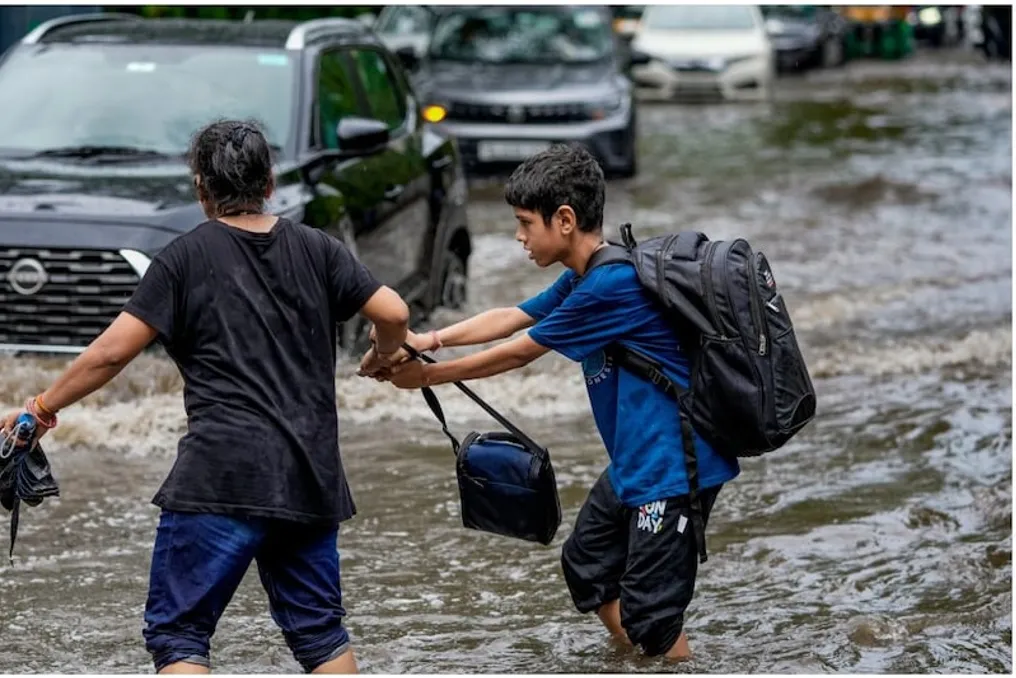
When it starts raining, people outdoors usually look for shelter and hurry to leave. After the precipitation begins, the primary task becomes finding any refuge. However, the question arises about the advisability of running in the rain. The common belief is that the faster a person leaves the rain zone, the less they will get wet, but the answer to this question is not that simple.
For the past fifty years, scientists have been studying exactly which method is most effective for reducing wetness during rain. Research provides certain recommendations regarding behavior in such conditions.
In 1976, Harvard mathematician David I. Bell provided a mathematical solution to this problem, which was published in The Mathematical Gazette. Bell analyzed various rain scenarios and concluded that if the rain falls strictly from top to bottom, running is the preferred option. The faster a person reaches their destination, the less time they spend under the influence of the rain. This conclusion also applies when the wind blows directly against you.
Nevertheless, Bell's calculations show that even very fast running does not provide a significant advantage. Even if a person runs at world record speed, they will get only about 10% less wet compared to walking speed. Therefore, excessive effort in running is not necessary to escape the rain.
The most interesting situation arises when the wind is blowing from behind. In this case, raindrops move with the wind in the direction of the person's movement. According to Bell's calculations, in this situation, there is no need to run as fast as possible. Simply put, if the wind is blowing from behind, moving at a speed close to the wind speed, or running at a speed equal to the wind speed, may be the least wet option. Thus, one cannot claim that the fastest running always leads to the least wetness.
Another factor was added to this issue in 2017. A study published in the Journal of the Washington Academy of Science in 2017 deepened this topic by including not only walking or running speed in the model, but also the person's height and build. According to this model, under certain circumstances, shorter people may get less wet than taller people. The reason lies in the fact that body shape and the surface area contacting the rain play a significant role.