The website uses a security service to protect against cyberattacks. The action you performed triggered this protective system.
The website uses a security service to protect against cyberattacks. The action you performed triggered this protective system.
There are several actions that can lead to such a block, including entering a specific word or phrase, executing an SQL command, or submitting incorrect data.
Users are advised to contact the website owner to report the block. When contacting them, they should specify what actions were being performed when this page appeared, and also provide the Cloudflare Ray ID located at the bottom of the page.
Significant and historic changes in the field of education were approved by the legislative assembly of Punjab. The state government adopted a major bill aimed at curbing the arbitrary practices of private schools, excessive fee hikes, and annual changes to school uniforms.
Addressing the session, Chief Minister Bhagwant Mann stated a firm stance, emphasizing that education in Punjab would no longer become a commercial enterprise. During the discussion of the bill, he issued a warning to private educational institutions and announced several important measures.
He reported that schools which have increased fees by more than 15 percent over the last three years will be subjected to a financial audit. Furthermore, private schools will now be prohibited from changing their school uniform for three years. This completely bans the practice where parents are forced to spend money on new designs and uniforms every year.
It was also stipulated that if a school invests funds in infrastructure development (buildings or facilities), it cannot directly increase tuition fees. Instead, it must approach the Tariff Regulatory Authority, which will only permit a fee increase once, not exceeding 8 percent.
While discussing the bill, the Chief Minister mentioned the visit of US President Donald Trump to India. He noted that his wife, Melania Trump, visited government schools in Delhi during the trip and highly praised the education model. CM Mann made an emotional appeal to the deputies to consider this law as a sacred document concerning education and pass it unanimously to avoid negative public sentiment.
Following the address and prolonged debates in the Punjab Legislative Assembly, a vote was held on the key education reform bills, and they were passed unanimously.
Among the important laws passed are: Punjab Regulation of Fee of Un-aided Educational Institutions (Amendment) Bill, which regulates fees and uniforms in private schools; and Cloud University, Hoshiarpur Bill 2026, which was approved by Education Minister Hardjot Singh Bains for establishing the first 'private digital university' in the state.
In some educational institutions across the country, the results of grade reviews requested by students have not yet been posted. While grades have been received in several schools, some errors are slowing down the publication process.
One such institution is Liceu Camões in Lisbon. The RTP reporting team confirmed receipt of the results for 14 exam reviews, but they have not yet been published. Some parents and students visited the school to check the results, but the information has not yet been made public. Parents point out inaccuracies and await updates on the Inovar platform.
In the north, at Escola Secundária de Rio Tinto, another reporting team confirmed the existence of over 100 requests for grade reviews awaiting publication. The results were sent to the school after midnight on Monday, specifically at 00:47, but publication had not occurred by morning.
The director of Escola Secundária de Rio Tinto explained to RTP that he tried to open the access code for the exams on Monday morning but received an error. Consequently, contact was established with the Agrupamento de Júri Nacional de Exames de Vila Nova de Gaia to resolve the issue.
The situation at Escola Secundária de Anadia developed differently. Almost all results were published last Friday, with the exception of nine grades that had not been submitted. The school director, Aníbal Marques, informed RTP that as soon as he noticed the missing data, he contacted the National Jury, and the grade was resent to the school on Sunday, after which it was published.
Overall, more than 20,000 requests were supposed to be published nationwide on Friday. The Ministry of Education previously explained that only a 'residual' volume of reviews remained to be sent to the schools and assured that no student would be deprived of the opportunity to apply to higher education institutions in the first stage.
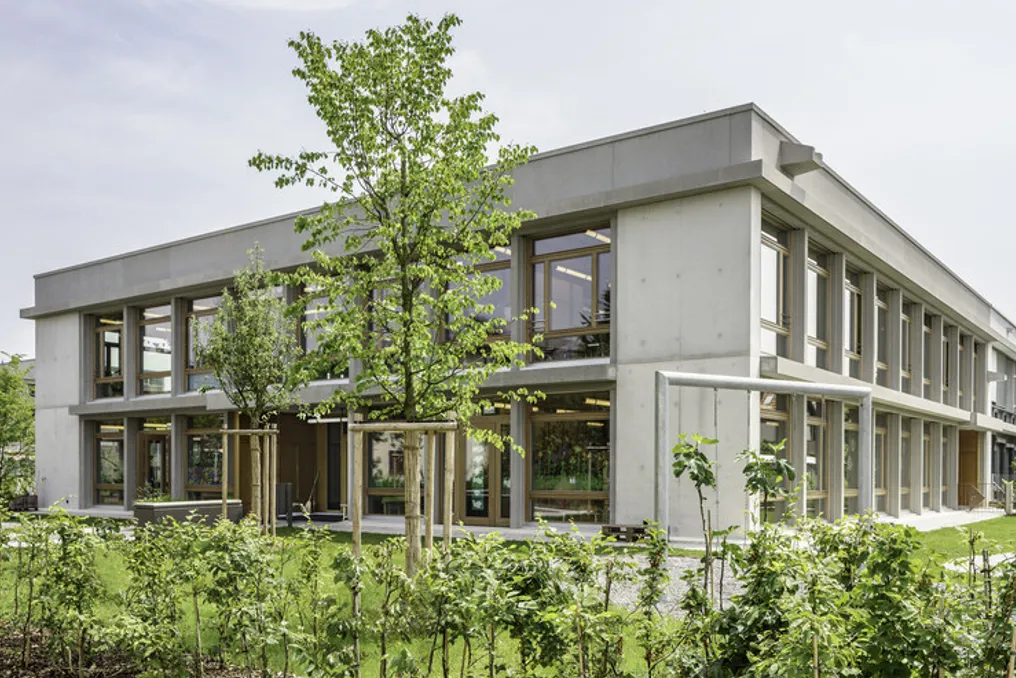
The listed Mösli school complex, located on the northern edge of Ostermundigen, features a well-defined orthogonal structure and is situated in a vast wooded area. This complex consists of four compact pavilion buildings arranged around a central courtyard, delimited by covered walkways, which constitutes the spatial core of the site.
The recent expansion aims to add new rooms designated for the kindergarten and full-time school, extending the existing complex, including sports areas, towards the west side. Due to its more distant location on the site, the new volume was designed to be intentionally secondary to the original buildings, both in terms of size and architectural language.
The facade of the addition follows the structural principles and material identity of the initial complex. Using sandblasted concrete elements and wooden frames, it establishes a relationship of respect and containment with the listed buildings. Although the exterior maintains a deliberate discretion, the interior reveals a welcoming and distinct atmosphere.
Large floor-to-ceiling windows ensure the entry of natural light into the classrooms, promoting a strong visual connection with the natural surroundings. The interior space is enriched by colorful built-in cabinets, exposed concrete walls, and ceilings with warm wooden beams, creating varied and inviting environments for learning, recreation, and social interaction. The combination of these durable materials with selected colors gives the interior a character that is simultaneously tranquil and stimulating.
The expansion of the Mösli school complex is conceived as a subtle yet precise addition to the pre-existing ensemble. Instead of competing with the original architecture, the project maintains the continuity of its constructive and spatial logic while meeting current educational demands. The final result is a cohesive learning environment that provides children with security and a diversity of spatial experiences.