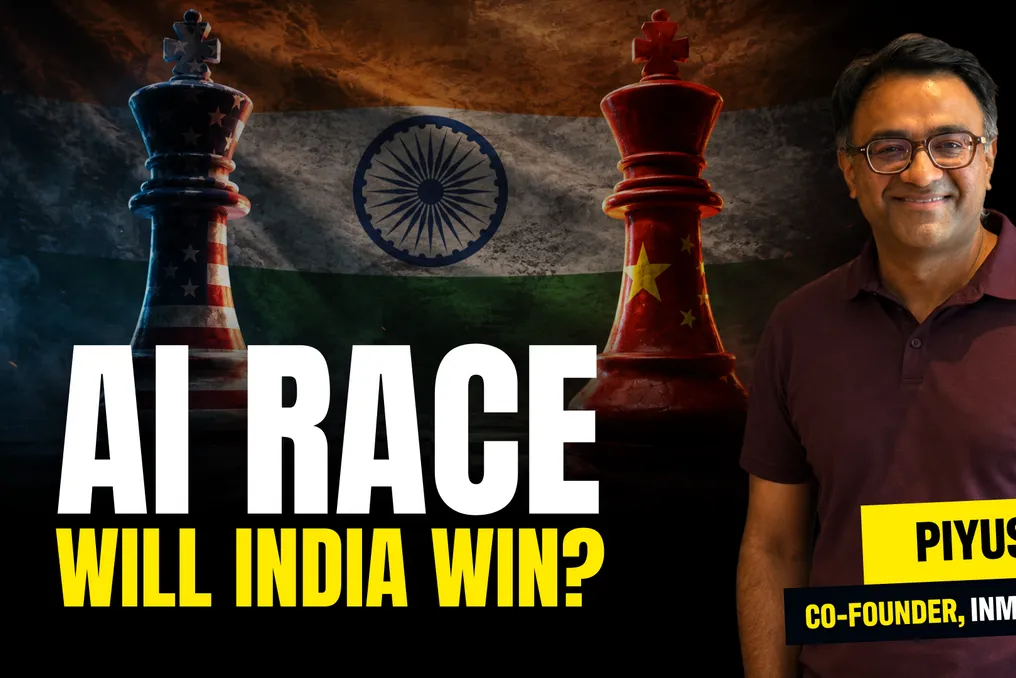
Piyush Shah, the renowned Indian founder of two unicorn companies (InMobi and Glance), shares his opinion on why the strategy for developing artificial intelligence in India must differ from the approaches of Silicon Valley or Beijing, and which areas startups should focus on.
Shah, who built two globally scaled technology companies from India, spent nearly two decades working in Silicon Valley, Beijing, and Bangalore. This experience convinced him that each region develops AI in its own way, and the true opportunity for Indian founders lies in understanding the country's genuine strengths.
According to Shah, in the next decade, victory in the field of AI will depend not only on creating larger models. It will be achieved by solving real problems, mastering distribution, and forming sustainable business models.
Shah believes that the AI ecosystem is already divided into various areas of excellence. He notes: 'The US invents AI. China industrializes AI.'
While American companies continue to lead in the development of advanced models, research, and computing infrastructure, China integrates AI into manufacturing, robotics, logistics, warehouses, and factories.
Shah's philosophy is rooted in the evolution of the InMobi and Glance companies themselves. Instead of viewing India as a single market, both companies constantly looked outward. He emphasizes: 'I always say that we implemented innovations because we were always at the intersection of Bay Area, Bangalore, and Beijing.'
The ability to observe different ecosystems and identify gaps shaped Shah's view: India's biggest opportunity in AI is not in cutting-edge research or manufacturing dominance. Instead, it is using AI to improve the daily lives of millions of people.
Unlike countries focused on expanding technological frontiers, Shah believes that India can create disproportionate value by making AI accessible to everyone. He asserts: 'While the US tries to raise the ceiling significantly, I think we can raise the floor for a billion people.'
He cites educational AI tutors, healthcare consultants, financial coaches, agronomic experts, and multilingual voice interfaces as areas where India can create solutions combining inclusivity and scale.
India has repeatedly demonstrated the ability to build digital public infrastructure covering hundreds of millions of users. Shah sees a similar opportunity in AI. He advises: 'Choose a problem, solve it well, solve it inclusively, raise the floor, and then reach a billion people in almost 100 countries.'
In his view, India's competitive advantage lies not in creating technologies for a small group of advanced users, but in democratizing AI for the masses.
Despite the huge attention consumer AI applications receive, Shah believes the industry is ignoring one of its biggest problems—the inference economy.
Traditional software companies are primarily concerned with customer acquisition cost and lifetime value. AI companies must now consider another significant expense: the cost of generating every AI response. Shah calls this 'inference CAC,' meaning how much is spent on acquiring and retaining a customer compared to the cost of providing that AI experience.
Unlike traditional cloud infrastructure, inference costs are directly tied to user engagement. Every query, recommendation, and AI-generated response consumes computational resources. As usage grows, so does the bill.
'The largest consumer AI companies have not solved their inference CAC problem. This fundamentally changes the economics of creating AI consumer products.'
He notes: 'You never hesitate before you have an app, and you say: I'll put it in the store, and I'll be fine if hundreds of millions of users download and use it. Today, you are afraid that if you have an AI experience and you launch it, and 100 million people download and use it, you will go bankrupt.'
This is a problem Shah understands from personal experience. Glance creates AI-based consumer experiences for shopping and search, while InMobi collaborates with global companies involved in consumer AI. Instead of focusing only on engagement, Shah says both companies are making significant efforts to solve distribution and inference economy challenges.
He believes the next phase of consumer AI will require entirely new monetization models, similar to how advertising fueled the growth of the open internet. 'Advertising democratized the open Internet. A new form of advertising is needed to democratize consumer AI.'
It is in this area that InMobi helps global enterprises solve this specific problem. If consumer AI is still searching for a sustainable economy, Shah believes enterprise AI has already found a clearer business value.
During a recent OpenAI event, he expected discussions on the latest consumer products, but the focus was overwhelmingly on enterprise transformation. 'If I can guess, 70% of their revenue this year and going forward will come from enterprise AI, not from consumer AI subscriptions or advertising.'
This shift is also reflected in InMobi and Glance's approach to AI partnerships. In addition to creating AI-driven commerce experiences, the companies invest in optimizing infrastructure, recommendation systems, and AI computing efficiency, actively collaborating with startups in advertising, personalization, and commerce.
For founders, Shah believes the biggest opportunities lie in solving deep, domain-specific workflows. Whether it involves manufacturing, warehousing, filing tax returns, pharmaceutical approvals, or healthcare operations, enterprises increasingly value AI products that can demonstrate measurable results within weeks, not months.
Despite AI significantly lowering product creation barriers, Shah argues that one competitive advantage has not changed. 'Distribution is the moat.'
Drawing on InMobi's own global journey, he believes founders often underestimate how complex market entry execution remains. Selling to large global enterprises still requires trust, local presence, and authority. 'In my opinion, for large-scale distribution, you still need that person in New York.'
He also urges founders to think beyond traditional sales methods. Building thought leadership, publishing analytical materials, and establishing industry expertise can become powerful distribution channels, especially for AI startups solving specialized enterprise tasks. Shah even suggests partnering with large IT service firms instead of competing with them. Companies like Infosys and TCS already have relationships with enterprises that many startups find difficult to establish. Instead of viewing them as competitors, founders can leverage these networks to accelerate adoption.
Technology may be easier to create than ever. However, winning customers remains just as challenging.
For someone who has built globally from India for decades, Shah's optimism about AI stems not from larger models or faster chips. It comes from solving significant problems at scale. Whether it is InMobi's work in ad tech, Glance's AI-powered consumer experiences, or his broader observations in the US, China, and India, Shah returns to the same belief: India's opportunity lies in creating AI that reaches more people, solves everyday problems, and builds businesses with a sustainable economy. In Shah's view, this could ultimately be India's most enduring contribution to the AI era.
The creators of the long-awaited teaser for the film 'The Paradise' have released it. This film, directed by Shrikant Odela, depicts a dark and tense life in the slums. The superstar will play the role of 'Jadal'—a tough and fierce tribal leader.
In the film, he will confront the main villain, played by Raghav Juyal himself under the pseudonym Vikram Malik. The release date for 'The Paradise' was also revealed—September 24, 2026—along with the screening of the Hindi teaser.
The video showcases the character's journey, who started as a prostitute's son, presenting a blend of intense emotions and action scenes, allowing viewers to see the talented artist. This bloody teaser also features a new look for Naani, clearly showing his thirst for revenge, struggle, and desire to survive.
Raghav Juyal's look in the teaser caused a sensation among fans, generating significant buzz due to his fierce appearance. Following the film 'Kill,' fans are eagerly anticipating his predatory persona in 'Paradise.' This new look comes amidst the fact that his first solo role, the film 'Bhai Tera Star Hai,' failed at the box office.
In the movie, Raghav Juyal is portrayed as a dangerous antagonist. The magnificent visual elements, powerful soundtrack, and plot suggest that this film could become a major blockbuster in Raghav's career.
The film 'The Paradise,' directed by Shrikant Odela, will be released in theaters on September 24, 2026. It will be available in eight languages: Telugu, Tamil, Hindi, Kannada, Malayalam, Bengali, English, and Spanish.
Key roles in the film are also played by Kayadu Lohar, Sonali Kulkarni, and Mohan Babu. The music for the film was composed by Aniruddha Ravichander, and it will be produced by SLV Cinemas.
Artificial intelligence (AI) is increasingly being used to tackle the most persistent development challenges of the country. Although AI is often discussed in the context of chatbots, coding assistants, and workplace productivity enhancement, a quieter transformation is taking place in India.
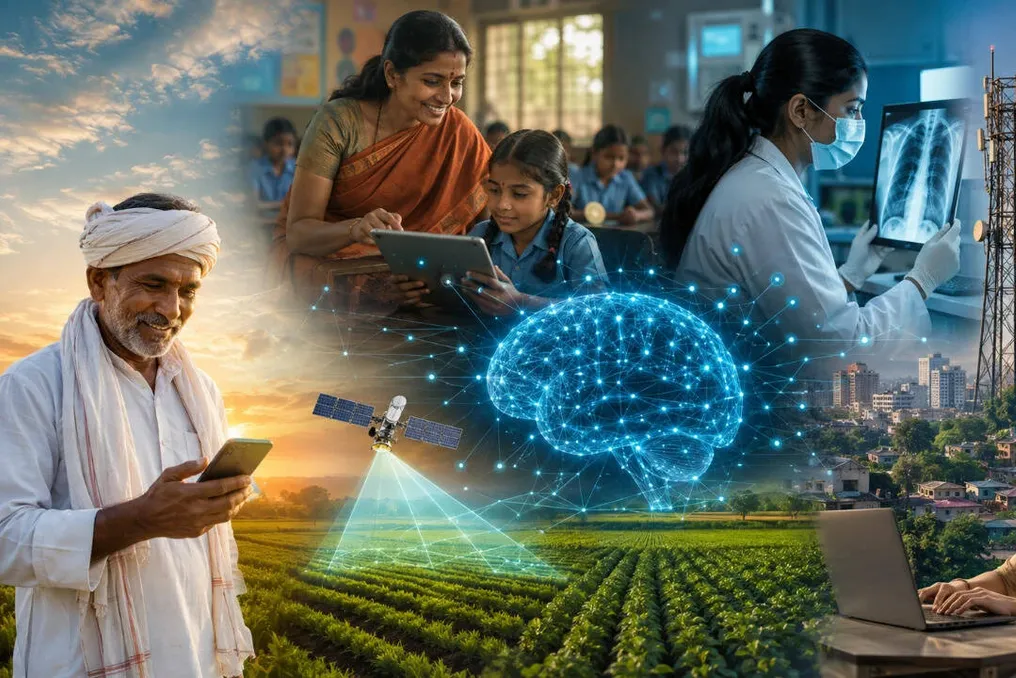
In India, AI is being implemented to solve serious issues such as assisting farmers in adapting to climate change, supporting teachers in rural classrooms, improving tuberculosis screening, and ensuring the accessibility of public services in various languages.
Government agencies, technology companies, startups, non-profit organizations, and research institutions are collaborating to deploy AI in a way that can reach millions of people, rather than just a small number of users.
Another area seeing rapid innovation adoption is climate resilience. The company SatSure combines AI with satellite imagery data to help banks assess agricultural loans, track climate risks, and evaluate farms.
The company claims that its systems operate in over 70,000 villages, which helps reduce loan underwriting time and improve assessments for farmers who often lack formal credit history.