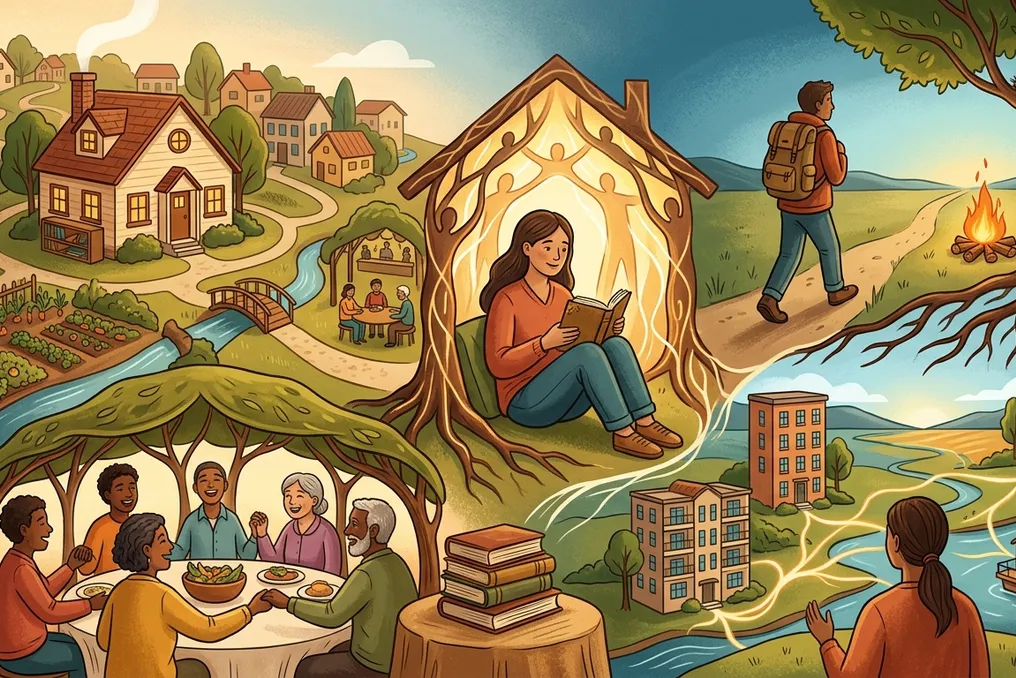
Home is often perceived as a physical place, but its meaning extends far beyond walls, rooms, or a specific location. For many people, home symbolizes safety, memories, self-identity, and a sense of understanding. It can be connected to family, community, culture, or even a person who evokes a feeling of acceptance. The search for belonging is one of the most universal human experiences.
People often spend their lives trying to understand their place in the world, which shapes their personality and what truly makes a place feel like home. Books possess a unique ability to explore these emotions through characters who leave their places, seek acceptance, rebuild their lives, or discover that belonging is not always tied to geography.
Jhumpa Lahiri's novel 'The Namesake' examines the complex relationship between cultural identity, family, and self. The story follows Gogol Ganguli, the son of Indian immigrants in America, who struggles with understanding his name, heritage, and his position between two cultures.
Gogol's journey demonstrates how home can exist at the intersection of different worlds. His experience reflects the difficulties of growing up with multiple identities and the attempt to reconcile family expectations with personal desires. The book teaches that belonging does not always mean choosing one side of oneself; sometimes home is created by embracing all aspects of one's personality.
The novel 'A Man Called Ove' tells the story of a lonely man who loses his purpose in life after personal losses. However, unexpected friendships with neighbors gradually change his perception of connection and belonging.
Ove's character shows that home is not just a physical space, but also the people around us. The relationships he builds remind him that even after loss, warmth, care, and a sense of community are possible. The book explores how human connections can transform loneliness into a feeling of belonging.
Sandra Cisneros' novel 'The House on Mango Street' tells the story of Esperanza Cordero, a young girl growing up in a poor neighborhood who dreams of a place she could call her own. Through short and powerful stories, the work touches upon themes of gender, culture, identity, and the meaning of home.
Esperanza's relationship with her neighborhood shows how places can shape our memories and influence who we become. The novel teaches a lesson that home is not always perfect, but it can become part of a personal history and inspire the creation of a better future.
Eme Tan's novel 'The Joy Luck Club' explores the relationships between immigrant mothers and their daughters as they navigate cultural differences, family history, and identity. The book reveals how generations of experience influence the sense of belonging.
The characters face difficulties in understanding each other due to different backgrounds, but ultimately realize the importance of shared stories. The novel shows that home is often built through memories, traditions, and emotional bonds passed down through generations.
Despite the apparent simplicity of the children's story 'The Little Prince,' it raises profound ideas about love, relationships, and what gives meaning to a place. The Little Prince's journey across different planets demonstrates that belonging stems from the connections we create and the people we love.
His bond with the rose teaches that love and responsibility give meaning to our lives. The story reminds readers that home is not necessarily a location, but rather where our hearts feel connected.
Min Jin Lee's novel 'Pachinko' describes the fates of several generations of a Korean family living in Japan, exploring themes of survival, discrimination, migration, and identity. The characters experience the difficulty of feeling like outsiders while trying to build a life in a place that does not fully accept them.
Their path shows how complex the feeling of belonging can be when people find themselves between different cultures and historical eras. The book asserts that home is often what people create through resilience, family ties, and shared experiences.
'Where the Crawdads Sing' tells the story of Kya Clark, a young woman who grows up in isolation in the swamps of North Carolina. Rejected by society, she finds solace and a sense of belonging in nature. Kya's story explores what happens when a person feels disconnected from people but deeply connected to the surrounding world.
Her journey reveals the human need for acceptance and understanding. The book teaches that belonging can be found in unexpected places, and that the feeling of home begins with self-acceptance.
These books convincingly prove that home is not always a place we return to; sometimes it is something we create through relationships, memories, and self-acceptance. The search for belonging is an integral part of the human existence. Whether it is family, friendship, culture, or personal identity, these stories remind us that everyone seeks a place where they are seen, valued, and truly at home.