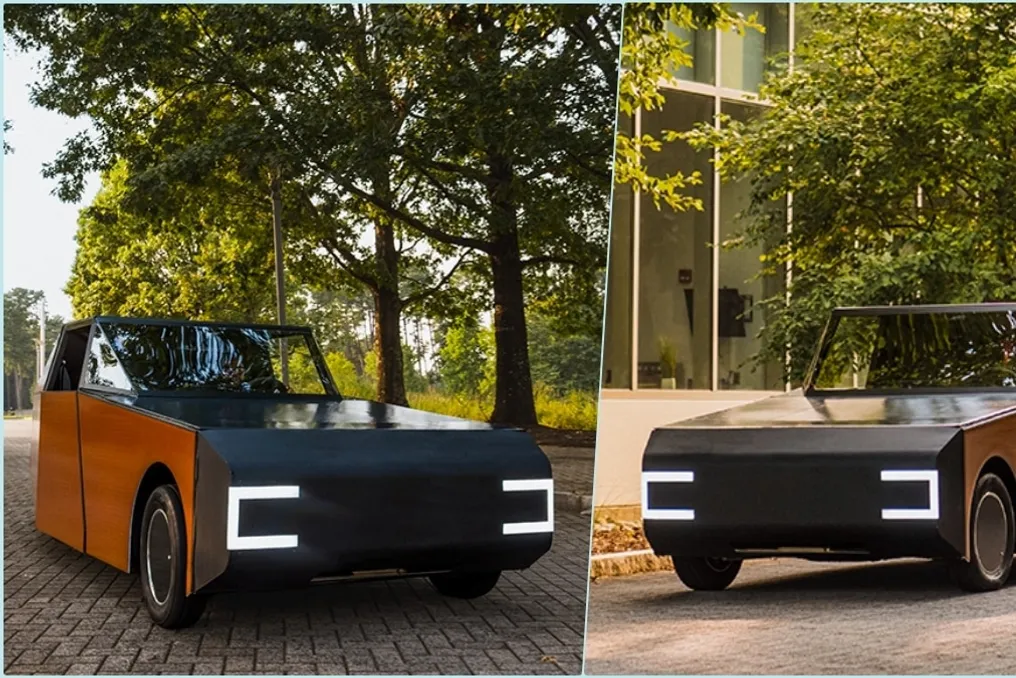
A prototype of the Luminetta Solar Car electric vehicle, developed by students with the participation of a research group from BMW and Clemson University in the USA, has been presented. This car, named Deep Orange 17 Luminetta, is a two-door electric coupe designed not only to charge the battery but also to generate additional electrical energy.
The main claimed operating principle is that the car is capable of producing more electricity than it consumes while driving. The power system is a key element of the design. Over 1700 photovoltaic cells are installed on the car's body, integrated into the external panels. These solar cells continue to generate energy while the car is moving or parked.
The development of the solar panels was carried out in collaboration with the Fronhofer Institute of Solar Energy. A feature of these panels is their ability to generate electricity even under partial shading. Stefan Augustin, manager of BMW's research and new technologies project, noted that the student team spent several years overcoming technical difficulties to create a machine capable of producing surplus energy.
A durable film was used to protect the solar cells, and the body is painted in a special color created using laser manufacturing technology, which improves both the appearance and the safety of the components.
To assess the car's potential, the students simulated solar light availability in cities such as Frankfurt, Madrid, and Mumbai, in addition to Greenville in the USA. Based on a daily distance of 20 kilometers, testing showed that the car can generate solar energy equivalent to an additional range of about 50 kilometers, depending on the city. Because of this, the car has been designated an energy-positive vehicle, as it is capable of producing energy in real conditions, not just consuming it.
The car's design is inspired by the boxfish, which helps reduce aerodynamic drag. Lower resistance allows the car to use less energy for movement. Furthermore, the design provides sufficient space for passengers.
The car integrates a regenerative braking system that converts energy usually lost as heat during deceleration back into electricity. An intelligent torque distribution system and a specialized drive control system are also installed to optimize energy usage.
The car's interior is designed in a modern style and equipped with a user interface displaying important information in real time. The car supports Apple CarPlay and Android Auto connectivity, combining futurism with everyday convenience.
Another significant feature is the low weight of the prototype—only 550 kilograms (about 1212 pounds), which is approximately four times lighter than standard production cars. To achieve this lightness, a complex material set was used for the chassis: structural steel, aluminum, carbon fiber, and metal joints manufactured using 3D printing, which maintains strength while minimizing mass.
Currently, the Deep Orange 17 remains a prototype, and it is unclear whether it will be released to the market. However, the project demonstrates new directions for the development of electric mobility by combining solar panels, a lightweight chassis, aerodynamic design, and energy recovery technologies.