When the Ramayana is mentioned in people's memories, images of Rama, Sita, Kaikeyi, or Manthara often arise. Kaikeyi is known as the queen whose two boons changed the fate of Ayodhya, and Manthara is considered the organizer of this decision. Sita is portrayed as a divine woman who left the luxury of the palace to follow her husband into the forest. However, among these well-known characters was also Kaushalya, the mother whose pain was the deepest, but whose sorrow remained unnoticed in the grand story of the Ramayana.
Kaushalya, the senior queen of Ayodhya, never asked for boons, did not fight for power, nor did she participate in any conspiracies. She did not make decisions that could change the course of history. Nevertheless, her name can be placed first among those who paid the highest price for Rama's exile. She had to watch her son, whom she saw seated on the throne, leave for the forest.
To understand Kaushalya's suffering, one must return to the morning when Ayodhya was preparing for Rama's coronation. The mother, busy with preparations for crowning her son, suddenly learns that her son will leave the palace and go into fourteen years of exile. In Valmiki's Ayodhya Kanda of the Ramayana, Kaushalya is depicted performing auspicious rites for Rama's coronation, but when Rama brings her the news of the exile, her world collapses in an instant. Instead of seeing her son crowned, she has to watch him leave for the forest.
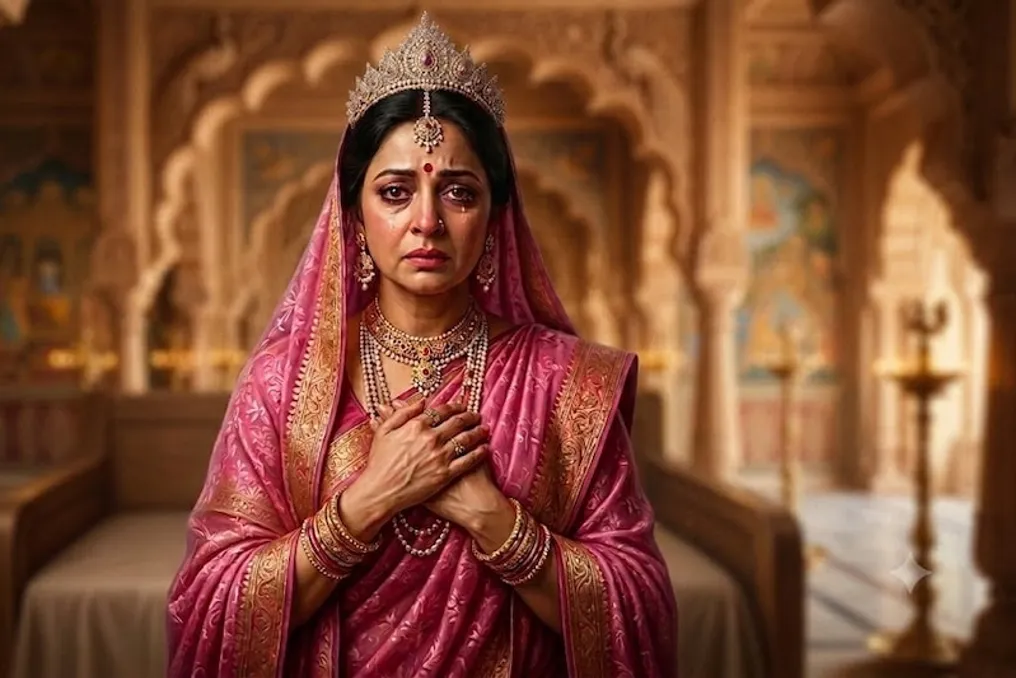
Upon hearing about the necessity of the exile, all the luxury of Ayodhya seemed meaningless to Kaushalya. Her son, who was soon to wear the royal crown, now had to go to the forest. In Valmiki's Ramayana, Kaushalya could not suppress this blow; she weeps, openly expressing her grief. Before her stood two poles: Dasharatha's promise and the dignity of the Raghu lineage, and on the other side—maternal love that did not want to see her son on such a painful path. Kaushalya found herself at a crossroads: on one side, duty, on the other, a mother's heart, and this time, the price of fulfilling duty was separation from her son.
However, Kaushalya's greatness is shown not in her grief, but in her ability to cope with that grief. She tries to stop Rama, but despite this, she blesses him and sees him off. For Rama, the exile was a matter of fulfilling his father's promise and protecting dharma, but for Kaushalya, it meant losing her dearest son before her eyes. Rama had to leave; it was decided. All that was left for Kaushalya was the opportunity to place her hand on her departing son's head and wish him well.
After Rama's departure, Kaushalya's grief deepens. She mourns not only the separation from Rama but also questions Dasharatha. She worries about how Rama, Sita, and Lakshmana, who grew up in the palace, will endure the harsh conditions of life in the forest. After Rama's departure, Dasharatha also could not bear the sorrow and died. But at this moment, another trait of Kaushalya's character emerges. Between Dasharatha's death and Rama's exile, the family was internally shattered. Rama left, Dasharatha died. Bharata felt guilt. At such a time, Kaushalya could have fully immersed herself in her grief, but her attitude towards Bharata gives her personality a special status.
When Bharata returns to Ayodhya and learns the truth about Rama's exile and his father's death, he is distressed. In this very touching scene of the Ramayana, Valmiki depicts a grieving Kaushalya embracing Bharata tenderly. She sets aside her own pain and shows warmth towards Bharata. It is this quality that makes Kaushalya not just Rama's mother, but a major character in the Ramayana. Perhaps her greatest contribution to the narrative of the Ramayana is that, while being at the center of power, she did not become part of the political game.
After Rama's departure, the story of the Ramayana continues. Rama goes to the forest, meets sages, Sita is abducted, there is a meeting with Sugriva and Hanuman, there is a battle with Lanka, and Rama achieves victory. Every major stage of the plot develops with Rama, but in Ayodhya, Kaushalya only has waiting. This is the most unnoticed aspect of Kaushalya's sacrifice. During his exile, Rama had journeys, struggles, companions, and victories. Kaushalya only had waiting. Before Rama, every day represented a new challenge, but before Kaushalya, it was the emptiness of every day. Therefore, it might be more accurate to say that Rama experienced exile, while Kaushalya experienced the longing for Rama's exile.
In Tulsidas's Ramcharitmanas, Kaushalya's character is also linked to deep love and devotion to Rama. Rama is not just the prince of Ayodhya, but also an equivalent of God. In this case, Kaushalya's motherhood is in a state of confusion.
In South Indian traditions of the Ramayana, various literary shades of Kaushalya's motherhood and separation from Rama are also presented. Kamban's Tamil Ramayana presents the story of Rama more poetically.