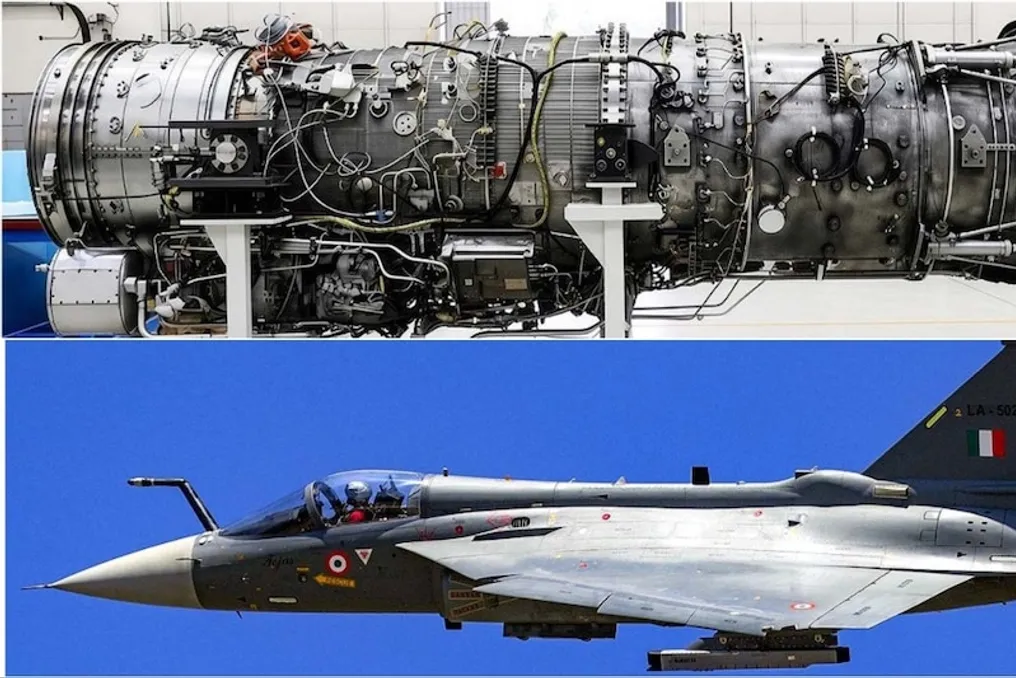
Due to delays in the supply of American GE F404 engines for the Tejas fighter, DRDO has developed an alternative solution. India will no longer require the GE F404 engine from America. Currently, a fully updated version of the Kaveri engine, named Kaveri 2.0, is under development, promoted by the Gas Turbine Research Establishment (GTRE) of DRDO.
The main objective of this project is to replace the American GE F404 engines on the Tejas fighter. Production of the Tejas Mk1A faced obstacles due to supply chain issues, making this domestic project particularly important. The initial concept for the Kaveri engine was launched back in the 1980s, but it was postponed in favor of the Tejas due to thrust and weight problems.
GTRE has completely redesigned the engine, creating a new baseline design. Kaveri 2.0 aims to achieve a dry thrust of 55 to 60 kilonewtons without afterburners and 90 to 100 kilonewtons with afterburners. This will ensure high maneuverability for the fighter. This performance meets or exceeds that of the existing GE F404 engines currently used in the Tejas Mk1A.
Older derivatives of the Kaveri engine (KDE) provided only thrust in the range of 49–52 kilonewtons, which was insufficient for modern combat aircraft. The new core focuses on a high-pressure compressor to increase compression ratio and fuel efficiency. Engineers are using advanced bladed discs made of titanium alloy. These monolithic structures prevent air leaks, reduce weight, and improve the thrust-to-weight ratio. Single-crystal blades are employed to enhance thermal efficiency, capable of withstanding high temperatures.
A significant weight reduction is planned: the initial weight of Kaveri was about 1235 kg, but the current goal is to make it less than 1100 kg, with further reduction towards 1000 kg using additive manufacturing and composite materials. Additionally, a Full Authority Digital Engine Control (FADEC) system will be integrated to ensure optimal engine operation in various flight modes.
The Tejas Mk1A program suffers from delays in the delivery of GE F404 engines from the USA. Although Hindustan Aeronautics Limited (HAL) has prepared numerous airframes, deliveries are delayed due to global supply chain issues and production constraints. Kaveri 2.0 is planned to be installed in the Tejas fleet in the 2030s as a mid-life upgrade. This will reduce dependence on imports and eliminate risks associated with deliveries when the current engines undergo overhaul.
This project differs from the joint program with Safran, where an engine with a thrust of 120 kilonewtons or more is being developed for fifth-generation stealth fighters like AMCA. Kaveri 2.0 is positioned as a medium-thrust workhorse engine suitable for platforms like the Tejas. Thus, India is pursuing a dual strategy: meeting current needs and developing technology for future advanced aircraft.
The dry variant of Kaveri, without afterburners, is also suitable for use in Unmanned Combat Aerial Vehicles (UCAVs). These drones are designed for long-duration flights at high altitudes, and the dry engine contributes to fuel economy and maintaining stealth characteristics. This will accelerate the 'Ghatak' program and enhance India's self-reliance in unmanned combat capabilities. There are plans to use Kaveri 2.0 in Tejas Mk2 or other platforms, and a phased testing process is scheduled.
Testing will include ground tests, high-altitude trials, and subsequent flights on a test range. A modified Tejas aircraft is being prepared to serve as a testbed, as the original Tejas design accounted for the dimensions of Kaveri. Progress is assessed as encouraging, but challenges remain. In the past, the project has been criticized for delays and technical difficulties. Many experts and defense analysts demand stable and adequate funding for timely completion of the project. Developing jet engines is a complex process requiring expertise in hot section materials, compressor efficiency, and control systems.
The success of the project will strengthen the Tejas fleet and increase export potential in the defense sector. Reducing dependence on foreign engines will ensure strategic autonomy. An engine adapted to local climatic and geographical conditions can demonstrate superior performance in the Indian environment. Kaveri 2.0 symbolizes the 'Atmanirbhar Bharat' (Self-Reliant India) initiative.