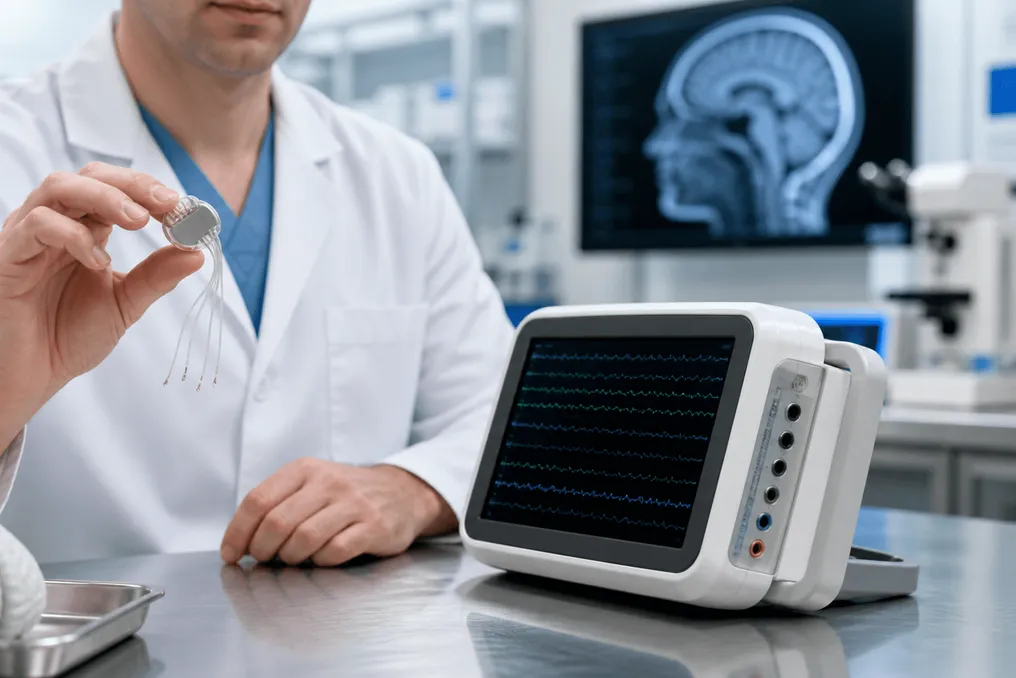
The most notable headline in the field of brain-computer interfaces (BCI) in 2026 appeared on March 13th when China's National Medical Products Administration approved the NEO device from Neuracle. This marked the world's first registered invasive BCI medical instrument. By August, it had been implanted in over thirty-six patients in Shanghai and neighboring hospitals, providing more than fourteen thousand cumulative days of implant safety and leading to clinically significant improvements in upper limb function in over sixty percent of recipients. It is important to note that China's lead was achieved through obtaining a standard certificate, not through the equipment itself.
The NEO device is not a direct competitor to Neuralink. It is an eight-electrode, coin-sized array that is placed epidurally, between the skull and the dura mater, without penetrating brain tissue. In contrast, Neuralink's N1 system inserts 1024 flexible electrodes directly into the cerebral cortex. Chinese regulators classify both devices as invasive BCIs, giving NEO an advantage in terms of regulation, although both systems solve different engineering problems. Parameters such as bandwidth resolution, surgical risk, and long-term stability are at different points on the spectrum.
Three teams are operating in China, advancing their projects in parallel. Neuracle is focused on the semi-invasive regulatory pathway. The company Stairmed uses the ultra-flexible cortical implant WRS01 and has already integrated several patients with high paraplegia into a working environment, such as for tagging in e-commerce. NeuroXess demonstrates decoding accuracy above ninety percent with its flexible electrode and full bandwidth system. In addition to Neuracle, the Beinao No.2 project has reached the stage of a fully implanted wireless array with 512 channels and is currently undergoing trials on large animals. Each team is betting on its own type of determinism.
Investment capital follows regulatory maps, not any single technology. In the first half of 2026, 64 BCI funding rounds totaling 7.25 billion yuan were conducted in China, exceeding the total volume for all of 2025 in just three months. ActiveTech closed a seed round of 330 million yuan in early August, making it the largest early-stage BCI deal. Investors are also aiming to capture an entire categorical window, rather than choosing one winner.
The real hurdles lie below the certification level. National standards for BCI system architecture and multimodal data formats came into effect on August 1st and were developed by twenty-three organizations. Issues regarding reimbursement, multi-center clinical programs, and patient data portability remain unresolved. The certificate gave China a lead in timing, but the rest of the decade will depend on who can make the implant a routine medical device, rather than a research artifact.