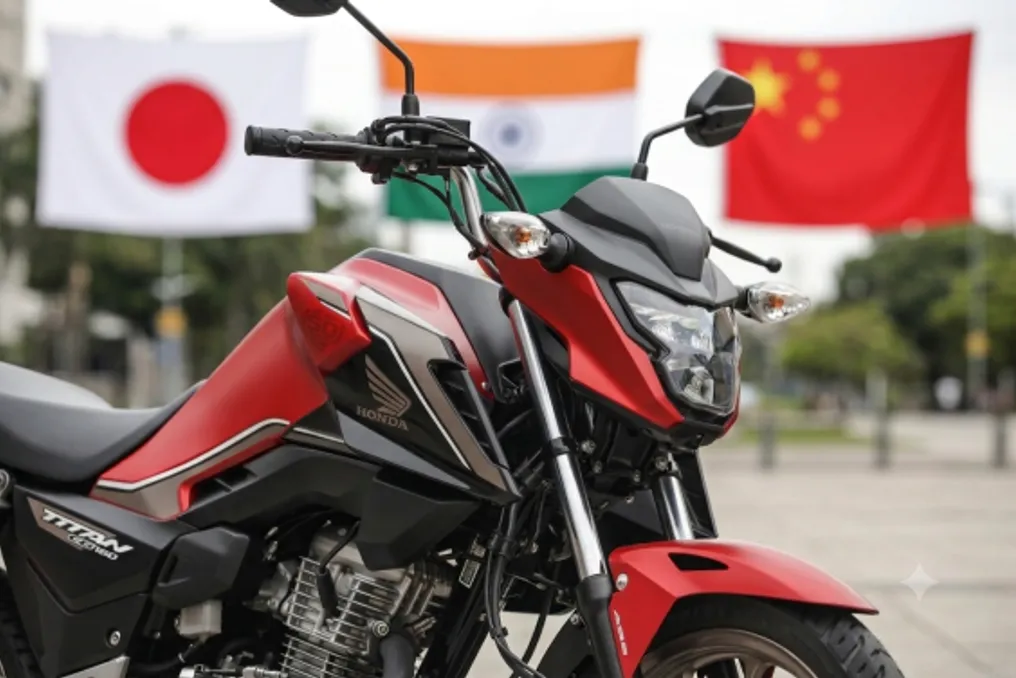
The Brazilian motorcycle market has experienced great diversification of Asian brands since 2017. Chinese and Indian companies, such as Haojue and Royal Enfield, began their presence in the country, and this trend intensified with the arrival of Bajaj in 2022, Zontes in 2023, and the recent entry of Cfmoto in 2026.
This market expansion naturally raises the level of competition, posing a challenge to Japanese brands established in Brazil before the 2000s, including Yamaha (which arrived in 1970), Honda (1971), and Suzuki (1992).
Perception within the motorcycle community suggests that 'Honda and Yamaha are losing ground to Chinese and Indian brands.' However, market expert Seku Mello questions whether this statement reflects a real problem in the national scenario.
Currently, Honda holds 63.73% of the share in the national motorcycle registration market, according to data from the National Federation of Automotive Vehicle Distribution (Fenabrave). Although these numbers have shown a decline over the years, the Japanese company had previously reached more than 85% of this market.
Yamaha's situation is different, as the manufacturer maintains a 13.70% share in the market, fluctuating at this percentage for several decades, recording both peaks and valleys.
Other Perspectives on Competition
According to Seku Mello, the leading brands are indeed ceding market share, but this does not constitute an immediate crisis. He argues that despite the reduction in percentage share, the total sales volume of these companies continues to rise, driven by the overall growth of the Brazilian market. Thus, even with a smaller percentage, the absolute number of motorcycles sold has increased.
In 2003, when Honda ended the year with 83.73% share, it registered 717,137 registrations. In 2025, although its percentage fell to 66.82%, the total number of registered motorcycles exceeded 1,468,229 units, doubling the volume.
Mello adds that this is a natural development in the sector, given that the continuous entry of new manufacturers into Brazil offers consumers a wider range of choices. The greater the variety of brands in the country, the more the market tends to be divided among them.
Differences Between the Brazilian and Global Markets
Although the diversification movement is natural in Brazil, the global perspective presents a different picture, especially for Honda. A Japanese director of the company expressed concern about Japan's inability to keep pace with the rapid evolution of Chinese industry. The difference lies in the speed of innovation: while Japanese manufacturers take five or six years to develop a new model, Chinese ones introduce a vehicle, evaluate its performance, and replace it quickly if necessary.
Seku Mello projects that if this trend persists, Honda's share could drop to between 30% and 40%, with other brands competing for slices between 5% and 15%.
However, accelerated investment does not guarantee permanent dominance. Honda has 76 years of global operation and celebrated 50 years in Brazil, boasting a consolidated network of over 1,300 certified sales and maintenance points, which supports its reputation for 'Japanese quality.'
Shineray, for example, demonstrates a dynamic process by launching various models to test the market, quickly discontinuing those that do not meet expectations, or making technical and displacement updates.
It should be noted that Shineray is involved in a dispute with Abraciclo, the motorcycle manufacturers' association, which accuses it of committing fraud in emissions tests and illegally marketing vehicles in Brazil.
Another prominent Chinese brand in Brazil is CFMOTO, known for offering competitively priced products. Despite being seen as a potential 'threat' to the Japanese brands, CFMOTO is still in the early stages of its journey in the national territory.
Considering that Shineray already has a long history in the market and CFMOTO is recent, stating an imminent concern for Honda and Yamaha may be premature. Among Indian brands, such as Royal Enfield and Bajaj, there are significant forces in the East that compete in segments similar to those of the Japanese brands.
While Chinese manufacturers stand out for agility, Indian brands currently have advantages in volume and experience. India is the world's largest motorcycle market, and its factories are accustomed to producing robust and low-cost models, even if with less technological advancement in many cases. Like their competitors, Indian manufacturers need time and investment to match the fame and infrastructure established by Honda and Yamaha in Brazil.