The solar eclipse that occurred on May 29, 1919, just six months after the end of World War I, entered the history of science because it helped confirm the General Theory of Relativity proposed by German physicist Albert Einstein four years earlier.
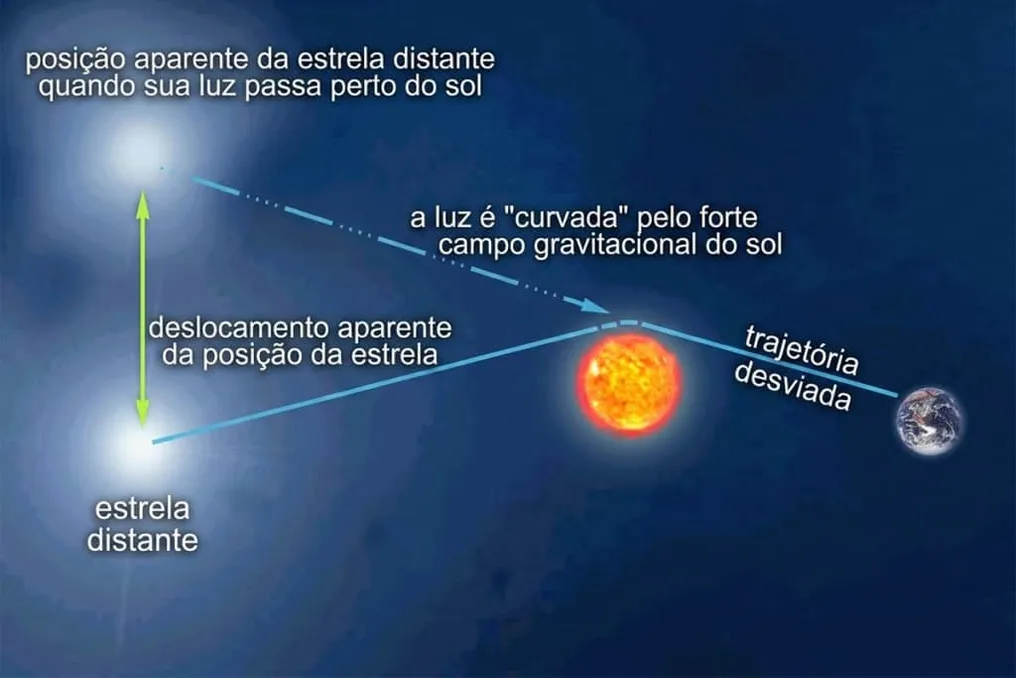
At the time, Einstein put forward the revolutionary idea that gravity does not simply attract objects but can also deform space, time, and even deflect the trajectory of light. According to this theory, the light from stars should slightly bend when passing through the strong gravity of the Sun.
A total solar eclipse presented an ideal opportunity to test this prediction, as the Moon blocked the sunlight, allowing observation of stars usually invisible during the day.
Additional Information
According to the European Space Agency (ESA), observations were conducted by two expeditions organized by the Royal Society and the Royal Astronomical Society. One expedition took place in Sorolla, Ceará, Brazil, and the other on Prince Island, off the west coast of Africa. Researchers photographed stars located near the Sun during the eclipse and compared their positions with images taken previously when the Sun was not in that part of the sky.
The results presented in London on November 8, 1919, showed that the light from stars was indeed deflected by the Sun's gravity with an intensity very close to what Einstein predicted. This discovery became a milestone in physics, weakened Isaac Newton's theory of gravity, and turned Einstein, who was 40 years old at the time, into the most famous scientist in the world.
Despite the widespread resonance, some scientists questioned the accuracy of the measurements made during the eclipse. In subsequent decades, new observations and studies using radio telescopes yielded more precise results, although doubts about the experimental error persisted.
Final confirmation was achieved between 1989 and 1993 thanks to the ESA's Hipparcos satellite. This satellite, equipped for extremely precise measurement of the positions of over one hundred thousand stars, was able to detect the light deflection caused by the Sun's gravity without needing an eclipse.
Hipparcos measurements demonstrated that Einstein's prediction was correct with an error of only one part in a thousand. This result strengthened the General Theory of Relativity as one of the pillars of modern physics, confirming the decisive role of the 1919 eclipse in changing humanity's understanding of the Universe.