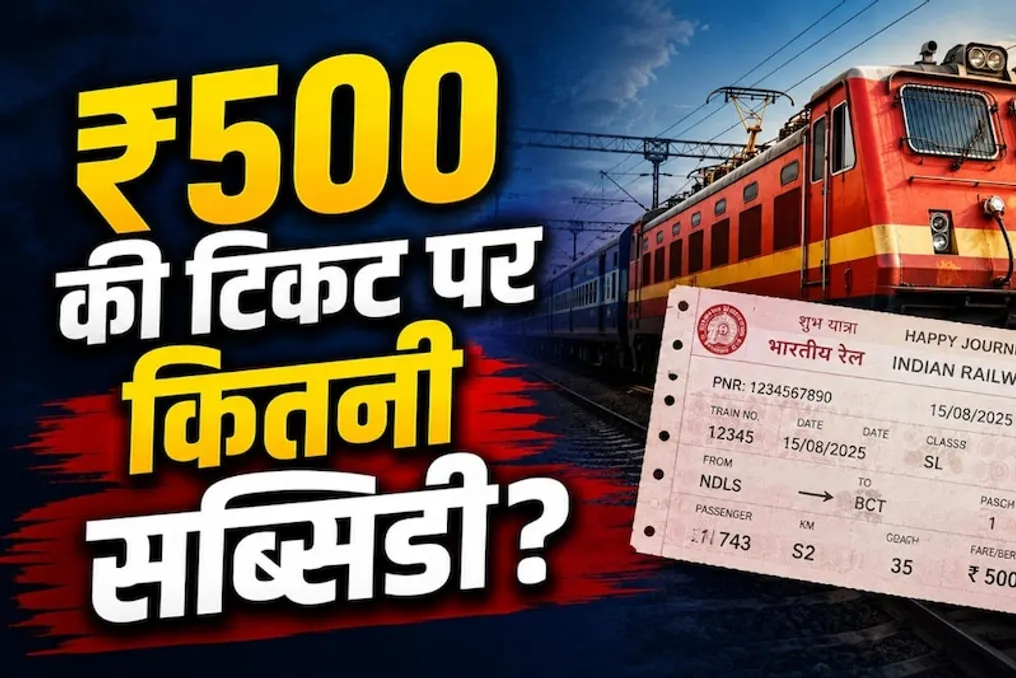
The question arises regarding the amount of the government subsidy for tickets costing 500 rupees, and the railway has provided detailed information on the calculations. When purchasing such a ticket, the passenger does not pay the entire amount, as the railway itself covers a significant portion of the travel costs.
During the Lok Sabha session, it was stated that passengers are provided with a subsidy on ticket costs of approximately 43 percent. This means that for a 500 rupee ticket, there is substantial financial support from the railway hidden within.
The railway presented a detailed report on how much money it spends on a 500 rupee ticket and the overall calculation of this subsidy. In the financial year 2024-25, a total subsidy of about 60,239 crore rupees was provided to passengers on fares.
To simplify understanding, consider a hypothetical case: if a passenger paid for a 500 rupee ticket. According to railway data, the passenger fare constitutes about 57 percent of the full cost of the journey, while the remaining 43 percent is covered by the railway as a subsidy. Consequently, if we take 500 rupees as the payment by the passenger, it does not mean that the full cost of the journey was only 500 rupees.
If 500 rupees represents 57 percent of the fare, then the actual cost of providing this journey approaches 877 rupees. Of this amount, the passenger pays about 500 rupees, and the railway compensates approximately 377 rupees as a subsidy.
In other words, on a 500 rupee ticket, the average subsidy amounts to about 377 rupees. However, it is important to understand that this is just an example based on average data. The subsidy amount will not be the same for every journey, route, class, or type of ticket, as the general rule of 43 percent subsidy is applied to the average passenger fare.
The railway clarified that if the cost of transporting one passenger is 100 rupees, only 57 rupees are charged to the passenger for the ticket, and the remaining 43 rupees are covered by the railway as a subsidy. Applying the same formula to a 500 rupee ticket allows for easy understanding of the picture: if the 500 rupees paid by the passenger corresponds to 57 percent of the total cost, then the railway additionally covers about 377 rupees.
Thus, the passenger gets the opportunity to travel by train at a significantly lower price than the actual cost of the journey.
According to the railway, in the financial year 2024-25, a subsidy of approximately 60,239 crore rupees was provided for passenger tickets. The railway emphasized that this subsidy applies to all passengers, not just specific categories.
The railway also mentioned in its response benefits and services provided to passengers from certain categories, such as the elderly and passengers with disabilities, in addition to fare reductions.
Ultimately, if we consider the 500 rupee ticket as an example, according to the 43 percent subsidy, the railway covers about 377 rupees. The actual cost of the passenger's trip may be around 877 rupees, but it should be remembered that this is an example calculated based on average indicators, and the actual subsidy may differ for a specific ticket or train.