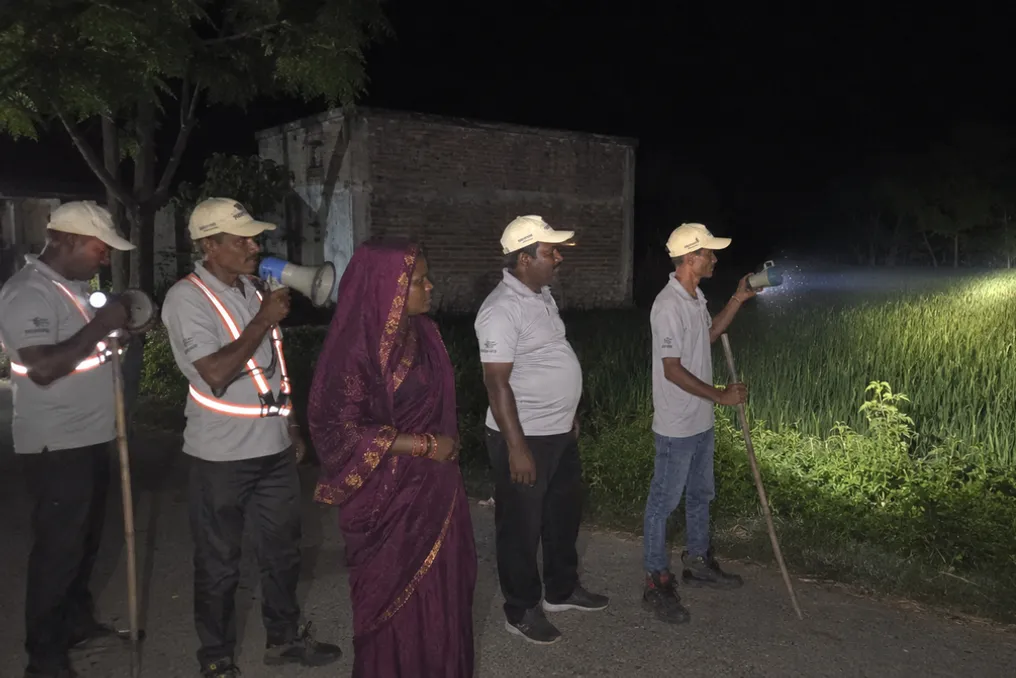
When the last fires die down in villages bordering the forests of Uttar Pradesh, the farmers' workday is just beginning. Around 10:30 PM, after spending the day planting, feeding livestock, and doing household chores, a group of farmers gathers on the outskirts of the village. They put on reflective jackets over dusty shirts, check the batteries in their flashlights, tie whistles around their necks, and ensure the megaphones are working.
It is unknown how long the night will last. Sometimes they return home before midnight, while on other nights they stay awake until dawn, tracking elephants moving through fields where sugarcane grows just a few meters from the forest.
Their task is not to drive the animals away. Their goal is to ensure a safe passage for both the elephants and the people who share this landscape. This is the life of the Gadjimtrs in Katarniyaghat—a community rapid response network that has become one of the most effective examples in India of human-elephant coexistence.
Elephants remember routes across the border between India and Nepal. The villages are located in the Terai Arc Landscape, a transboundary protected landscape stretching across northern India and southern Nepal. Dense pine forests, wetlands, and river meadows connect the Dudhwa Tiger Reserve with Bardia National Park in Nepal, allowing elephants to move across the international border as they have for generations.
However, political borders mean nothing to an elephant. Elephants remember migratory paths and ancient trails for decades thanks to the large hippocampus in their brains. The oldest matriarch guides the herd hundreds of kilometers to hidden water sources, safe trails, and food, using this spatial memory. They seem to justify the saying that 'they never forget.' The hippocampus is part of the brain responsible for memory and spatial navigation, helping them remember routes and survival information for years.
Long before the appearance of villages, roads, and sugarcane fields, these seasonal migration routes already existed. Today, as agriculture expands closer to forest boundaries, these ancient trails increasingly intersect with human settlements.
The Uttar Pradesh Forest Department, in collaboration with the Nature, Environment and Wildlife Society (NEWS), launched the Gadjimtra initiative in 2021. The Gadjimtras serve as the first line of response when elephants approach populated areas. As part of an annual capacity-building program, local residents from vulnerable villages were trained in elephant behavior, conflict mitigation, early warning systems, and safe response protocols before being incorporated into the Gadjimtra team.
Today, over 150 trained volunteers from villages such as Rampurwa, Matehi, Amba, Bishunapur, Bavanipur, and Bardia form a community early warning network that has changed the approach to elephant movement management in the region. The results are already evident: according to NEWS, the initiative has helped reduce crop damage by almost 70 percent in the last year.
The second shift begins after dinner
To understand what a full day, and especially a full night, looks like for the people protecting both villages and elephants, The Better India met with the Gadjimtra rapid response team in Katarniyaghat. Although their work may resemble wildlife rescue, the Gadjimtras are primarily farmers.