The Yogi government launched the 'One District One Product' (ODOP) program in Uttar Pradesh on January 24, 2018, following the example of Japan's 'One Village One Product.' The success of this initiative was noticed by the central government, which subsequently extended this scheme across the entire country.
In Varanasi, under the ODOP framework, industries producing wooden toys, pink miniature enamelware, and sarees are developing. Since the launch of this program, there has been a significant increase in the production of these goods, particularly in the saree and silk material industries.
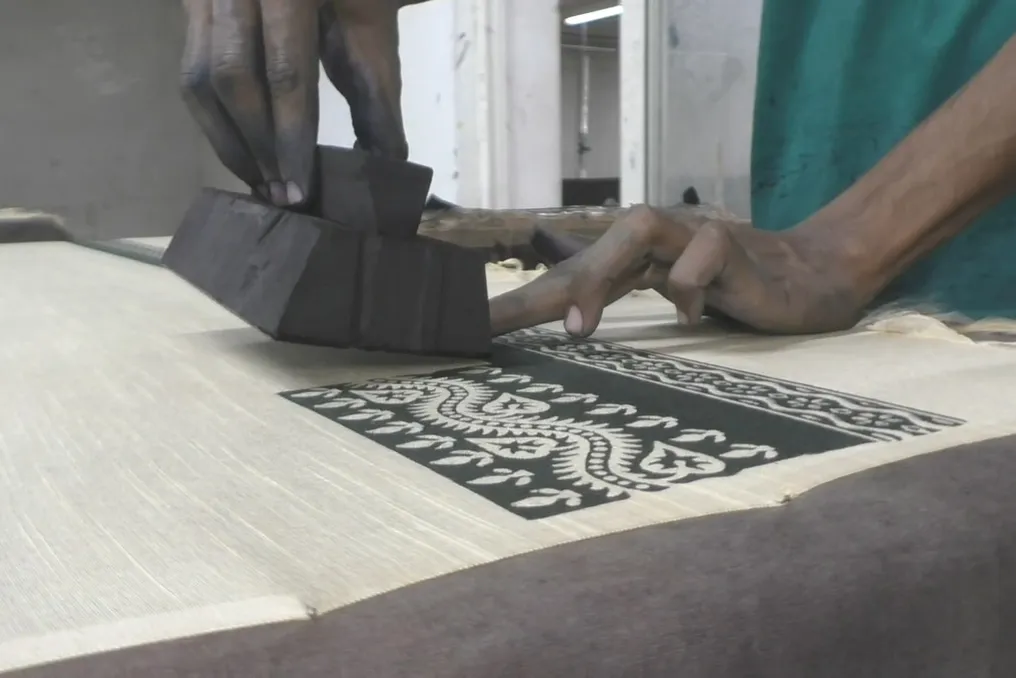
The ODOP-CFC center operates in Jagatpur, Varanasi. Its key feature is that weavers from Varanasi and surrounding areas no longer need to seek small orders elsewhere. They can perform digital printing, screen printing, block printing, dyeing, and finishing their silk materials and sarees in one location.
Namita Bhuradia, director managing ODOP-CFC, stated that the equipment at the center simplifies and accelerates production processes. Work involving digital printing, screen printing, block printing, dyeing, and finishing takes place here. Weavers come to the center and utilize these services at reduced rates.
Bhuradia also reported that the operation, which started two years ago with only four employees, now employs over 70 people, bringing them financial benefits.
Ritesh Pal, a weaver who uses the center for silk material work, noted that he benefits from the center because all his tasks are handled in one place, eliminating the need for him to worry about travel.
Artisans involved in this project, such as Kuldeep and Manish, claim that their financial situations have improved. Designer Pandj Singh Patel also emphasized that securing employment immediately after graduation helped him achieve economic stability, and the atmosphere there is very conducive.
Designer Prince Gupta added that the opportunity to receive training in one place allowed him to improve his financial standing through his work there.
Shailesh Singh, a weaver from Bhatti village in Lakhta, Varanasi, who utilizes his weaving machine under ODOP, shared that after the implementation of ODOP, entrepreneurs received full support from banks. Following the purchase of equipment, production increased significantly, benefiting not only him but also those associated with him.
He reported receiving a profit of 25% subsidy or up to 10 million rupees. He also mentioned that the marketing of Banarasi sarees and dress materials is done independently. Regarding income growth, he stated that his financial condition has improved, his relationship with banks has strengthened, and this has benefited those connected to him. Thus, ODOP has benefited the entire community.
Dhananjay Singh, who works at Shailesh's factory, recounted that he previously worked in Panipat, Haryana. However, being originally from Fatehpur, it became easier for him to commute from Varanasi. Therefore, he began coming to Varanasi to service the machines, and other workers joined him. This not only allows him to save money but also improves his financial situation, with the saved money being used for household needs. He sincerely thanks the government for ODOP.
Abhishek Priyadarshi, Deputy Industrial Inspector of the Varanasi Centre for Industry and Entrepreneurship Development, provided information on ODOP, describing it as an ambitious program implemented at both the state and central government levels. Under this scheme, three products were selected for Varanasi: Varanasi sarees, pink miniature enamelware, and wooden toys.
This program was created to promote traditional artisans, artists, and entrepreneurs who have been engaged in this field for many years, focusing on financial integration. The government provides various forms of support. The first measure is subsidization, offering discounts of up to 25%. To date, loans totaling 126 crore rupees have been disbursed under the ODOP program to 820 saree traders.
The second component is training. Practicing artisans are provided with 10 days of training and a set of tools. Through this component, training and loans have been provided to 2,500 people, and the process continues via CM scheme loans.
The third component is ODOP-CFC, which includes four types of work: digital printing, screen printing, block printing, as well as dyeing and finishing. All these services are offered below market prices, and weavers can take advantage of them. The government has provided a 90% grant for this component.
The fourth component is ODOP-MDA, designed for product marketing, where the government covers up to 75% of the stall rental fee. The government also pays for one person's travel expenses and product transportation. To date, this service is provided to 3-4 thousand people across the country, abroad, and in the region. He also mentioned that the export of Banarasi sarees is constantly growing.