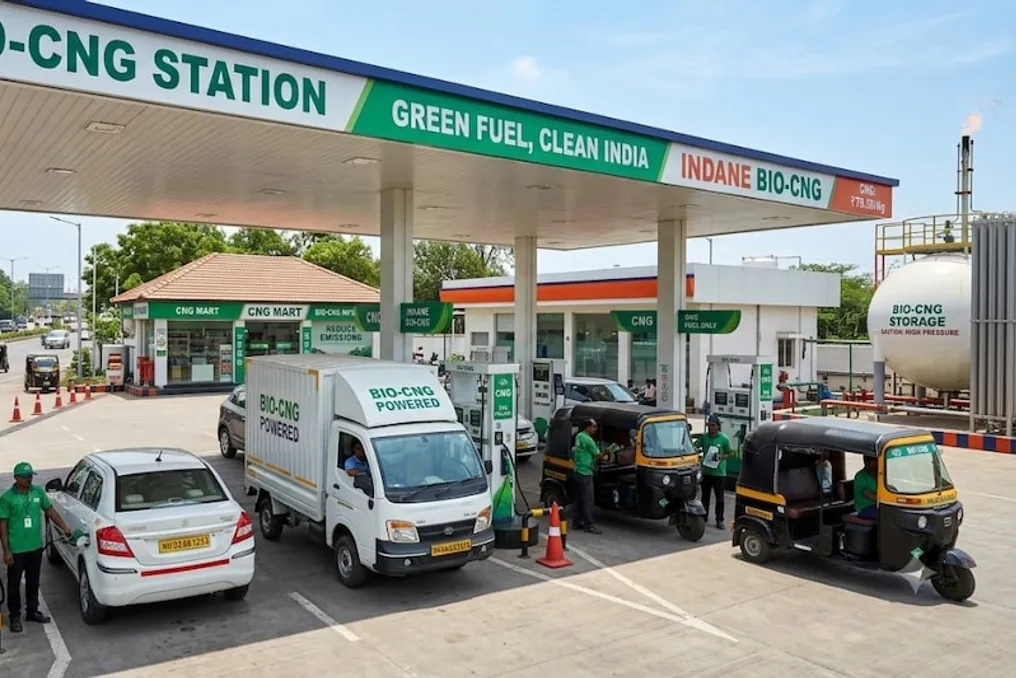
Amid ongoing discussions about adding ethanol to gasoline, the government has made a significant decision regarding CNG: it plans to gradually blend regular CNG with Bio-CNG, which is gas derived from biogas. The central cabinet recently approved the 'National Circular Bioenergy Scheme – GOBARdhan.' This scheme allocates 23,731 crore rupees to incentivize the production of compressed biogas (CBG).
The government stated that the GOBARdhan scheme will be operational until 2036. The program's goal is to increase domestic production of compressed biogas by approximately tenfold. To achieve this, conditions such as assured offtake, fixed prices, capital subsidies, pipeline infrastructure, and simplified access to financing will be provided.
Compressed biogas (CBG) will be produced using organic agricultural waste, animal manure, sugar industry waste (such as bagasse), and municipal organic waste. This biogas will then be blended with CNG used in vehicles and piped natural gas (PNG).
According to the government, this will promote the development of local fuel and reduce dependence on imported fuel. However, the main question arises regarding the impact on owners of regular CNG vehicles: will they need to change anything, and how will this affect fuel consumption and performance?
Bio-CNG is also known as compressed biogas (CBG) and is produced from organic waste. Raw materials can include crop residues, manure, sugar mill bagasse, and municipal waste. After processing these wastes, a gas is obtained whose structure is very similar to regular CNG. This is why Bio-CNG can be delivered to consumers through existing gas pipelines and the CNG network. That is, the refueling method at CNG stations for regular customers will not change.
Gradually, the share of Bio-CNG will increase in regular natural gas, similar to how ethanol was added to gasoline.
In contrast, CNG (compressed natural gas) is produced from natural gas extracted deep underground. It consists mainly of methane. After extraction from gas wells, the gas is purified and then compressed under high pressure to fill cylinders. This gas is delivered to gas stations via pipelines and cylinders.
Under the GOBARdhan program, the government mandates that City Gas Distribution (CGD) companies purchase and integrate a certain volume of Bio-CNG into the gas network. These companies supply CNG for transport and PNG for household needs. The share of Bio-CNG will increase gradually. A target of 3 percent is set for the fiscal year 2026-27. Then, in 2027-28, the share of Bio-CNG will rise to 4 percent, and starting from 2028-29, it will reach 5 percent, representing an annual increase of about 1 percent.
It is important to note that this target applies not only to CNG used in transport but also to the total volume of gas supplied through the CGD network, including both CNG and PNG for home use.
To ensure such a large volume of Bio-CNG in the country, the construction of many new CBG production plants will be required. The government is working on various support measures for this. The advantage is that companies producing Bio-CNG will not have to search for a market for their fuel. CGD companies will provide buyers for Bio-CNG, guaranteeing stable prices and predictability. Furthermore, financial assistance will be provided for building new facilities, necessary infrastructure for connection to gas pipelines, and credit guarantees for projects. In fact, the government aims to increase the volume of CBG produced in the country by approximately ten times in the coming years, allowing waste to be used for fuel production and reducing dependence on natural gas.
The most important question concerns CNG vehicle owners: will they need to make any modifications? According to available information, the chemical structure of Bio-CNG is very similar to regular CNG, so existing CNG vehicles will not require engine, fuel tank, or other equipment replacement to run on blended gas. Thus, owners will simply need to refuel at the usual CNG station, and the driving experience will remain the same. Changes related to the increased share of Bio-CNG will concern the gas supply system, not the vehicle itself.
This eases the situation for CNG vehicle owners, as Bio-CNG is designed to be compatible with the existing natural gas network and vehicles. According to Indian Oil, CBG...