Imagine looking at a city from an airplane, and it resembles a computer microchip or a perfect chessboard. Each block is an identical square section, every street is a straight line, and every turn is a perfect angle. This image belongs to the beautiful city of Barcelona in Spain.
Upon closer inspection of these square blocks, one can notice that their corners are not sharp 90-degree angles; instead, they are cut off at a 45-degree angle. These blocks are called 'octagonal blocks.' This remarkable design was developed by architect Ildefons Cerdà in the 1850s, even before the invention of automobiles. However, he foresaw that the future appearance of steam or motor vehicles would lead to accidents and severe traffic jams at sharp corners.
Thanks to these cut-off corners at intersections, open space was created, which improved air ventilation and ensures excellent visibility for transport in the modern era. Today, these cut-off corners are one of the main features of Barcelona.
Barcelona in the mid-19th century looked very different from today. The city was heavily restricted by old medieval walls. The population density was so high that sunlight barely penetrated the narrow streets. Dirt, pollution, and epidemics such as cholera turned the city into something dreadful. The situation was so dire that the average life expectancy of ordinary residents then dropped to 30–35 years. At that time, the administration of Barcelona made a historic decision and demolished the suffocating old walls, commissioning the design of a new city to the visionary engineer Ildefons Cerdà.
Cerdà was not just an engineer; he was also a social thinker. He rethought the concept of urbanization. He believed that regardless of wealth or poverty, every person has an equal right to fresh air, sunlight, and greenery. Therefore, rejecting traditional urban planning, he divided the entire city into blocks of identical shape and size.
According to Cerdà's original plan, buildings were only supposed to be constructed on two or three sides of each square block, leaving the central part empty for a large public park or garden. He wished for every resident, when opening a window, to see trees, not concrete. Nevertheless, in subsequent decades, constructions also began to be erected in these inner gardens due to commercial interests.
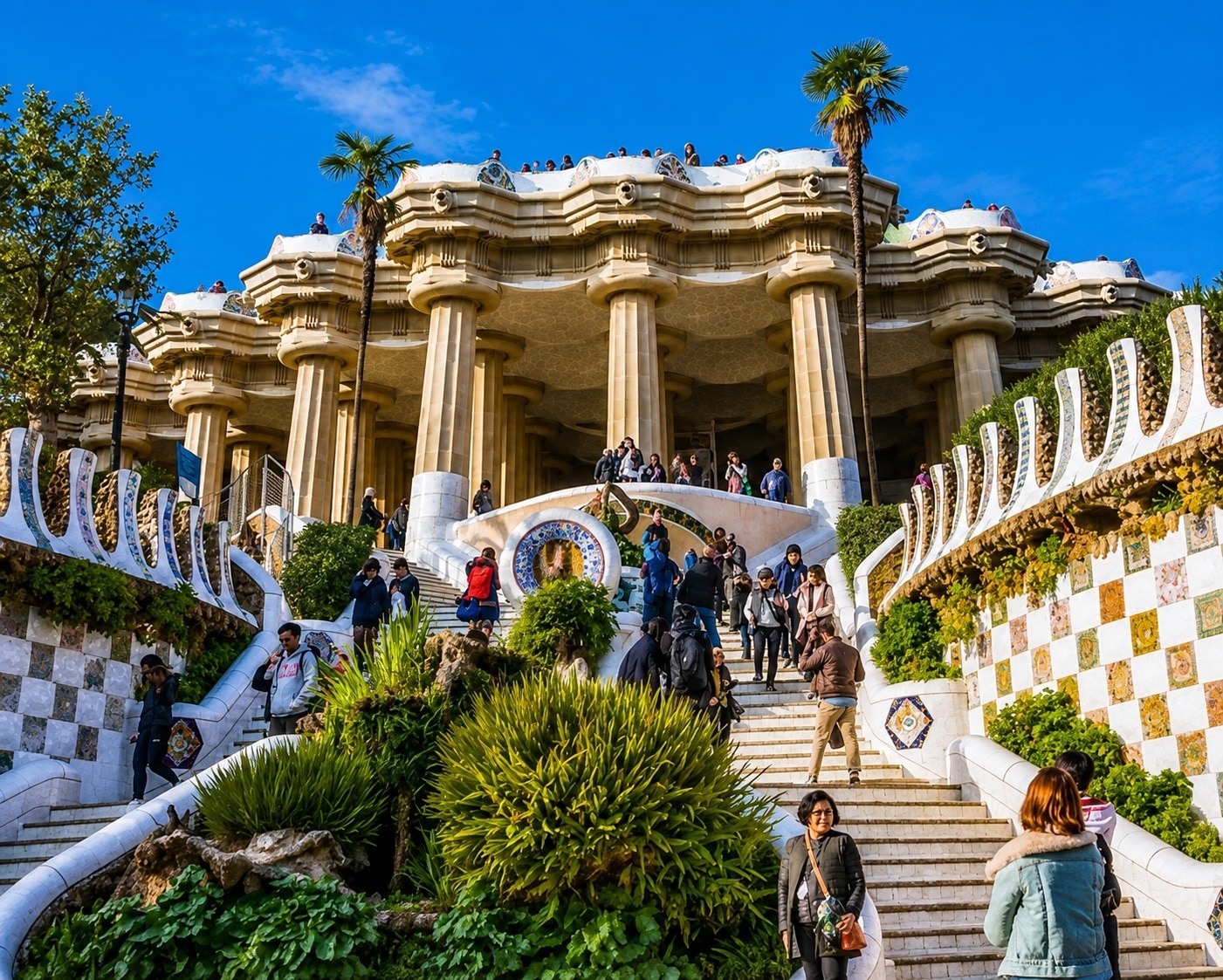
It is said that Cerdà was responsible for the mind of Barcelona, while the soul of the city belonged to Antoni Gaudí. Cerdà gave Barcelona a disciplined and mathematical mind, and the great architect Antoni Gaudí breathed a magical artistic soul into it. Gaudí was the founder of Catalan Modernism. He believed that straight lines were man-made, whereas everything God created in nature is curved, i.e., organic.
Gaudí completely abandoned the use of straight lines in his buildings. The roof of Casa Batlló resembles a dragon's spine, and the balconies of Casa Milà look like ocean waves. The Sagrada Familia church, located in the center of the city, is considered a marvel. Its interior columns resemble stone trees, representing a unique combination of nature and spirituality.
Today, the city's population is about 1.65 million people, with over 5.5 million living in the entire metropolitan area. This city, which welcomes more than 10 million tourists annually, is now applying Cerdà's plan in a new form to tackle its biggest problem—pollution and traffic congestion. This new approach is called 'superblocks.' Superblocks are created by combining several blocks, and many blocks are declared 'car-free zones.' Transport is allowed only around the outer perimeter of the superblock, while pedestrians rule the inner areas. Furthermore, bicycle paths, playgrounds, and community centers are being increased. Thanks to this, the level of NO2 pollution in the city has decreased by 25%.
Moreover, while preserving the untouched narrow labyrinths of 14th-century streets in the old historical 'Gothic Quarter,' modern glass skyscrapers, such as the bullet-shaped 'Torre Glòries,' have been erected in the city's new financial district. This is a perfect combination of historical heritage and high-tech sustainability.
The architecture of Barcelona teaches us that a city should be designed not merely as a collection of concrete boxes, but with consideration for human well-being, fresh air, and peace of mind. This is why, whether you walk through the streets of Barcelona or look at it from above, you feel that architecture is not just the construction of walls, but a living art of writing poetry in stone.