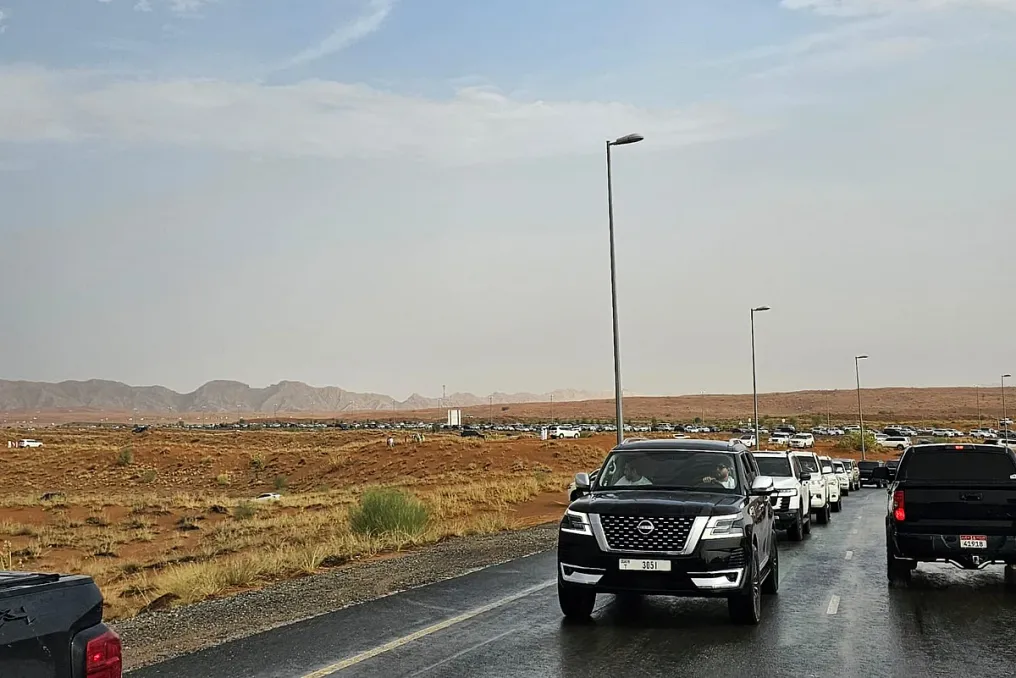
On Saturday, thousands of residents from the United Arab Emirates headed to Al Meyha in search of rain amidst the summer heat. What many expected to be a trip for light rain turned into a dramatic day with heavy precipitation, thunder, and hail near the Mahafiz intersection.
As the storm intensified, the sky darkened, and visibility on the roads sharply decreased. Hail struck cars and bounced off the ground, while hundreds of residents gathered at various points in the area to observe and record the weather.
Many of them did not end up in Al Meyha by chance; they specifically traveled there, following cloud movements and weather updates. Families and groups of friends spent hours on the road, hoping to catch the rain before it moved away.
According to Sajjad, a known UAE meteorologist, such trips can last from five to seven hours and cover over 150 kilometers, as people constantly move from one location to another. Unlike a regular road trip, rain chasers often head home without knowing exactly where they will arrive; the final destination depends on cloud movement, and plans can change several times within a few hours.
Shaad, a resident of Dubai who went on this adventure with his family, said that they decided to go to Al Meyha after seeing the clouds in the area darkening on a radar application. They understood they might arrive too late but decided the trip was worth it. He noted: 'We left behind completely different weather, and by the time we reached Al Meyha, it was raining heavily, thundering, and even hailing.' He added that the children were very excited as they had never experienced anything like this during the summer in the UAE, and the trip paid off when they finally found the storm.
Abdulla Al Ahli, a resident of Hawanij, joined his friends. He reported that the rain chase turned into a new type of journey for them. They usually start moving upon noticing a good chance of rain and then constantly change their route depending on the direction of the clouds. He emphasized: 'Sometimes you drive for more than an hour and arrive after the rain has already stopped, so there is always an element of luck. We are not heading to a fixed place; we are just following the rain.'
Sajjad, the UAE meteorologist, stated that he himself engages in rain chasing more than once a week from March to November, when there is a possibility of precipitation. However, even after long hours on the road, rain chasers sometimes return without the desired experience. He explained that sometimes they arrive at a location after the rain has already stopped, and traffic jams can delay them, or clouds can move through inland areas that are difficult to track. 'Tracking clouds becomes easier when they are moving towards highways,' he explained, 'this allows us to continue moving toward the storm instead of our route being interrupted by hard-to-reach areas.'
A typical rain chase takes about five to seven hours. Sajjad specified that the total distance can be up to 100 km on some days, but on other days it can exceed 150 km as the clouds continue to move. 'On a good day, the reward can come several times. We can experience rain or storms more than three times in one trip if they continue to follow the clouds after one episode ends.'
The meteorologist noted that there is no single application that can accurately tell a rain chaser where the next downpour will occur. He analyzes wind direction, pressure, temperature, and humidity before deciding which area has the highest chance of cloud development. 'Two sea breezes play an important role during summer afternoons. One comes from the Arabian Gulf, and the other from the Gulf of Oman, and both bring moisture inland.' He added that when these winds meet, they can contribute to cloud formation, but low pressure, high temperature, and sufficient humidity are also necessary to intensify the clouds.
The meeting point can change daily. On one day, stronger clouds might be near Al Meyha, while on another, they might appear in the direction of Sharjah, Masafeh, or Fujairah. This means there is no single spot where residents can simply go every time they want to find rain. A successful chase can involve multiple stops, sudden changes in direction, and hours of driving before the rain finally appears.
Sajjad predicts another chance of rain on Sunday, this time closer to the outskirts of Dubai. He suggested that clouds might develop around Lisaili, Al Qudra, Margama, and nearby areas, depending on the weather development throughout the day. 'However, the exact location can change as the clouds form and move. For rain chasers, this means Sunday could bring another day on the road, watching the sky and following the clouds to where the rain develops.'