
In an article dedicated to the path to economic progress and improvement, Javan argues that for many years, Iran's economic policy has focused on external sanctions and strategies to counteract them. He emphasizes that to lessen the negative impact of external restrictions, the government must combine economic diplomacy with internal structural transformations.
Eliminating internal obstacles hindering production and investment will not only strengthen Iran's economy against external pressure but also create conditions for sustainable growth, increased employment, higher productivity, and improved public welfare. The author insists that Iran's economy needs structural reforms more than ever—reforms aimed at eliminating internal 'sanctions,' optimizing economic activity, and enhancing the country's long-term capacity to sustainably neutralize the consequences of foreign restrictions.
Arman-e-Melli: Is the Strait of Hormuz a prelude to final negotiations?
The newspaper Arman-e-Melli analyzed the regional situation, paying particular attention to the issue between Iran and the United States. According to the publication, an analysis of reports published by regional and international media indicates a possible approach to a resolution in negotiations between Oman and Iran regarding the Strait of Hormuz. The actions of Iran, the United States, and mediators suggest that the Hormuz issue should be viewed as the primary channel for any negotiations or agreements with Washington.
Iran, believing that the US is obstructing the implementation of agreements in Isfahan, continues to maintain that the Hormuz issue must remain an available lever of pressure against Washington and its regional allies. Tehran intends to engage in bilateral negotiations with the United States only after this issue is resolved. If both sides can settle the issue of passage through the Strait of Hormuz, it could lay the foundation for resolving a larger problem—ending the war—and potentially open the way for further negotiations between Iran and the US.
Jam-e-Jam: America's weakness lies in its inability to understand the Iranian people
In an interview with political analyst Dr. Jadollah Javani, the publication Jam-e-Jam discussed America's 'humiliating defeat.' According to Javani, Americans and their allies now clearly realize that Iran's military potential is at peak readiness, following the losses sustained in Kuwait, Bahrain, and Jordan by Iranian armed forces. He asserts that any mistake by the adversary—especially a careless ground invasion by US troops into Iranian territory—will result in entry points becoming graves for the misled mercenaries.
In Javani's view, Iran's advantage lies in its realistic assessment of the enemy, whereas America's Achilles' heel is its inability to understand the Iranian people. Today, he says, the United States is forced to acknowledge an inevitable strategic defeat because it entered a war with a people it never understood.
Sazandegi: The future of the Strait of Hormuz
Sazandegi highlighted the possibility that Iran and the United States are approaching a point of mutual understanding. Experts believe that a new agreement regarding the Strait of Hormuz could serve the interests of both countries. If the naval blockade is lifted, Iran can resume oil exports, and the United States can find a way out of the current deadlock. As reported by The New York Times, such an agreement would provide Iran with a strategic leverage it previously lacked.
However, Trump opponents view any deals with Iran as a sign of US retreat. Failed negotiations or sabotage by the United States or Israel could push the region into a new phase of mutual attacks between Iran and America. Even with an agreement on Hormuz, disputes between Tehran and Washington will not end; the parties will move into a more complex phase—nuclear negotiations. This issue is significantly more complex than regulating shipping in Hormuz and may provide a clearer picture of the future of Iran-US relations and regional development.
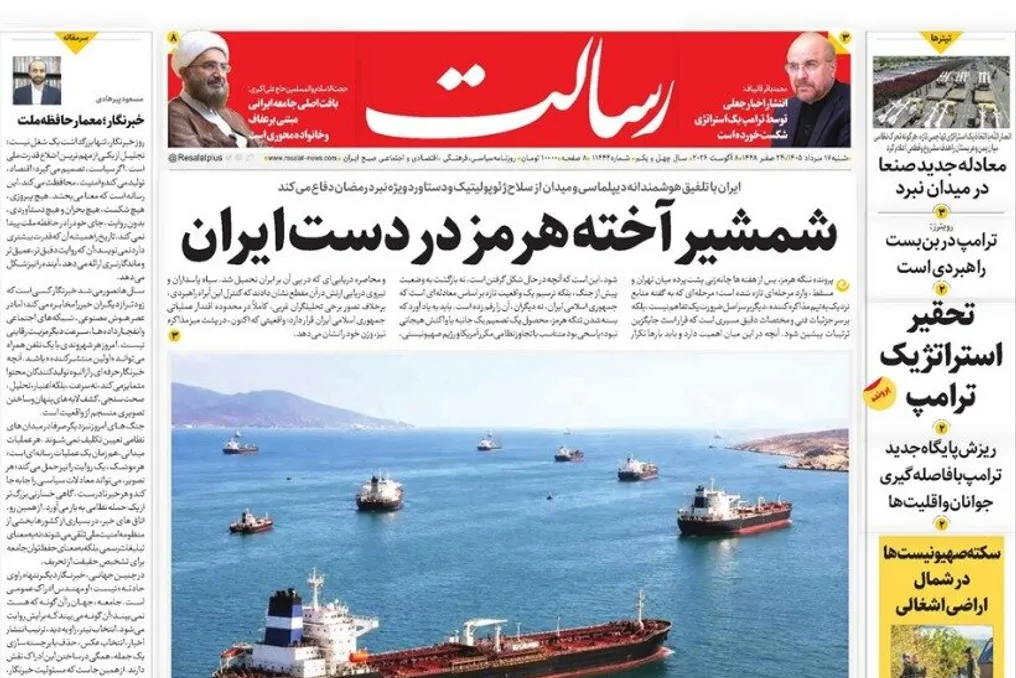
Resalat: Internal proxies are the West's only remaining hope
Resalat analyzed what it sees as a shift in US strategy. Military events and shelling in Iran's southern skies and strategic sea lanes demonstrate a key phase of change in the confrontation with Washington and Tel Aviv. Months after the start of this conflict round, the military and strategic stalemate of the United States and Israel in containing Iran's deterrence network is becoming increasingly evident. This failure, the publication claims, has pushed the Western axis toward conducting intelligence warfare, special operations, and activating infiltration networks and coup attempts inside Iran.
The main battlefield is no longer just the sea or military bases; it has moved inside Iran's security structures and into efforts to maintain internal stability. The most dangerous aspect of this strategic shift, according to Resalat, is the West's dependence on internal proxies.