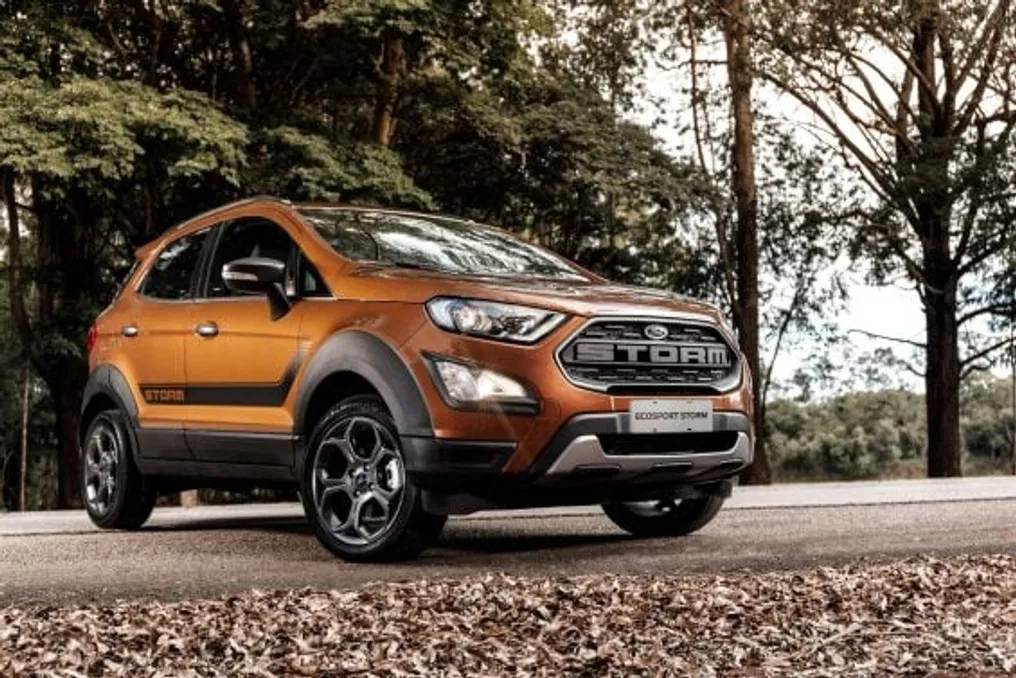
The Ford EcoSport Storm stands out for its bolder and more urban look, lending sportiness to a vehicle that could otherwise be considered discreet. Ford utilized this aesthetic in the Storm version during the final years of the EcoSport's production.
This model managed to combine a distinctive design with high-end finishing features, making it an attractive alternative for those seeking a raised vehicle with a robust appearance, good performance, and even the option of 4x4 traction for limited adventures.
The first generation of the Ford EcoSport was introduced in February 2003, marking a new concept for the sport utility body. Originating from the Fiesta hatchback, it emerged as the most accessible SUV in the country, offering 1.0, 1.0 Supercharger, 1.6, and 2.0 engine options.
Initially, the EcoSport was predominantly urban, and only in 2005 did it gain on-demand all-wheel drive capability, a change driven by insistence from Ford of the United States. However, 4WD variants represented only about 2% of sales during this initial period.
The second generation of the EcoSport was launched in July 2012, maintaining its urban essence but now derived from the New Fiesta. In the higher configurations, the 2.0 engine remained, while the 1.6 8V was replaced by the 1.6 16V Sigma.
This second generation was equipped with the Powershift gearbox, a six-speed dual-clutch automatic transmission, which caused problems for several owners. In 2019, Ford introduced the Storm version for the EcoSport, characterized by a sportier design, a 2.0 engine, and all-wheel drive.
Subsequently, Ford had the opportunity to replace the EcoSport's 1.6 engine with the 1.5 Dragon and swap the Powershift for a conventional six-speed automatic transmission. In 2021, Ford ended its manufacturing operations in Brazil, and the SUV concluded its trajectory, accumulating over 720,000 registrations over 18 years.
The EcoSport was the second product of the Brazilian Ford's Amazon project, which began with the fifth-generation Fiesta manufactured at the automaker's new plant in Camaçari (BA) starting in 2002, a factory that currently belongs to BYD.
There are reports that the first sketch of the Eco was made on a restaurant napkin. However, Ford also considered competitor movements, such as Fiat's Adventure versions, and market research indicating that less than 5% of SUV owners used 4x4 traction.
For this reason, the EcoSport was conceived without the 4x4 option and built on a unibody chassis. Nearly ten years later, other brands recognized this need, and today the market is dominated by truly urban SUVs, largely thanks to the first Eco.
While competitors reacted, Ford kept the EcoSport as the best-selling SUV for over a decade. Sales began to be significantly affected in the second half of the 2010s with the arrival of a series of compact crossovers.
The Ford EcoSport Storm was launched in 2019, drawing attention mainly for its more sober look. This includes the black grille with the version name embossed on a horizontal bar, darkened headlight lenses, and a bumper distinct from the rest of the line.
This front design was inspired by the front of the previous generation F-150 Raptor pickup (which was not yet scheduled for sale in Brazil). On the sides, the vehicle boasts 17-inch alloy wheels with an exclusive design and body decals. At the rear, there is a custom spare tire cover and darkened taillights.
Although based on the top-of-the-line Titanium version, the Storm incorporated darkened patterns on the roof lining and dashboard. Orange accent details were added to the bottom of the multimedia screen, door handles, and center console.
An interesting fact is that this variant helped increase the participation of 4WD versions. If this index did not exceed 2% in the first generation, it was only with the Storm that it reached over 5% of the SUV's total registration mix.
In this phase of the EcoSport, the naturally aspirated 2.0 16V engine from the Ford Duratec family already featured direct injection, resulting in 176 hp with ethanol and 170 hp with gasoline, powers that may be sufficient in certain situations.
Initial accelerations are satisfactory, showing agile responses. However, the six-speed automatic transmission demonstrates slowness in the higher gears, resulting in a 0 to 100 km/h time of 10 seconds.
Torque reaches 22.5/20.6 kgfm at 4,500 rpm, which requires attention to engine revving when overtaking with the Ford EcoSport Storm on highways.
Dynamically, the SUV is pleasing. It is relevant to mention that this generation of the EcoSport used a high-precision laser measurement system for front alignment at the Camaçari factory, a technique similar to that used on the Mustang of that era, in addition to having an active front grille.
Additionally, the Ford EcoSport Storm configuration received specific adjustments to the suspension (independent multi-link rear) and electric power steering. Stability is good, as the SUV tends to roll little and maintains good pointing in curves.
One of the highlights of the Ford EcoSport Storm is the all-wheel-drive system (4WD). Developed by Mazda (the Japanese brand in which the American held a stake until the 2010s), it operates through on-demand viscous coupling.
All-wheel drive allows for light expeditions on innocuous and discreetly rough dirt terrain. Furthermore, the suspension adjustment raised the SUV by 1.7 cm (totaling 1.70 m), with a ground clearance of 20 cm and an approach angle of 23.6 degrees.
However, it is important to note that the EcoSport is fundamentally an urban SUV, and more off-road sections should be avoided. Its 19-degree departure angle does not help much, and this variant uses asphalt tires, offering no low mode for the 4WD system.
Because it is derived from a compact hatchback, the EcoSport's interior does not feature extraordinary luxuries. The environment is similar to that of the New Fiesta, offering restricted space for legs, shoulders, and knees for both front and rear passengers.
The SUV compensates with a high driving position. Although the seats could have better density, the trunk accommodates 362 liters, a volume greater than current hatchbacks like the Fiat Argo.
The interior finish is superior to the first generation but remains relatively simple, with a predominance of rigid plastic and few soft surfaces. The darker tones of the Storm help mitigate this internal simplicity of the Ford EcoSport.
The suspension deserves positive mention, providing comfort to front occupants with low steering wheel vibration and minimizing rear sway, even though it is a tall SUV. Acoustic insulation is effective for most of the time.
The Ford EcoSport Storm is the most complete model in Ford's small SUV lineup. In terms of safety, it features seven airbags, traction control, stability control, hill descent control, blind spot monitoring with cross-traffic alert, camera and reverse sensor, low tire pressure warning, and adaptive bi-xenon headlights with automatic height adjustment and washers.
The top-of-the-line version is also equipped with an eight-inch multimedia center with integrated GPS, phone mirroring, USB port, Bluetooth connectivity, and a premium Sony sound system. Other items include a panoramic sunroof, keyless entry with push-button start, leather-wrapped seats and steering wheel, automatic and digital air conditioning, rain and dusk sensors, cruise control, shift paddles, and lumbar support for the driver's seat.