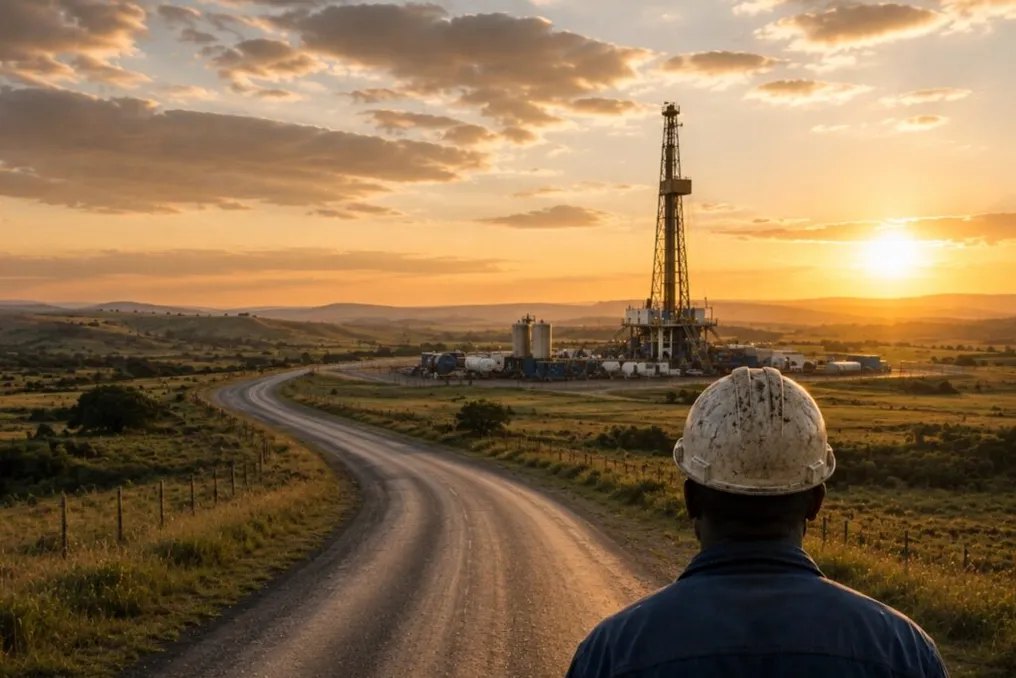
The Mpumalanga province has been involved in resource extraction for decades, which was subsequently burned. The province is characterized by extensive coal mines, dominant power stations, and a landscape composed of conveyor belts, power line supports, and giant cooling towers. This region, known as the Highveld, served as South Africa's industrial battery, powering the country but at the cost of significant environmental damage.
Another fossil fuel type is currently being explored. The publication Daily Maverick reported that the Perth-based group Kinetico Energy has targeted gas resources in Mpumalanga, describing them as 'world-class reserves.' This opens up prospects for a new phase in the province's long-standing relationship with combustible materials.
According to information from Kinetico, the company achieved '100% drilling success' in four of its exploration blocks in both Mpumalanga and the neighboring Free State province. Kinetico's Executive Chairman, Adam Sierakowski, also promised 'very careful environmental stewardship,' emphasizing that the project would not involve hydraulic fracturing (fracking).
Given that South Africa must complete its coal era, the situation resembles a reboot. The national 'Just Energy Transition' program is built on the idea of shifting to a cleaner energy system without completely abandoning the people and economies that developed around coal. Mpumalanga is where this theory most often confronts reality.
There are jobs that need protecting, towns built around mining, vast energy infrastructure that cannot simply be switched off, and a national grid requiring reliable energy production. Announcing an energy transition is one thing; sustaining it during the transition is quite another.
In this context, gas appears highly attractive. It burns cleaner than coal and can generate electricity when the sun is not shining and the wind is not blowing. Furthermore, it can become an alternative energy source for industry, which is particularly relevant given South Africa's problems with the long-term supply of existing gas reserves.
Until now, the country has heavily relied on gas from Mozambique, but these resources will not last forever. The company Sasol warns of an inevitable decline in Mozambican supplies, complicating an already difficult energy crisis. In light of this, finding gas closer to home looks significantly more interesting, and Mpumalanga's geology is suitable for it.
The province's coal formations contain methane, including coal methane, making the underground landscape that fostered South Africa's coal economy potentially useful for other purposes. Nevertheless, there are strong arguments for developing gas fields. If it helps replace coal generation, support renewable energy sources, and provide the country with an additional source of stable energy, it could play a beneficial role during the transformation period.
However, there is a difference between using gas in a transitional period and creating a new industry that must exist for decades. Once funds are invested in drilling, pipelines, processing facilities, and everything necessary to turn an underground resource into a commercial product, the economy tends to maintain that activity. For Mpumalanga, coal should never have been the only story. And yet, here we are.
Part of the concept of 'just' in the energy transition includes affected communities and the environment. The Highveld is not an empty geological site where drilling can happen unnoticed. It is agricultural land, it is homes for communities, and it is one of the parts of South Africa most severely impacted by industrial mining. One farmer from Mpumalanga told DM: 'Some of us are very worried about what might happen on our land and beneath it. And there are those who see money on the horizon and are ready to sell their inheritance.'
Thus, any new gas development must answer the same questions as almost any major mining project: what will happen to the water, what will happen to the land, what will happen in case of failures, and who will bear the consequences. The province is already forced to present a future free of coal, with grand plans for renewable energy, new industries, and economic diversification. But transitions are complex processes; a coal miner does not automatically become a software engineer just because a green economy has been announced, nor can a mining town magically transform just because a policy document mentions 'diversification.' And the energy system cannot simply replace coal overnight without consequences.
Gas is presented as cleaner than coal, and in some cases, this is true. It can ensure energy security and potentially attract investment. It can create jobs and reduce dependence on imported fuel. However, it is still a resource that needs to be extracted, processed, and burned, so South Africa must decide whether it is a useful intermediate step or just another path from which it is hard to turn back.
For Mpumalanga, this is not just another story about what lies beneath the Highveld. It is a question of what the region will look like in the next hundred years. The province has supplied South Africa with energy for generations, paying for this role with polluted landscapes, environmental damage, and community ties to an industry whose future is becoming increasingly uncertain. Now, another fossil fuel has appeared on the horizon. Perhaps gas will indeed be the bridge that South Africa crosses from dirty coal, but if we are serious about moving in a different direction, we must ensure where this bridge leads.