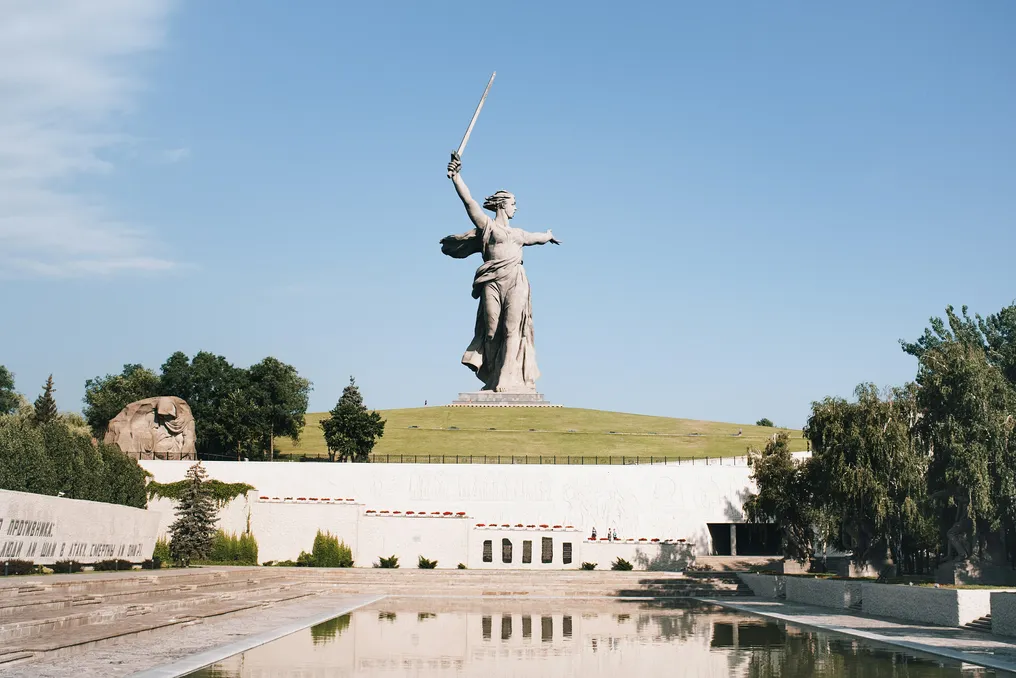
The "Motherland Calls" monument in Volgograd, depicting a woman with a giant sword in a defiant pose, symbolizes the resilience of the Soviet people against the onslaught of Nazis. This monument is considered the largest statue of its kind in Europe and was the largest in the world for over two decades after its complex construction.
The city, known today as Volgograd but called Stalingrad at the time the statue was unveiled in 1967, is the site of one of the decisive events of the Second World War. There, for just over six months between 1942 and 1943, Russian soldiers and civilians resisted quarter by quarter, house by house, against German troops, which became a turning point in the European conflict.
Casualties in the Battle of Stalingrad are estimated to be between 1 and 3 million people, making this event one of the bloodiest and simultaneously most fateful in history. When the Nazis were forced to retreat due to the huge number of casualties and the harsh Russian winters, the course of the Second World War began to change. If Adolf Hitler's command had achieved successes across Europe previously, the following years were marked by a gradual reduction of his territorial dominance, culminating in a final defeat in 1945.
The "Motherland Calls" statue was conceived to immortalize this legacy, which is a central element of the Soviet Union's self-perception regarding its sacrifices in the war. Despite all the difficulties associated with the monument's construction, it was completed in October 1967, when the Russian Revolution celebrated its fiftieth anniversary.
The woman representing Motherland has a height of 52 meters from the pedestal, and her sword adds another 33 meters to the total height. Upon its initial presentation to the people of Stalingrad, the monument was the largest in the world, a title it held for another 22 years.
However, ensuring this status was not easy. The project, signed by Evgeny Vuchetich, Yakov Belopolsky, and Nikolai Nikitin, faced numerous structural problems, ranging from the foundations to the statue's composition itself. At the base, the issue of underground aquifers, which threatened the structure's collapse, needed to be resolved; and at the top, the first saber was so heavy that wind could cause the entire structure to rotate on its axis.
Given all these complexities, it is not surprising that the construction, which began in 1963, took four years before being handed over to the public. Even after the official opening of the statue, various works continued to ensure its integrity: for example, the saber was replaced, and other restoration work was carried out during the 2010s to prevent structural collapse. Currently, this monument is seeking inclusion in the UNESCO World Heritage List, although this has not yet been achieved.
When "Motherland Calls" was completed in October 1967, it was the largest monument of its kind in the world, surpassing the Buddha sculpture in Sichuan province, China, which held this title for 12 centuries. While the Russian structure was 85 meters high, the one near Leshan city reached 71 meters from the ground.
Nevertheless, since then, other statues have surpassed the colossal monument of Volgograd. The first such statue appeared in 1989—the Cannon sculpture, a form of divine state related to compassion in Buddhism, standing 88 meters tall, opened on the Japanese island of Hokkaido. Today, the tallest statue in the world is located in India, in the state of Gujarat, and is called the "Statue of Unity." It depicts the politician—the founder of the nation's independence—Sardar Patel, who died in 1950. This structure, impressive at 182 meters high, is located near the city of Kevadia and was unveiled in 2018. Including the base, the complete monument reaches 240 meters from the ground.
Despite being surpassed by several constructions in Asia, the Volgograd statue remains the largest located in Europe and ranks 11th in the world.