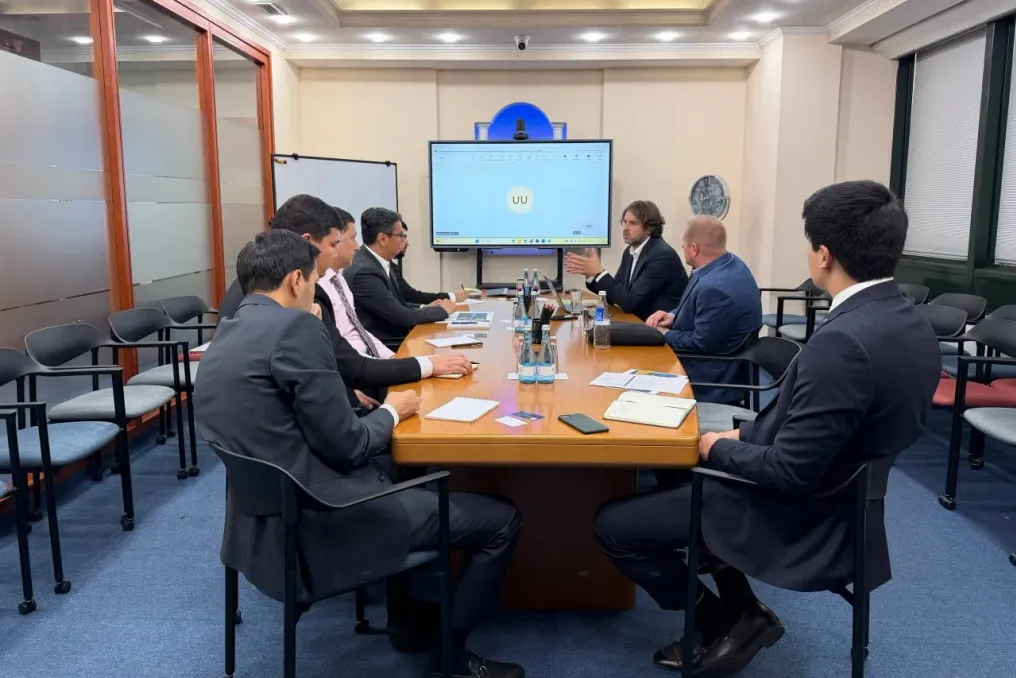
The Uzbekistan Deposit Guarantee Agency held a meeting with representatives of the international company Regnology, which specializes in SupTech solutions.
The Uzbekistan Deposit Guarantee Agency held a meeting with representatives of the international company Regnology, which specializes in SupTech solutions.
The main topic of discussion was global trends in the digital transformation of deposit guarantee systems. The Deposit Guarantee Agency announced this meeting.
The meeting included the General Director of the agency, Ulugbek Khamdamov, as well as Regnology representatives Garrett Scott and Michal Pechotsky.
The parties reviewed modern digital platforms and management solutions used by other deposit guarantee organizations. Special attention was paid to automated data collection and quality verification from participating banks, maintaining a depositors' register, automating compensation payments, data analysis, risk monitoring, and secure information exchange among financial system participants.
Participants also exchanged views on the functionality of the presented technological solutions, the international experience of their implementation, and the prospects of using similar tools in the deposit guarantee system of Uzbekistan.
The Agency stated that it continues to study best international practices, analyze modern digital technologies, and assess the possibilities of integrating them into the national deposit guarantee system as part of further transformation.
Majid Karimov, Director of the Agency for Knowledge and Qualifications Assessment of Uzbekistan, held a meeting with Alberto Biancoli, Head of the Education Department at the UNICEF Office in Uzbekistan.
During the negotiations, the parties discussed ways to develop the system for assessing the quality of national education, as well as prospects for further cooperation. Information about the meeting was provided by the Agency for Knowledge and Qualifications Assessment.
The topics discussed included efforts to improve the quality of education assessment in line with international standards, the introduction of a unified state exam for graduates of general secondary schools, and the development and conduct of an international audit of the national certification system for general education subjects and foreign languages.
Participants also exchanged views on priority areas of interaction. These include raising the professional level of assessment specialists, attracting international experts, improving assessment tools, and further strengthening the reliability, objectivity, and transparency of the national certification system.
The parties emphasized the critical importance of continuing joint work, integrating international experience into the national assessment system, and implementing joint projects aimed at improving the quality of education.