Observing a total solar eclipse is a unique event for most people. Although NASA records often mention an interval of 375–400 years for the same location, this number represents only a global average, not a strict rule.
Observing a total solar eclipse is a unique event for most people. Although NASA records often mention an interval of 375–400 years for the same location, this number represents only a global average, not a strict rule.
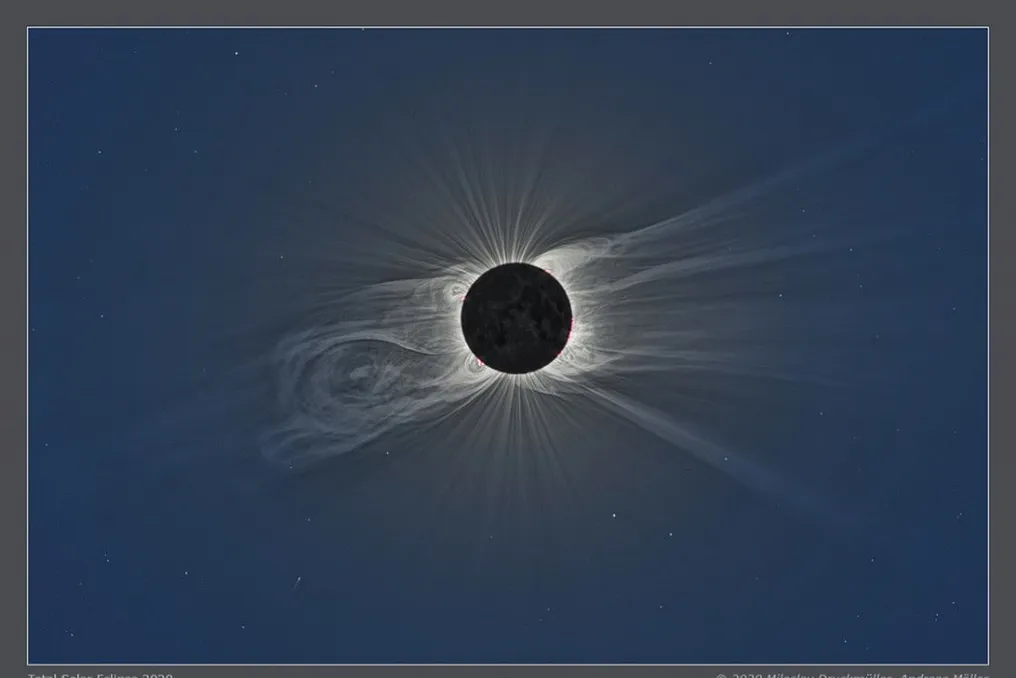
The geographical rarity of this phenomenon is due to the fact that the Moon's darkest shadow, called the umbra, is extremely narrow, usually measuring between 100 and 200 km wide. As the Earth rotates and the Moon orbits the planet, this edge of the shadow 'traces' the surface as a thin and fast line, creating what is known as the path of totality. Since the vast majority of the planet lies outside this zone, seeing complete darkness in a backyard requires a colossal confluence of circumstances.
Furthermore, eclipses occur within so-called 'families' that repeat every 18 years, 11 days, and eight hours (this is called the Saros Cycle). Imagine the rotation of the Earth: during these extra eight hours of rotation, the planet continues to spin and moves the area of the previous eclipse, causing the next event of the same family to pass over a completely different part of the map.
Because of this movement of the eclipse trajectories, they are distributed unevenly across the planet. Only in rare cases do small regions fall into the zone of two events in a very short period: the city of Carbondale in Illinois, USA, saw the shadow in 2017 and again in 2024 (only seven years apart), while Angola registered two total eclipses within 18 months, between 2001 and 2002.
In contrast to these fortunate instances, other populated areas face millennia-long droughts to maintain the average planetary figure of about four centuries. The city of London in England experienced a gap of 837 years between total eclipses, not witnessing the phenomenon from 878 until May 1715.
The total solar eclipse that will occur next Wednesday (the 12th) will cover the continental territory of Spain for the first time since 1905, concluding a period of 120 years and 348 days, according to El País.
Eclipses are astronomical events characterized by the complete or partial obscuration of a celestial body by another celestial body positioned in front of the light source. In 2026, a lunar total eclipse, or 'Blood Moon,' and a solar annular eclipse, which formed a 'Ring of Fire' in the Antarctic sky, have already occurred.
Two more events are scheduled for this year, both in August; the first is the total solar eclipse expected next week, as mentioned earlier. The season will conclude with a partial lunar eclipse on the night of the 27th to the 28th (which will be visible across all of Brazil).
The main difference between these two phenomena lies in the arrangement of the three bodies. During a lunar eclipse, the Earth is positioned between the Sun and the Moon, and its shadow darkens the satellite. During a solar eclipse, the Moon is positioned between the Sun and the Earth, projecting its shadow onto a specific area of the planet and completely or partially obscuring the Sun.
According to astrologers' forecasts, a solar eclipse will occur on August 12th, which will not be visible in India, and its sautaka period will not be considered valid. Astrologer Dr. Arunesh Kumar Sharma reported that this solar eclipse will happen in the Cancer sign, but its influence may be felt by representatives of other signs as well.
Currently, Ketu is in the Leo sign, so it is crucial to understand what impact this solar eclipse will have on people of this sign.
Pandit Arunesh Kumar Sharma stated that the second solar eclipse of the year signals potential financial loss for people born under the Leo sign. Residents of this sign should make any financial decisions with extreme caution. For those in business, this period may prove particularly difficult, as they face significant losses in trade. Therefore, large investments should not be made during this time, and the future path should only be determined after consulting advisors.
People employed at work may also face difficulties due to this solar eclipse. Their income may suffer, and saving money will become a very difficult task for them. Controlling expenses can become a serious test. Therefore, it is recommended to create a budget and avoid spending based on others' examples. Anxiety will often arise during this period, and one should not consider changing jobs, as this could lead to future losses.
This solar eclipse can affect a person's self-esteem, personality, and life. A decrease in self-confidence can lead to problems on the career front. Nevertheless, this experience will provide an opportunity to better understand oneself and become more conscious. One should avoid hasty reactions or attempts to control all circumstances. Furthermore, the person will constantly worry about how they are perceived by others. However, it is better to focus on planning the future rather than paying attention to others. This difficulty will become a serious life test for them; if they overcome it, their future path will begin to become easier on its own.
True strength comes from inner understanding and self-knowledge. It is necessary to deeply study oneself, create a budget, and try to save money. People of the Leo sign should perform an offering to the Sun daily from a copper pot in the morning and repeat the mantra 'Om Suryaya Namah.'