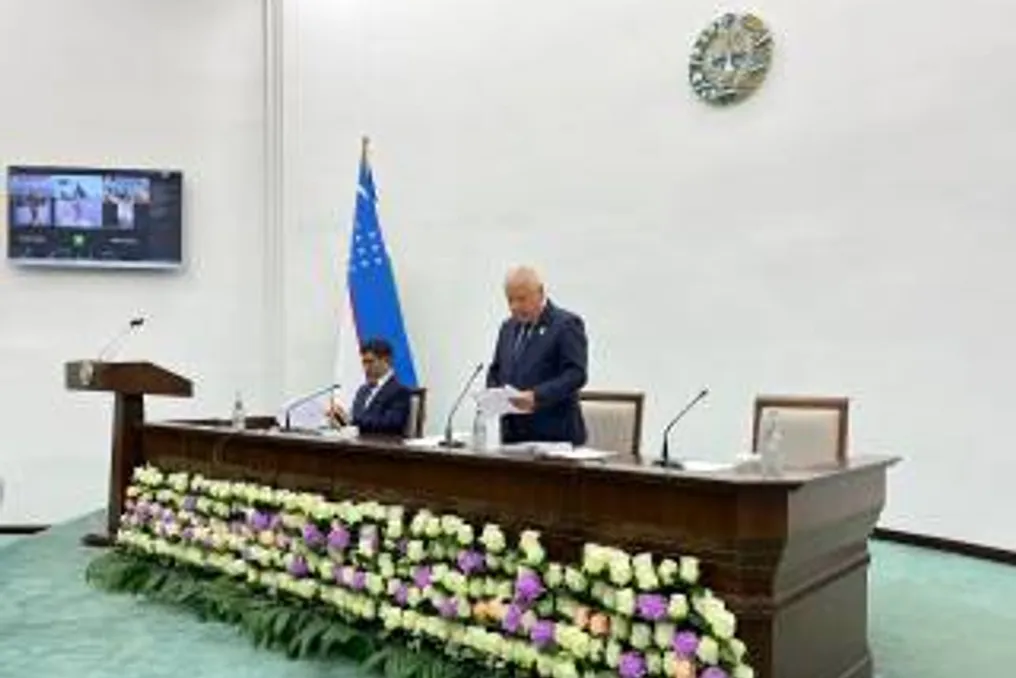
At the 34th meeting of the Kengash of Navoi District, issues regarding the implementation of the socio-economic strategy 'Navoi-2030' were discussed. During the meeting, topics included improving the crime situation in the region in the first half of 2026, crime prevention, eliminating their causes, ensuring legality, strengthening law and order, preventing offenses, and combating crime, as well as fulfilling the tasks set in the program to transform Konimekh District into an anti-corruption zone.
The first item was presented by Tohirjon Safarov, Deputy Director of the Agency for Strategic Development and Reforms under the President of the Republic of Uzbekistan. He emphasized that the 'Navoi-2030' strategy is a logical continuation of the national development strategy 'Uzbekistan-2030' and was developed to ensure the execution of the Presidential Decree of February 16, 2026, on the consistent continuation of reforms and transition to a new stage of development. This strategy is important both for defining a new stage of regional development and for practically implementing the reforms being carried out in the country.
As of the end of 2025, the gross regional product of Navoi District reached $13.4 billion, and per capita income amounted to $12,000. Economic growth rates remain at 7-8 percent. According to the strategy, the gross regional product should grow to $25.8 billion by 2030. It is planned to increase the production of industrial goods by 2.5 times, services by 2.2 times, and construction works by 1.6 times. These goals will be achieved through the development of sectors such as metallurgy, chemistry, mechanical engineering, building materials, logistics, digital services, and tourism. Furthermore, the goal of keeping inflation at 5 percent has been set.
Export development is also one of the key directions of the strategy. It is planned to increase export volume to $2.3 billion by 2030, expand the geography of exports to 80 countries, and increase the number of exporting enterprises to 225. It is expected to reduce the share of raw materials in the export composition and increase the share of high value-added products, such as mechanical engineering, chemistry, building materials, textiles, agricultural products, and tourism services. Achieving an export volume of 400 units will contribute to increasing the international competitiveness of local producers.
Environmental sustainability is included as an integral part of the strategy. Plans include increasing renewable energy capacity to 1800 megawatts, reducing water losses from 35% to 20%, expanding forest areas to 65 thousand hectares, planting 70.5 million trees, reducing annual harmful emissions into the atmosphere, and increasing household waste recycling levels to 40%. A special innovation of the strategy is the introduction of a 'regional passport' for each district and the implementation of a monitoring system for all projects categorized as 'green', 'yellow', and 'red' through digital platforms. Intermediate evaluations are also planned for 2028 and a final evaluation for 2031 with the publication of results for the public.
The district prosecutor, Abduqahhor Mullazhonov, presented a report at the meeting on the efforts made in the first half of 2026 to improve the crime situation in the district, prevent crimes, and eliminate their causes. The results of work under the President's decrees of January 5, 2026, No. PQ-1 and No. PQ-2 were analyzed. Thanks to the introduction of a new address system for creating a safe environment in settlements, no crimes were committed in 193 settlements. Of the 39 settlements previously classified as 'red', the situation improved in 19, and in 23 settlements, no crimes were registered at all, demonstrating the effectiveness of a preventive approach to preventing offenses.
Azat Tasbaev, head of the district Internal Affairs Department, also presented a report on the measures taken during the first half of the year to ensure legality, strengthen law and order, prevent offenses, and combat crime in the region. He also spoke about measures to fight and prevent corruption within the district Internal Affairs Department and its structural units. Additionally, an analytical report on the results of the wide preventive monthly campaign 'Safe and Healthy Country' was presented, along with a plan for further measures to combat cybercrime and raise the legal culture of the population.
Medgat Tulegenov, deputy head of Konimekh District, reported on the fulfillment of tasks defined in the program to transform the district into an anti-corruption zone, including fighting corruption among the population and creating a lead-free environment.
During the meeting, deputies expressed their opinions and suggestions on the issues considered, after which corresponding decisions were adopted.