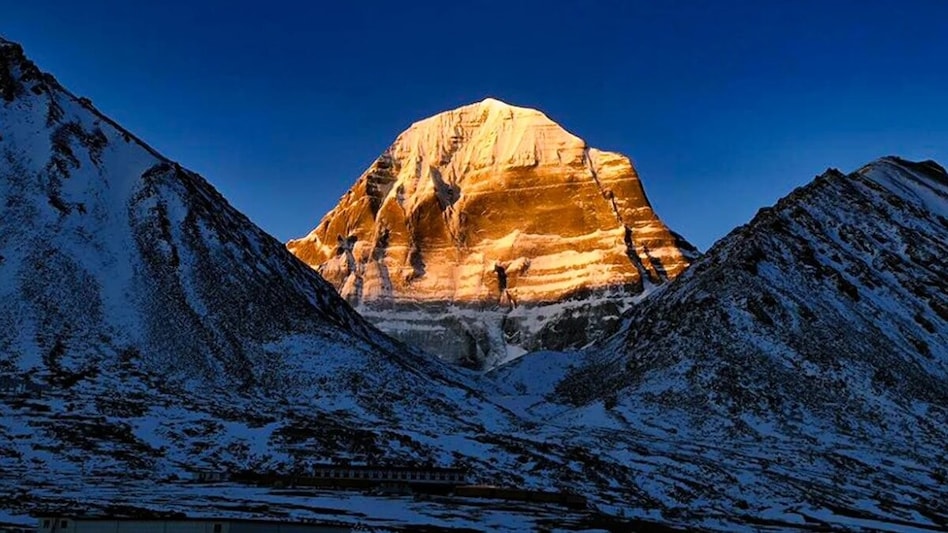
During daily morning prayers, the mantra 'Om Namah Shivaya' is often recited. During meditation, an image of a majestic, snow-covered mountain appears before one's eyes, upon whose summit resides Lord Shiva himself. This picture is not a fabrication; such a mountain truly exists—it is Mount Kailash, located in Tibet, near India.
However, the information we are about to reveal may be surprising. Humanity has reached the Moon, tunneled under the sea, and conquered the world's highest mountain, Everest, which people climb today by paying money. But on Mount Kailash, the abode of Lord Shiva, no one has yet been able to ascend.
Interestingly, Mount Kailash is approximately 2000 meters lower than Mount Everest. Nevertheless, attempts have been made. About a hundred years ago, two British mountaineers discovered a path to this mountain, but something happened at the last moment that forced them to turn back. Can this be considered a coincidence or some kind of omen?
Reinhold Messner, one of the greatest mountaineers in the world, who was granted permission by the Chinese government to climb Kailash, also declined. His final words became a key part of this story: 'If we conquer this mountain, we conquer something in which people's faith lives.'
Why is Mount Kailash so special?
One must consider: if there is a path and the possibility of obtaining permission, what force prevents people? Some claim that time flows differently around Kailash, and nails and hair grow faster. Other legends state that people visiting the vicinity of the mountain age rapidly. However, these claims lack any scientific evidence.
Essentially, these stories are based primarily on rumors and exaggerations. High altitude oxygen scarcity, harsh weather conditions, and psychological pressure can lead a person to delusions. Kailash is sacred not only to Hindus. In Buddhism, it is considered a center for meditation, and according to Jain teachings, the first Tirthankara Rishabhanatha attained liberation here. In Tibetan Bon Buddhism, it is called the soul of the earth. Thus, four great religions regard this mountain with reverence.
Four major rivers originate from the vicinity of Kailash: Sindhu, Satluj, Brahmaputra, and Karnali. The waters of these rivers are a source of life for millions of people. Two lakes, Mansarovar and Rakshas Tal, are located at the foot of Kailash. The water in one lake is fresh and life-giving, while the water in the other is salty and barren. In one place, nature displays two completely different aspects.
Why is the ascent impossible?
In history, several mountaineers have attempted to climb here, but each time they have faced failure. Over time, the belief has strengthened that this mountain is intended not for conquest, but for worship. Today, climbing Mount Kailash is completely forbidden. It is one of those places where humanity recognizes its limits. On Everest, you can find trash, broken equipment, and abandoned bodies. But Kailash remains the same—calm, sacred, and untouched. Perhaps some things are not meant for victory, but only for bowing one's head before them. Mount Kailash is one such mountain.