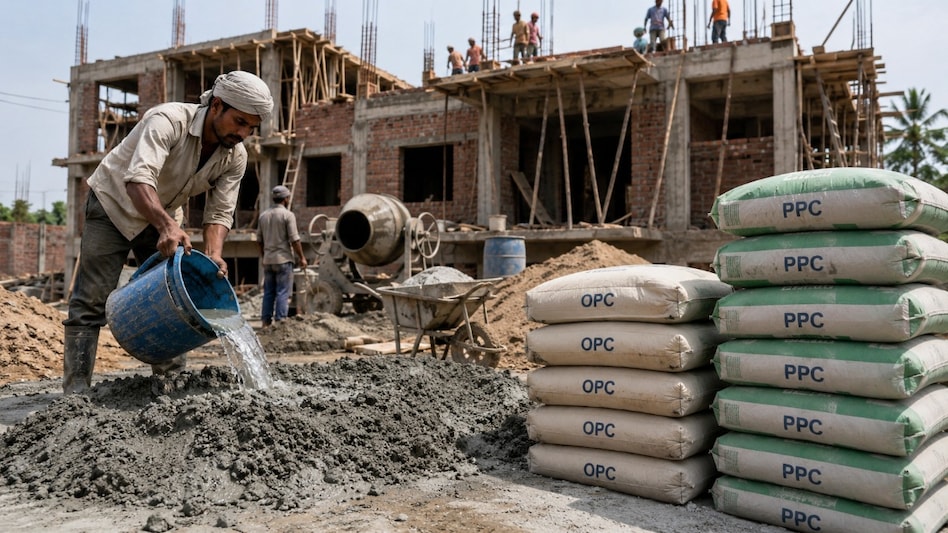
Building a house today has become the realization of a dream, and attention is paid to the smallest details at every stage of work. When choosing building materials, the decision on the type of cement is critically important, as it determines the longevity of the entire building. Two types of cement dominate the market: OPC and PPC, raising the question of which one is best suited for constructing a residential house.
When constructing buildings, people usually focus on bricks, reinforcement, and budget, but cement plays a decisive role in ensuring the strength of the entire structure. To understand the differences between these two types, let's examine their characteristics in simple terms.
OPC stands for Ordinary Portland Cement. It is one of the most common types of cement, manufactured by grinding clinker and gypsum. Sometimes, materials such as limestone, fly ash, or slag are added to its composition in small quantities.
The main advantage of OPC is that it gains strength very quickly in the early stages. Therefore, if rapid structural reliability or the need for prompt formwork removal is required, OPC is a good choice. It is used where extreme concrete strength is not required.
This cement is used in the construction of columns and slabs of multi-story buildings, as well as in projects requiring quick completion of work and the creation of structures capable of rapidly bearing loads, including industrial and large-scale projects.
PPC stands for Portland Pozzolana Cement. It is produced by mixing OPC clinker and gypsum with pozzolanic materials such as ash, volcanic ash, calcined clay, or silica fume.
Although PPC gains strength slightly slower than OPC in the initial period, its strength gradually increases over time. In many cases, its final strength reaches the level of OPC or even exceeds it. Another important property of PPC is low heat release during hydration, which reduces the likelihood of cracks appearing in the concrete and makes the structure more durable.
For the construction of ordinary residential houses, PPC cement is most often used, especially for bricklaying and plastering, as well as in areas exposed to water or moisture. It is indispensable when building dams, canals, and large concrete structures intended for long-term use.
If you are building a regular house and want it to remain strong for many years, minimizing cracking and moisture influence, PPC cement is generally considered the preferred option. This is why its use in residential buildings is rapidly increasing nowadays.
However, if the project requires very fast completion of construction work, prompt formwork removal, or high early-stage strength, then OPC cement will be more suitable. Both cements are high quality, but the choice depends on the specific needs of your construction. If rapid strength is the priority, choose OPC; if the goal is to ensure durability, crack resistance, and protection against moisture, then PPC will be more appropriate. Therefore, before starting construction, you should study not only the price but also the properties and applications of each cement.