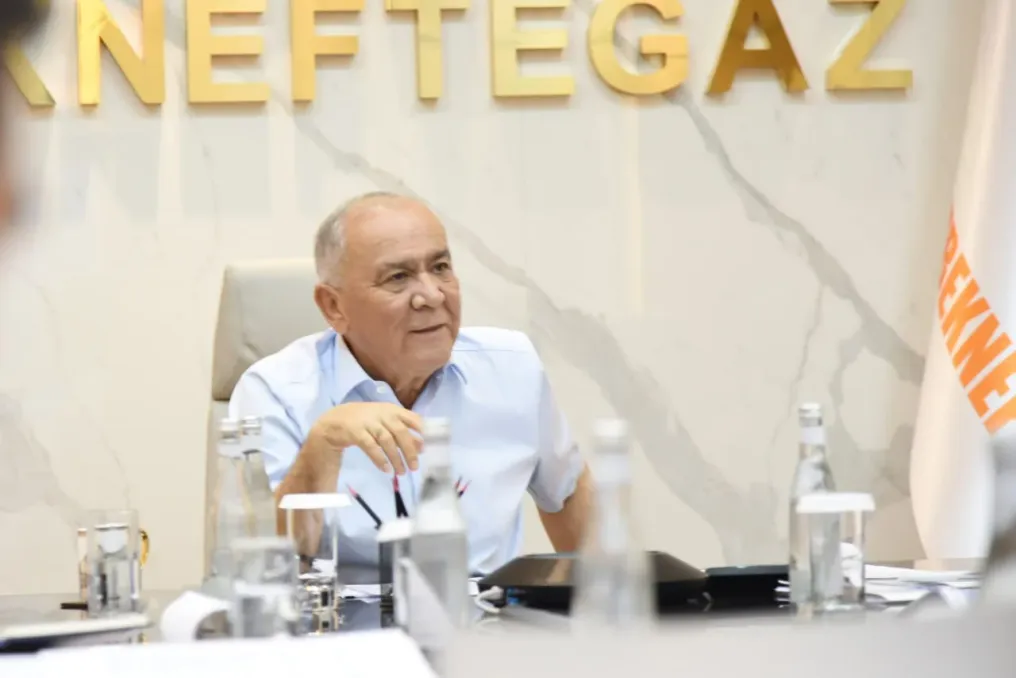
Uzbekneftegaz announced that August and September will be months dedicated to increasing natural gas production. This goal was stated during another working meeting chaired by the company's chairman, Aziz Sanginov.
Uzbekneftegaz announced that August and September will be months dedicated to increasing natural gas production. This goal was stated during another working meeting chaired by the company's chairman, Aziz Sanginov.
Various measures aimed at increasing gas production volume, improving field operations, modernizing production infrastructure, and enhancing employee working conditions were discussed at the meeting.
Company management instructed teams to update field operation systems, improve power supply reliability at production facilities, upgrade transformer equipment, replace insulators, and ensure the effective operation of gas piston generators.
Special attention was paid to fulfilling the gas production plan for August. Planned activities for each ten-day period, as well as for individual fields and wells, were analyzed.
According to company data, the commissioning of 27 new wells is planned for August. Uzbekneftegaz was also instructed to increase the efficiency of its well stock, accelerate planned and current repairs, clearly define areas of responsibility, and cooperate with Chinese research institutes to improve well repair technologies.
After analyzing shortcomings in the implementation of the company's target and investment programs for 2026, management ordered divisions to begin preparing programs for 2027. Priorities include improving project planning, accelerating 3D seismic surveys, developing exploration programs, ensuring timely execution of projects in new blocks, preventing construction delays, and strengthening material and technical support.
To guarantee the adherence to drilling project deadlines, the company was mandated to expedite the supply of imported equipment, prepare necessary road and engineering infrastructure in advance, and utilize additional machinery.
The meeting concluded that the introduction of modern technologies, expanding the use of automated control systems, ensuring the effective operation of modern equipment, and further increasing production efficiency remain key tasks for the company.
Working conditions at production sites in the Ustyurt region were also reviewed and deemed unsatisfactory. Management demanded the capital renovation of workers' housing, the provision of protective clothing to employees, and bringing living conditions in line with modern standards.
The commissioning of a new dormitory in Ustyor is planned for August 25, and dormitories at the Kokdumalak, Pamuk, and Alan fields must be fully renovated by the end of the year.
Furthermore, all company divisions were instructed to ensure thorough preparation for the celebration of Uzbekistan's 35th Independence Day.
Ford announced the launch of Fathom, its new mid-size electric pickup truck, which is projected to be priced below $30,000 in the United States. This model represents the first built using the automaker's Universal Electric Vehicle Platform and will cost $28,350 in the standard range battery configuration.
Although the vehicle has not yet been publicly unveiled, Ford stated that the official reveal and the start of pre-orders are scheduled for early 2027, with deliveries expected in the second half of that year.
Including the mandatory shipping and delivery fee of $1,595, the effective starting price of the Fathom reaches $29,945, falling slightly below the $30,000 target set by Ford since 2025. For comparison, the 2025 model year F-150 Lightning Pro, standard battery version, had an initial price of $49,780, making it approximately $21,000 more expensive.
In terms of design and functionality, Ford plans for the Fathom to offer interior passenger space superior to the Toyota RAV4, accommodating five adults, in addition to having a bed and a cargo compartment located under the hood. Listed features include a high-definition touchscreen integrated with Apple Maps, a digital key, bidirectional power supply capability for external equipment, and support for Apple CarPlay and Android Auto.
All vehicles will be equipped with BlueCruise, the driving assistance system that allows driving without holding the steering wheel on previously mapped highways. The manufacturer has not yet disclosed specific data on battery capacity, range, load capacity, or towing capacity, information that will be made available when pre-orders open.
The choice of the name took nine months of work. Kay Hart, General Manager of Ford Model and the company's electric division, stated that the goal was to select a name that would give 'personality to the vehicle, a soul.' The team researched the brand's history, covering models such as Galaxie, Taurus, and Ranchero, before opting for the final word, which was independently suggested by two writers and approved in focus groups.
The term Fathom has nautical origins, referring to a unit of measurement equivalent to about 1.80 meters, historically used by sailors to measure water depth. As a verb, it came to mean a complete understanding of something.
Production of this pickup will take place at the Louisville factory in Kentucky, using an assembly method where the front, center, and rear sections are built separately before being joined. This initiative is part of Ford's strategy to reverse the losses of the Model division, amid a slowdown in electric vehicle sales in the United States and due to the expiration of the $7,500 federal tax credit for consumers.
The US Senate approved the bill by a majority, which provides for penalties for major buyers of Russian oil and petroleum products, such as China and India. The argument in favor of this decision was that such trade contributes to the continuation of the war in Ukraine.
This bill has been given a new name—the 'Lindes O. Graham Act on Sanctions Against Russia and Iran 2026'—and was approved by the Senate with a vote of 86 in favor and 11 against. It allows President Donald Trump to impose 100 percent tariffs on goods from countries that are the five largest importers of Russian oil and gas.
Currently, the main buyers of Russian oil and gas are recognized as China, India, Azerbaijan, Hungary, and Slovakia. In addition to imposing sanctions against Russia, this law will extend the 'Iran Sanctions Act of 1996' until 2031. This act imposes fines on companies investing in Iran's energy sector.
The bill, supported by both parties, was promoted by Republican Senator Lindsey Graham (who passed away on July 11) and Democrat Richard Blumenthal. After Graham's sudden death following a trip to Kyiv, leaders of both parties took steps to pass the law with renewed enthusiasm to honor the late senator's legacy as an ally of Ukraine.
The late senator's sister, Darling Graham, who was appointed to his seat after his death, stated: 'This law forces key countries supporting the Russian economy to make a simple but important choice. A choice between doing business with America or buying cheap Russian energy.'
The bill also aims to introduce restrictions on Russian leaders and officials, including Russian President Vladimir Putin, wealthy industrialists (oligarchs), and financial institutions. After the vote, Senator Blumenthal told journalists that 'these harsh sanctions and tariffs will stop everyone involved in this deadly, criminal, and aggressive war.'
Some Democrats warn that this law grants Trump new tariff powers, even though they themselves include such duties in their trade policy. The bill will now be sent to the House of Representatives for approval when it reconvenes on August 31.