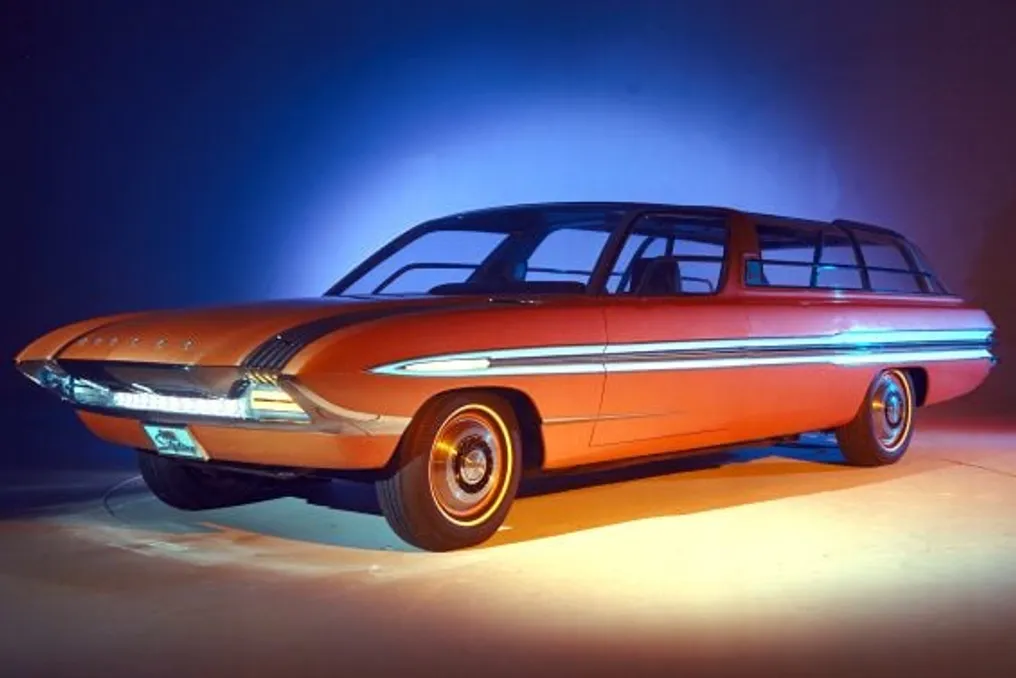
Ford employed artificial intelligence to create a commercial that was never produced. The automaker's historical archive team developed an advertisement in the style of the 1960s for the Aurora, a concept presented in 1964, and released it during AI Day, an unofficial commemorative date celebrated on July 16 in the United States.
This video simulates what the American advertising campaign of that era would look like if it had access to current technologies. According to Ford, this material was created using archival photographs, design documents, and the original promotional texts of the prototype.
A living room on wheels
The Aurora was first shown at the New York World's Fair in 1964, the same event where the Mustang was launched, but it was never intended for mass production. It was considered a 'dream car,' according to Ford itself, and was conceived at a time when the brand ranked third in minivan sales in the United States, behind General Motors and Chrysler. At the time, Gene Bordinat, then vice president of styling, described it as 'a mobile laboratory of new ideas in style and engineering.' The brochure distributed at the event detailed 23 innovations.
Measuring 5.766 meters long and 3.327 meters between wheelbases, the model was larger than the current Expedition MAX, Ford's largest SUV, which measures 5.631 meters and has a nearly identical wheelbase. The interior was segmented into three distinct areas: the command post, a central lounge equipped with an L-shaped curved sofa, a swivel chair, television, radio, sound recorder, and a cabinet containing a refrigerator and display case, and the children's compartment located at the rear.
This last space, situated where the trunk would be today, had seats facing backward and was accessible via a split lid, the lower section of which functioned as a covered step. An electrically operated glass divider isolated noise, and the area's AM/FM radio served as an intercom with the parents. Furthermore, the children's compartment had its own thermostat and a place to store toys.
What became reality
Some of the solutions proposed for the Aurora were implemented in production many years later. The dashboard featured a map showing the vehicle's real-time location, anticipating the functionality of onboard navigation in series Ford vehicles by approximately 30 years. Other features included zonal climate control, entertainment for rear passengers, and a polarized sunroof that could switch between transparent and opaque with the touch of a button. Instead of a steering wheel, there was an assisted bar that required only half a turn to go from one end to the other—a feature that only reappeared in recent Tesla models. Cruise control and variable ratio steering were also incorporated.
Other concepts remained only in the prototype. The front featured 12 sealed headlights of 2.5 cm in diameter, in contrast to the conventional two or four headlights, and blue electroluminescent strips ran along the sides, acting as position lights. The car was even considered for the production of the film '2001: A Space Odyssey,' a project that was ultimately abandoned. Later, in 1969, Ford manufactured an Aurora II, a more restrained version based on the LTD Country Squire minivan.