The architectural studio Snøhetta has presented the Theodore Roosevelt Presidential Library in Medora, North Dakota. This cultural site is conceived as both a place for preserving history and a living biological repository.
The architectural studio Snøhetta has presented the Theodore Roosevelt Presidential Library in Medora, North Dakota. This cultural site is conceived as both a place for preserving history and a living biological repository.
The project aims to immortalize the memory of the American president whose time in the Badlands region shaped his lifelong commitment to nature conservation. The library invites visitors not only to explore the landscape that inspired Roosevelt but also to actively participate in its restoration.
The library's ecological mission began even before construction started, in 2022. Snøhetta, in collaboration with ecologists, landscape architects, and local community volunteers, launched a large-scale prairie preservation initiative. As part of this work, seeds from over 200 species of native plants from the Badlands region in North Dakota were collected. Many of these species have become rare or are no longer commercially available.
These seeds are currently being cultivated before being planted on the library grounds, which contributes to the restoration of a resilient prairie ecosystem adapted to local conditions. Surplus seeds will also be distributed throughout the region, extending the project's influence beyond the building and supporting broader biodiversity conservation efforts. As Snøhetta explains, 'Through continuous maintenance and cultivation, the site's landscape will serve as a laboratory and a biological repository for Badlands flora.'
The concept of visiting the library is structured as an evolving journey that immerses guests in the sense of place. Visitors traverse the landscape before entering the galleries, and the accessible roof and elevated walkways encourage further exploration of the natural surroundings outside the library walls.
As part of the engineering solution, the 96,000 square foot library is integrated into the landscape. Two volumes of massive timber are situated under a single green roof, which the studio co-founder Craig Dykers compares to 'a leaf resting on two stones.' The library is constructed primarily from massive timber and locally sourced rammed earth brick, and it is designed according to the strict Living Building Challenge standard, one of the highest global standards for regenerative architecture.
It appears that Taylor Swift has set a boundary regarding the use of her music by Donald Trump, as songs featured in several videos by the Trump team on TikTok were removed from those posts.
The latest incident began when the Trump team published a video showing the President and First Lady Melania Trump watching a fireworks display on US Independence Day. This clip was accompanied by Swift's song 'August' from her 2020 album 'Folklore.'
The Team Trump account apparently directly referenced Swift in the caption, stating that she would be 'thrilled' by the use of her composition, and tagged her account. This post quickly drew the attention of Swift fans, many of whom called on the singer to demand the removal of her music from the political video.
By Friday, the music had been removed from the TikTok post; instead of the Swift song, viewers saw a notification that the audio was no longer available. Swift herself did not publicly comment on this incident, nor did her representatives make public statements about how the removal was requested. However, the timing of the incident led fans and entertainment publications to speculate that the song was taken down due to copyright compliance.
The situation was not limited to the song 'August.' Later reports emerged that two other Swift songs, 'Father Figure' and 'Opalite,' were also removed from videos associated with the Trump team. The song 'Father Figure' is from Swift's 2025 album 'The Life of a Showgirl,' and 'Opalite' also belongs to that album.
These removals attracted significant attention, given that Swift and Trump have a long history of political disagreements. Swift publicly criticized Trump during his first presidency and became increasingly active in political matters in subsequent years. During the 2024 presidential election, she supported Kamala Harris, posting her endorsement shortly after the debate between Harris and Trump.
In response, Trump criticized Swift on social media, suggesting she would not gain any political or commercial advantage from opposing him. Their relationship grew more complicated when Trump posted AI-generated images in 2024 falsely depicting Swift and her fans as supporters of his presidential campaign. The singer later supported Harris, clearly stating her political stance.
Swift has also taken steps to strengthen control over her intellectual property. In April 2026, she filed trademark applications covering aspects of her voice and image, amid growing concerns about artificial intelligence and the unauthorized use of artists' likenesses. Her official website also clearly states that Swift and her affiliated companies control the rights to intellectual property related to her name, appearance, and other protected materials, and describes procedures for copyright infringement claims.
Thus, the recent dispute on TikTok appears to be less about a public confrontation and more about control over how Swift's music is used. The Trump team seemingly intentionally drew attention to the singer by tagging her in the 'August' post, but the subsequent removal of the song meant the political video remained online without the soundtrack that originally accompanied it.
For Swift's massive fanbase, the removal was quickly perceived as a victory. Online reactions described the move as a direct response to Trump's attempt to link her music to his political message. Nevertheless, there is no evidence that Swift personally issued a cease and desist order or publicly demanded that Trump remove the songs. It is clear, however, that many songs from her catalog have since been muted or removed from Team Trump's TikTok posts, leaving the political videos without the music that originally accompanied them.
Kylie Jenner has attracted public attention with the new, bold campaign by the brand SKIMS. The company released its Everyday Cotton collection, which includes a new line of high-quality cotton bras and underwear. The founder of Kylie Cosmetics, who was 28 at the time of release, posed in several key looks, showcasing her toned body while revealing most of it.
In a press release, Kylie Jenner shared her impressions, saying: 'I enjoyed being part of the Everyday Cotton campaign.' The release also featured revealing photos of Jenner posing in styles that emphasize elasticity and breathability, such as the Cocoa Heather Triangle Bralette and Thong. She noted: 'This collection really excels in terms of cotton, which is such an important material for daily life.'
Jenner emphasized the comfort of the items, stating: 'The underwear and bras are soft, elastic, and very comfortable. They fit perfectly, just as you would expect from SKIMS.'
Kardashian, who was 45 at the time, shared on Instagram that she had 'never worn underwear before,' but the creation of SKIMS' 'softest and most elastic' pieces changed her mind. She added in her statement: 'Your everyday bras and underwear should feel as thoughtfully designed as everything else in your closet.' She continued: 'Everyday wear should be better, not bigger.' According to Jenner, they took favorite SKIMS items and improved them using the softest premium cotton, resulting in basic pieces that one wants to wear every day.
Four months ago, Kardashian caused a stir by releasing the SKIMS Faux Hair Micro String Thong, which, according to the SKIMS website, features a 'blend of curly and straight faux hair in twelve different shades.' The SKIMS founder told E! News on the red carpet in October about this 'furry thong' resembling a pubic area, stating: 'It was just a fun, silly idea. But you know, many other people like John Galliano have done it.'
Indeed, during a high fashion show in 2024, the British designer at Maison Margiela, aged 64, styled his models with micro-hairs—fake hairs intended to cover the pubic area. Trump added that it was 'so funny' and he couldn't believe it garnered so much attention, noting that it made them laugh and talk about it all day.
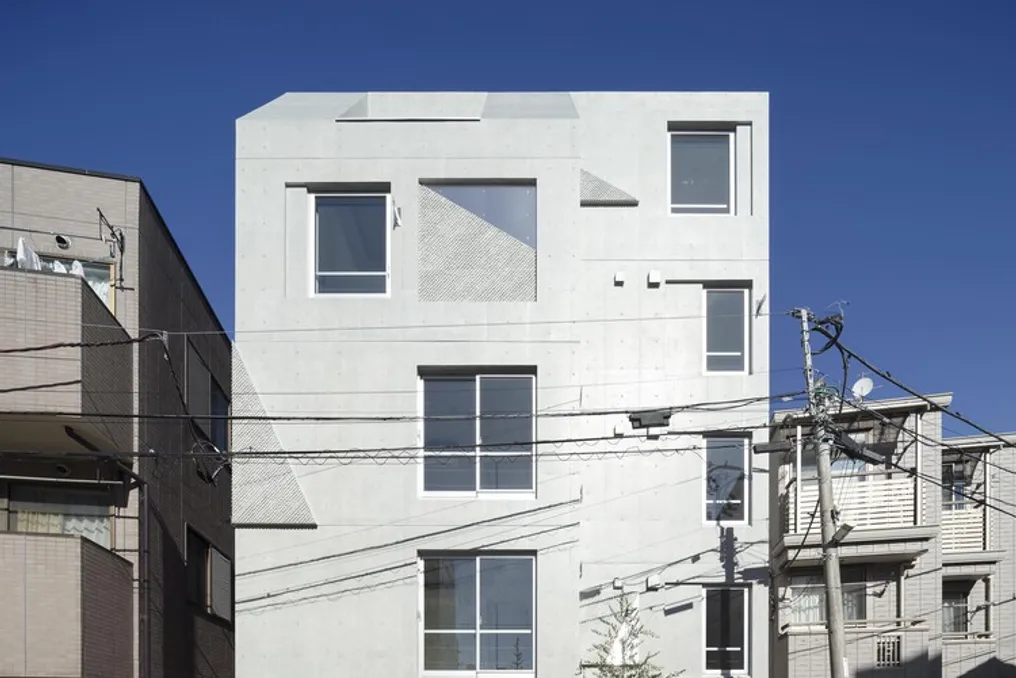
The Shin Nakano Residence, developed by Ryuichi Sasaki and Sasaki Architecture, was built as Grantage Shin Nakano in the Chuo district, located in Nakano, Tokyo. This reinforced concrete residential building has five floors above a basement level and accommodates eleven units, totaling a constructed area of 416.68 square meters. The project concept aimed to give an architectural expression to the geography that has shaped life in western Tokyo over millennia.
The building is situated in the center of the Musashino Plateau, a geographical formation spanning 700 square kilometers in the western part of Tokyo. This plateau, delimited by three rivers and abundant in groundwater, has supported human settlement since ancient times. The developer, Real Partners, requested a compact urban condominium on a limited plot of 152.27 square meters, and the architecture team responded by translating the deep local geography onto the surface, using the light and movement inherent to the building itself.
Ryuichi Sasaki, CEO and Principal Architect, explained that 'The Musashino Plateau is one of those landscapes people live on without ever truly seeing it.' He added that the project's challenge was to transform something as abstract as its position within a plateau into a tangible element that residents encounter daily, whether in the facade, the shadows of the stairs, or the light entering the rooms.
The trapezoidal motif, which gives the development its name, originates from the central location of the plot within the plateau. On the street-facing facade, this pattern is created with custom shapes, stainless steel, and exposed concrete surfaces, engraved as a relief directly into the cast-in-place concrete structure rather than being applied externally. The combination of the matte finish of the stainless steel, the reflections from the window glass, and the texture of the concrete allows the facade's appearance to change depending on the time of day and weather conditions.
Inside the entrance, rhythmic trapezoidal pillars and a pattern of trapezoidal tiles extend this geometry into three dimensions, defining the access and casting soft, dotted shadows reminiscent of a tree canopy. The common staircase follows the same theme with grid steps illuminated by the trapezoidal motif, generating a luminous effect similar to sunlight filtered through leaves. The lighting design, executed by Natsuha Kameoka of Lighting Sou, applies this same geometry at night.
With a site area of only 84.86 square meters, every solar direction is crucial. The building faces a wide street on one side and a plaza on the other, and the design utilizes both spaces to ensure natural light and cross-ventilation. The openings facing the plaza offer the interiors a view that is part of the neighborhood, not just the street, capturing the greenery of the trees and the daily activities of the neighboring nursery school children.
The interiors, characterized by their white and tranquil nature, use trapezoidal wall openings and a decorative glass railing—both visible from the street—to establish a rhythmic cadence that reconnects the interior to the facade. In the duplex units, a gently sloped atrium allows filtered light to pass through openings on the upper floor, creating a peaceful communal space that gradually reveals itself throughout the day. Light reaches these areas from the atrium, a skylight, and openings on both facades, continuously altering the character of each space with the movement of the sun.
To conclude, Ryuichi Sasaki stated that 'A residential building of this scale is experienced in fragments—an entrance, a staircase, a window—so the guiding motif needed to function in each of those moments.' He concluded by expressing pride in providing the residents of Nakano with a building that connects them, subtly and daily, to the ground on which it is situated.