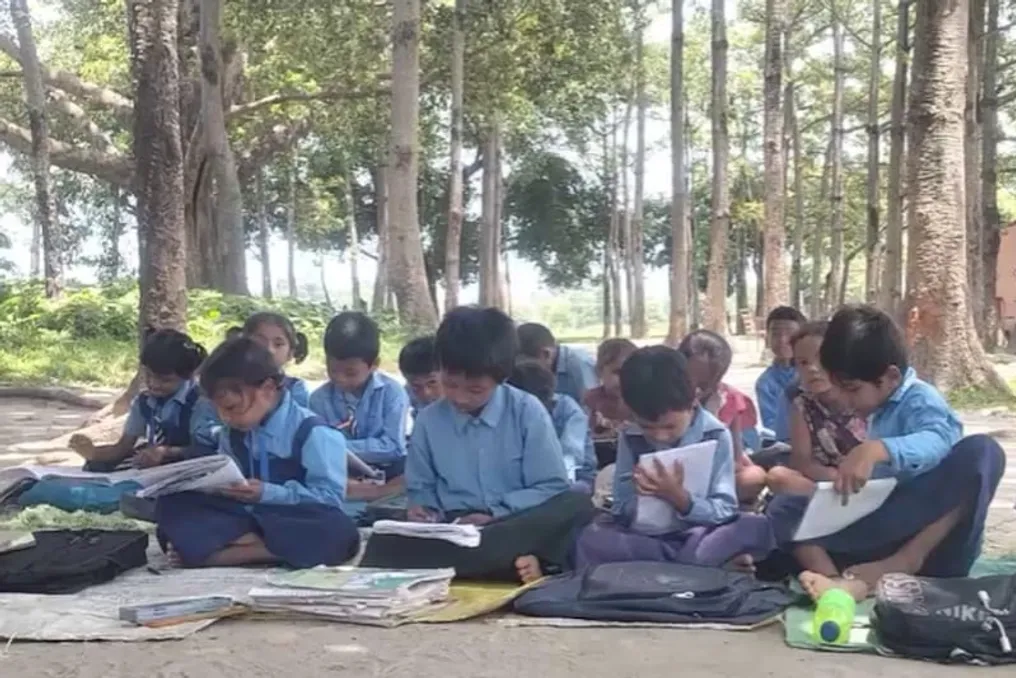
Discussions about transforming the state school system continue in the state of Bihar, with proposals for building new buildings, implementing smart classrooms, and improving conditions. However, the Aaj Tak team discovered a completely different picture in government schools in districts such as Saharsa, Paschim Champaran, Begusarai, Muzaffarpur, and Kamur.
Many educational institutions are still awaiting the construction of buildings. Children are studying in huts, under trees, or under metal sheds, and in some cases, several classes are held in one room.
In Saharsa, primary education takes place either under a hut shed or under a tree. In Baga, Paschim Champaran, the first grade is still held under a tree. In Begusarai, the entire school fits into one room and a corridor.
In Muzaffarpur, over 200 children study in two rooms and an old metal shed, while in Kamur, due to the dilapidated building and lack of space, several lessons have to be conducted simultaneously.
Although these snapshots are from different districts, their story is largely similar. The Aaj Tak team visited government schools in Saharsa, Paschim Champaran, Begusarai, Muzaffarpur, and Kamur. The reality on the ground has raised the question of when children in schools that still lack basic amenities such as buildings, toilets, drinking water, and sufficient rooms will benefit from education improvement programs.
Photographs of two primary schools in the villages of Maina Patti and Jhitkiya, Sonbarsa block, demonstrate that the shortage of buildings remains a serious problem. The primary school in Maina Patti village operates entirely in a hut. All classes from first to fifth grade take place in this hut.
There are 55 students enrolled in this school, and five teachers work there. There are only nine desks for sitting: two for the first to fourth grades and one for the fifth grade. The school lacks a toilet, library, or water supply system. Headmistress Kumari Ranjan reports that teachers bring water from home. During the rainy season, the hut's roof starts leaking, sometimes forcing classes to be suspended. Furthermore, the teachers do not have a separate rest room. Several letters have been sent to the district administration and the education department requesting the construction of a building, but work has not yet begun.
Another situation was revealed: a teacher of Urdu, Mohammad Shahjahan, is assigned to the school, but no student has enrolled in Urdu classes. Consequently, he teaches Hindi, mathematics, ecology, and other subjects so as not to disrupt the children's learning process.
The primary school in Jhitkiya village, Sonbarsa, was opened in 2007. Nearly 20 years later, the school has still not been able to build its own building. First and second-grade children sit under a tree. Classes from third to fifth grade take place in a temporary structure built on the land of a local resident, Kashi Babu. There are 91 children enrolled in the school, and four teachers work there. Teacher Rita Devi notes that applications for building a school have been submitted repeatedly. Officials have visited, but a permanent solution has not been found. The water from the school's pump contains a lot of iron, so it cannot be drunk. The principal's office is also located in a small storage room. Learning suffers the most during the rainy season.
The government primary school at Kunai Laxmipur in Devariya Taruanwa village has been waiting for a building for 14 years. After the old building fell into disrepair, a local resident donated land for the school. Nevertheless, a new building has not been constructed. As a result, residents collected funds and built a four-room metal shed. Currently, classes from second to fifth grade take place in this shed, and the first grade is under a tree. The school has 106 children and six teachers. Since there is no kitchen, children have to walk about a kilometer to get hot meals. In summer, the shed gets very hot, and during the rain, classes are often interrupted.
The new primary school in Mathiani block, Dhobi Tole, functions in one room of a public building and a corridor. 112 children study here. First and second grades take place in the corridor, while third, fourth, and fifth grades are held in one room.
Two teachers teach different classes from the same board. The children do not have desks. The school also lacks a pump and a toilet. Five female teachers are forced to use toilets in neighboring houses.
At Maya Talim school, with no building, more than 228 children from first to eighth grade are enrolled. Only two rooms and one dilapidated metal shed are provided for the entire school. Classes from first to fifth grade take place in one room. Students of sixth, seventh, and eighth grades study under the shed. The school has no tables. Children sit on mats. During the rain, water drips from the shed, and strong winds pose a risk of the board falling. Conducting multiple classes simultaneously also negatively affects learning.
At Akhalaspur primary school, there are only three teachers for 99 children. In the three rooms of the school...