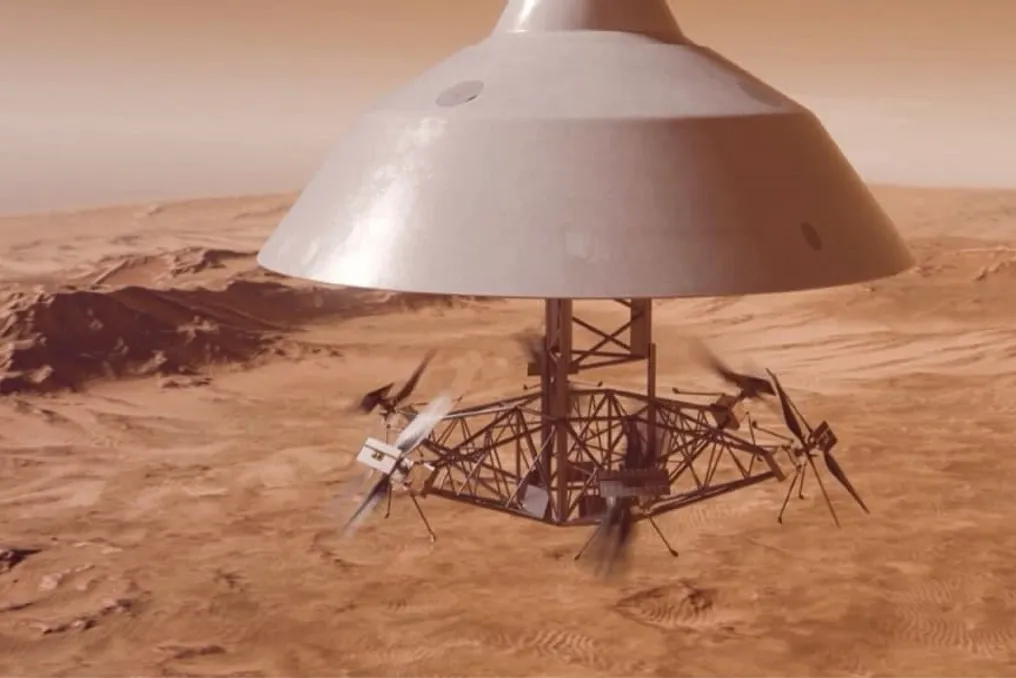
NASA has advanced the development of the SkyFall mission, which aims to send three small helicopters to conduct explorations on Mars. A crucial component of this project, an ultra-light and flexible antenna, was recently subjected to rigorous testing. This antenna was designed to operate in conjunction with a radar, whose function is to detect ice hidden just beneath the Martian surface.
The existence of frozen water is seen as an extremely important resource for future crewed expeditions to the Red Planet. This ice can not only be used for human consumption but can also be converted into breathable oxygen and hydrogen, a raw material for rocket fuel. The discovery of accessible deposits would significantly decrease the amount of supplies that need to be transported from Earth.
Summary of capabilities
Currently, probes in Martian orbit are capable of identifying large reserves of ice located tens of meters deep. However, these instruments have difficulty visualizing the superficial layers of the soil, which are precisely the areas most suitable for extracting this resource during future human missions.
According to NASA, this limitation will be overcome by the SkyFall mission's helicopters. Because they fly at low altitude and reduced speed, they will be able to use ground-penetrating radar to identify the transition between dry soil and buried ice just a few meters below the surface, generating much more detailed maps of these regions.
The radar will operate across a wide range of radio frequencies, spanning between 500 and 2,500 megahertz. This combination allows for data collection from various depths: longer radio waves can penetrate several meters, while shorter ones provide clearer images of the upper soil layers.
Although radar technology was already known, its integration into a helicopter of the SkyFall's size required an innovative solution. A standard antenna would be excessively large to be accommodated under the aircraft without interfering with landing procedures. Considering that the distance between the Martian ground and the underside of the helicopter is only about 15 centimeters, engineers had to create a much smaller and more pliable piece of equipment.
After evaluating several options, the team opted for the model called the Vivaldi antenna. This type of antenna has the ability to transmit and receive signals across a very wide frequency band, which is an essential characteristic for the mission's radar. Additionally, its flat shape simplifies manufacturing using light and flexible materials.
The curved antenna was named after its inventor, Peter Gibson, who compared its sinuous lines to the violin, an instrument associated with the composer Antonio Vivaldi.
Even with the use of this technology, the original antenna was still too large for the helicopter. Since the mission's radar was designed only to investigate up to approximately five meters deep in dry soil—which interferes less with radio waves than terrestrial terrain—researchers managed to further reduce the component's dimensions without compromising its effectiveness.
Nevertheless, the antenna remained about one and a half times longer than the helicopter's legs. This implies that it will need to fold with every landing, especially if the aircraft encounters a rock or an uneven surface. Subsequently, it must automatically return to its original shape to continue data collection during flight.
To support this repetitive effort, engineers coated the antenna with polyester and layers of Vectran, a highly resistant material that has already been used in the airbags that cushioned the landing of the Spirit and Opportunity rovers on Mars. The assembly was also equipped with flexible fiberglass springs and a magnesium structure to ensure stability during flight.
Despite all these reinforcements, the equipment remained quite light. The complete antenna weighs approximately 150 grams, slightly more than two violin bows. Mass reduction is fundamental, as any increase in weight directly affects the performance of aircraft that need to operate in the extremely rarefied atmosphere of Mars.
With the prototype development complete, the team began a series of tests at the Jet Propulsion Laboratory (JPL) in California. The purpose of these tests was to confirm whether the antenna could withstand the extreme conditions of a space mission without losing its ability to transmit and receive radar signals.
Engineers started by simulating the folding of the antenna to replicate its position after a landing on Mars. Next, the equipment was exposed to large temperature variations mimicking the planet's day-night cycle, where the thermal difference can reach about 94°C.
After this phase, the antenna was bent multiple times to represent dozens of landings made by the helicopters throughout the mission. Between each cycle, researchers paused the tests to check if the performance of the radio transmissions remained unchanged.
The tests also included an even more challenging scenario: the antenna was installed inverted during the radio frequency measurements, generating mechanical stress greater than what it would face in Martian gravity, which corresponds to only about one-third of Earth's gravity.
The results obtained were considered very favorable. At the end of the testing campaign, the antenna withstood the equivalent of 200 landings on Mars, exceeding more than double what was necessary to fulfill the main mission, without showing loss of performance or permanent deformation.
According to those responsible for the project, this result resolved the team's main technical doubts. Although new tests are still required before final flight approval, the achieved performance validated that the concept operates as expected.
Next steps
The next phase involves creating a new engineering model. This equipment will undergo vibration tests, opening tests under conditions simulating the Martian environment, and performance evaluations at Mars Yard, an area of JPL dedicated to recreating the terrain of the Red Planet.
Each of the three SkyFall helicopters will carry four scientific instruments. The mission benefits from the experience gained with the Ingenuity helicopter, which completed 72 flights on Mars over almost three years. The success of this aircraft proved the viability of controlled flight in the Martian atmosphere, paving the way for more ambitious aerial missions.
If the schedule is maintained, the SkyFall mission is scheduled to launch at the end of 2028, using the Freedom rocket developed by NASA itself. In addition to increasing knowledge about the Martian subsurface, the mission may pinpoint ideal locations for future human bases, making the exploration of Mars safer and more efficient.