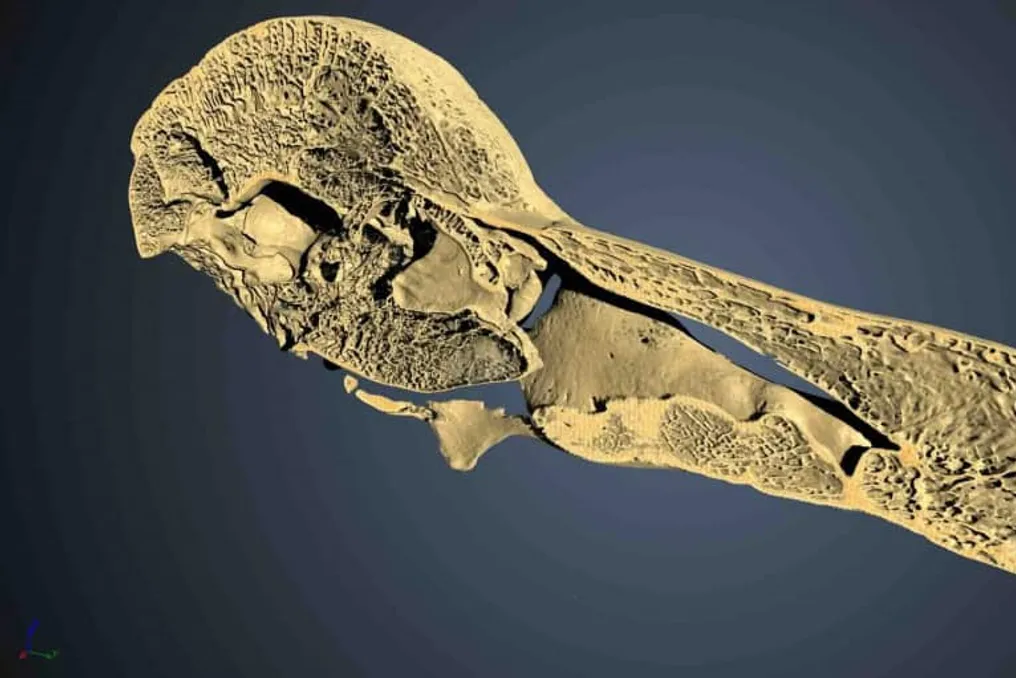
A recent study investigated how the dodo perceived its surroundings before disappearing, using only two complete skulls known globally: one kept at the Natural History Museum Denmark in Copenhagen, Denmark, and another at the Oxford University Museum of Natural History.
Researchers from the University of Lethbridge, Canada, led this international investigation, whose results were published in the Zoological Journal of the Linnean Society. The analysis focused on the digital reconstruction of the bird's brain space within the skull, comparing it to live pigeons and doves.
The scientists concluded that the dodo's sensory universe showed significant differences compared to living birds. The bird might have possessed a more flexible daily activity pattern, extending into sunrise and sunset. Furthermore, they suggest that the dodo had a more developed sense of smell than its current relatives and a greater aptitude for processing tactile information, aided by its large upper beak.
Peter Andrew Hosner, an associate professor and avian curator at the Natural History Museum Denmark and co-author of the study, commented that although the dodo is a well-known extinct animal, little was known about its actual life. He highlighted that access to one of the two complete skulls allowed for an unprecedented comparison with living relatives, generating new insights into how the bird interacted with its environment.
The anatomical comparison indicated a unique combination of sensory traits. The findings suggest that the dodo was not necessarily active only during the day, but could also operate at dawn and dusk. The possibility was also raised that the bird relied more on smell and used its upper beak to capture tactile data from the environment.
The researchers emphasize, however, that anatomy alone does not provide an exact determination of the bird's behavior; the results serve as indications of how the dodo might have obtained food and interacted with its island habitat in Mauritius before its extinction in the late 17th century, without offering a definitive portrait.
Hipsley added that the dodo's skull is distinct from any living bird, making it complex to interpret. Comparing the digital reconstructions of the two available skulls provided a more robust basis for identifying typical species characteristics and inferring its way of life.
Contrary to the common representation that the dodo was clumsy and unintelligent, the new study found no evidence that the bird possessed cognitive abilities inferior to those of live pigeons and doves. Instead, the findings point to a species with unique sensory adaptations, developed over millions of years on an isolated island.
Hosner concluded that the research establishes a new benchmark for understanding the bird's ecology and behavior, helping to overcome myths and build a more accurate picture of how this extraordinary creature lived before disappearing.
The Copenhagen skull is on permanent display at the Natural History Museum Denmark. The tomography was conducted during preparations for the inauguration of a new museum building, with permanent galleries planned for 2027, at which time researchers could examine the specimen with such detail.