
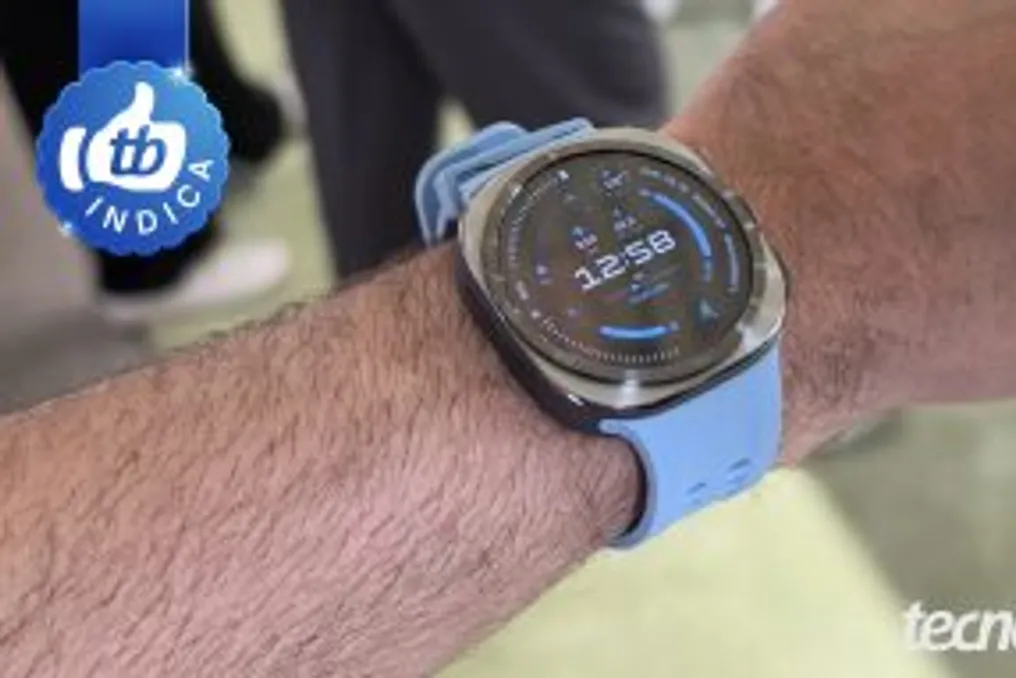
Choosing the best Samsung smartwatch fundamentally depends on the available budget and the user's specific needs. The standard Galaxy Watch line models offer well-balanced specifications in terms of connectivity and battery life, featuring advanced sensors.
For those who prioritize greater physical durability and battery autonomy, the Galaxy Watch Ultra line is the indicated option. Furthermore, the brand offers the Galaxy Fit, which stands out for its good cost-benefit ratio, although it presents more basic functionalities for physical activity monitoring.
Tecnoblog compiled a list with the seven best Samsung watches available in the Brazilian market, detailing the pros and cons of each device.
Galaxy Watch Ultra 2
The Galaxy Watch Ultra 2 was presented as Samsung's most sophisticated model in 2026. This watch incorporates the Qualcomm Snapdragon Wear Elite chip, replacing the old Exynos W1000, which promises to elevate both performance and sensor accuracy. Compared to the 2024 Ultra, the battery capacity increased from 590 mAh to 800 mAh, providing up to 80 hours of use, as announced by Samsung. Visibility under sunlight was improved with the maximum brightness increasing from 3,000 nits to 5,000 nits. Additionally, the Watch Ultra 2 received IP69K certification, ensuring resistance to high-pressure water jets, a feature absent in the original model.
Galaxy Watch 9
The Galaxy Watch 9 also migrated to the Snapdragon Wear Elite processor, abandoning the Exynos W1000 present in the Watch 8. In the 40 mm version, the battery grew from 325 mAh to 390 mAh, representing a 20% increase. In the 44 mm version, the advancement was more modest, going from 435 mAh to 445 mAh. The screen maintained the maximum brightness of 3,000 nits observed in the Watch 8, and storage remained at 32 GB.
In terms of health, the Watch 9 introduces two novel features compared to the Watch 8: Vital Signs, which integrates data on heart rate, oxygenation, skin temperature, and respiratory rate, and Heart Health Score. Overall, the most notable progress lies in the processor and battery of the 40 mm version, while the rest of the specifications remain very close to those of the Watch 8.
Galaxy Watch 8
The Galaxy Watch 8 shares characteristics with the Watch 9, including a personalized running coach, IP68 certification, military resistance, and support for over 100 types of activities. This watch is capable of measuring blood pressure, performing ECG, and checking antioxidant levels, using Galaxy AI for sleep analysis. The LTE connectivity variant allows for emergency calls independently of the phone in case of accidents or falls. The device also features integrated GPS, its own operating system for app downloads, and NFC technology.
A drawback of the device is the battery life, which is below that of the Watch Ultra, reaching approximately 30 hours when the Always-On Display feature is active.
Galaxy Watch Ultra
The Galaxy Watch Ultra, launched in 2024, is an advanced smartwatch equipped with dual-frequency integrated GPS (L1 + L5), allowing route tracking without needing the phone nearby. It also offers LTE connectivity for mobile data and artificial intelligence features. The device covers over 100 sports modes and includes health and safety features aimed at extreme activities. Its construction uses a titanium body, sapphire crystal screen protection, and up to 3,000 nits brightness for good visibility in direct sunlight. Although it is heavier and more robust than traditional models, which might bother some users, its battery lasts up to 100 hours, according to Samsung.
Galaxy Watch 8 Classic
The Galaxy Watch 8 Classic features the classic rotating bezel to facilitate navigation, operates with the 3 nm Exynos W1000 processor, and has 64 GB of storage. It performs measurements of heart rate, SpO2, ECG, and body temperature, and has IP68 certification for water and dust resistance. The LTE version allows for calls and mobile data usage, in addition to having NFC for payments. The device also integrates GPS and features a sapphire crystal screen with up to 3,000 nits brightness.
A disadvantage of this model is that it uses the same processor as the previous generation (Watch 7), unlike the Watch 9 and Watch Ultra 2, which already incorporate the latest Qualcomm chip. Furthermore, it is available in only one case size and is heavier than the conventional model.
Galaxy Watch 7
The Galaxy Watch 7 is available in two sizes, 40 mm and 44 mm, and uses the same processor as the Watch 8 (3 nm Exynos W1000), with 2 GB of RAM and 32 GB of storage for apps and music. It has 5 ATM, IP68 certification, and MIL-STD-810H military standard resistance, along with various health and sleep sensors. The watch features integrated GPS, a sapphire crystal protected screen, and over 100 training modes. Despite these features, it has a maximum screen brightness of only 2,000 nits and a 300 mAh battery, placing it below the newer models.
Galaxy Fit 3
The Galaxy Fit 3 is positioned as an entry-level Samsung smartwatch/band, intended for consumers looking for a more affordable device. It offers sleep monitoring, heart rate, blood oxygen, and over 100 sports modes. Its structure ensures IP68 protection against dust and water, plus 5 ATM resistance for pool use, with a battery that lasts up to 13 days. However, this model does not have integrated GPS, relying on connection to the phone to record walks, nor does it have NFC or mobile data, being exclusive to Android systems.
When deciding which is most suitable, it is crucial to evaluate the usage profile, the desired investment, and the indispensable daily resources. When selecting the best Samsung smartwatch, it should be noted that the Galaxy Watch line offers proprietary operating systems, app support, integrated GPS, NFC, and advanced sensors, but with lower battery autonomy. On the other hand, the Galaxy Fit line consists of simpler devices focused on basic health and exercise tracking, without GPS or an app store, but with a battery that can last up to 13 days for a lower cost.
The Galaxy Fit 3 is considered Samsung's most economical smartwatch because it provides the essentials in health and sports monitoring, has an AMOLED screen, and a battery lasting up to 13 days at a more advantageous price than other models.
It is important to note that the Watch FE often has a price very close to the Galaxy Watch 7, which offers a more updated processor, renewed sensors, and a better overall cost-benefit.
The Galaxy Watch Ultra and Ultra 2 models are the most water-resistant, boasting 10 ATM resistance certification (up to 100 meters), making them the only ones recommended for high-speed and diving water sports.
All models in the Galaxy Watch line (including Watch FE, Watch 7, Watch 8, Watch 9, Classic, and Ultra) are compatible with NFC for payments via Google Wallet or Samsung Pay. The Galaxy Fit 3 line does not have this functionality.
The Galaxy Watch Ultra models support longer periods of continuous use. Thanks to the large battery capacity (ranging from 590 mAh to 800 mAh) and power-saving modes, they offer the greatest autonomy among the brand's full-featured smartwatches.
Samsung watches use the Wear OS system, compatible with Android smartphones from other manufacturers, but they do not work with iPhones (iOS). The Galaxy Fit 3 band operates with its own system, compatible only with Android.
The LTE version supports e-SIM, allowing calls, message replies, and GPS navigation without depending on the proximity of the phone. The Bluetooth version has integrated GPS to track routes without the smartphone, but requires a connection to the phone to load online maps, receive notifications, or make calls.