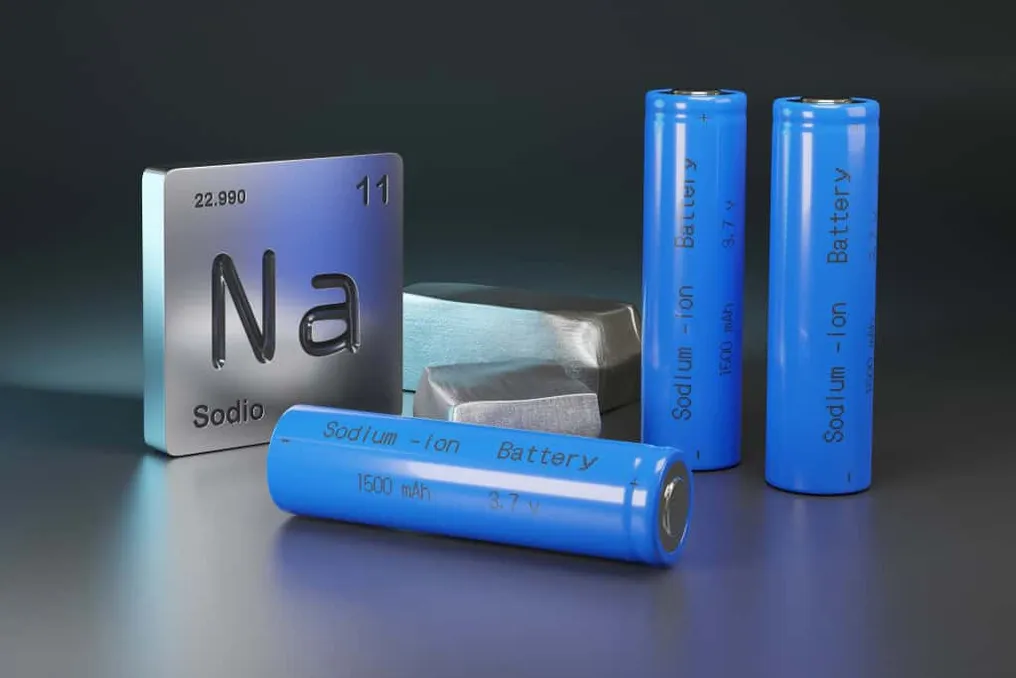
American energy technology companies have begun initial-scale production of sodium-ion batteries. This technology emerges as an alternative to current lithium batteries, with the potential to decrease global dependence on strategic minerals controlled by China.
The development of this technology, carried out by both startups and large corporations, is gaining relevance in stationary systems, such as power grids and data centers, where criteria like cost, safety, and longevity are crucial.
This advancement is occurring in the United States in 2026, driven by companies like Peak Energy and Inlyte Energy, which are accelerating industrial projects to compete in a market currently dominated by lithium-based solutions.
Sodium batteries operate on the same principle as conventional batteries, storing and releasing electricity as needed. The distinction lies in the materials used in their manufacturing: instead of depending on hard-to-obtain elements, they use sodium, which is abundant in common salt.
The involved companies expect this characteristic to help lower costs and facilitate energy storage expansion. This resource is seen as strategic because it allows for the accumulation of electricity during periods of high supply for later use during demand peaks.
This model can be beneficial for power grids, renewable energy infrastructure, and structures requiring constant supply, such as data processing centers. Furthermore, the technology presents itself as a substitute for fossil fuel-powered equipment in certain applications.
Despite its potential, sodium batteries still occupy a very small share of the global market, given that most current production is concentrated in China, while American companies work to increase their industrial capacity.
Among the companies seeking to progress in this sector, Peak Energy stands out, founded by professionals with prior experience at Tesla. This company plans to build a large-scale factory in California to expand the production of batteries intended for large-scale storage.
The project includes a unit in Sacramento with the capacity to generate four gigawatt-hours of batteries annually starting in 2027. This planned capacity exceeds the production of the company's pilot factory in Burlingame by dozens of times.
Peak Energy has already signed agreements with energy storage sector clients, such as Jupiter Power, Energy Vault, and RWE Americas, valued at over US$1.1 billion.
This competition places Peak Energy in rivalry with Tesla, which holds hegemony in the American large-scale storage segment through its lithium-based Megapack systems.
A positive point about sodium batteries relates to fire risk. Lithium batteries can suffer from thermal runaway, where overheating of a cell can trigger chain reactions within the battery pack.
In conventional systems used in power grids, cooling equipment must be employed to manage temperature and mitigate risks. According to Peak Energy, this structure constitutes a significant portion of the operational costs of these facilities.
The sodium batteries developed by the company can operate with passive cooling, using the air surrounding the modules. Although not entirely immune to fires, the company points out that they demonstrate a lower probability of such occurrences.
Another American company, Inlyte Energy, adopts a different methodology. Its equipment uses materials such as iron, steel, aluminum oxide, and food-grade salt to create cells that, according to the company itself, do not combust.
The company claims that this behavior allows for more compact installation of the cells, increasing space efficiency in stationary systems.
The race for sodium batteries also constitutes an industrial dispute between the United States and China. The Asian country currently dominates a large part of the production chain for materials used in lithium batteries and has already announced plans to expand its sodium battery manufacturing.
Experts and industry executives warn that technological innovation alone does not guarantee industrial leadership. The challenge facing Americans is converting research and prototypes into competitive global-scale production.
Mukesh Chatter, CEO of Alsym Energy, a company that manufactures components for sodium batteries, emphasizes that the United States must avoid repeating scenarios where a national technology is produced in greater volume by foreign competitors.
Despite advantages in terms of cost, safety, and raw material availability, sodium batteries have a notable limitation: they store less energy per weight compared to lithium batteries. This disparity keeps lithium as the primary choice for applications where weight is a determining factor, such as in electric vehicles. However, in fixed installations, where mass and space have less influence, sodium may gain a larger share.
An industry projection suggests that within ten years, sodium batteries could account for more than one-third of global battery production, depending on the companies' ability to overcome manufacturing obstacles and achieve competitive prices.