The renowned military yearbook Jane's Fighting Ships, published by Jane's Information Group, serves as a detailed catalog of global navies and coast guards, covering warships, submarines, aircraft, and weapon systems.
In the 1989 edition, Jane's indicated that a country with 17 submarines possessed the seventh largest fleet of this type worldwide. This quantity was shared between India and Pepsi, a soft drink company based in the United States.
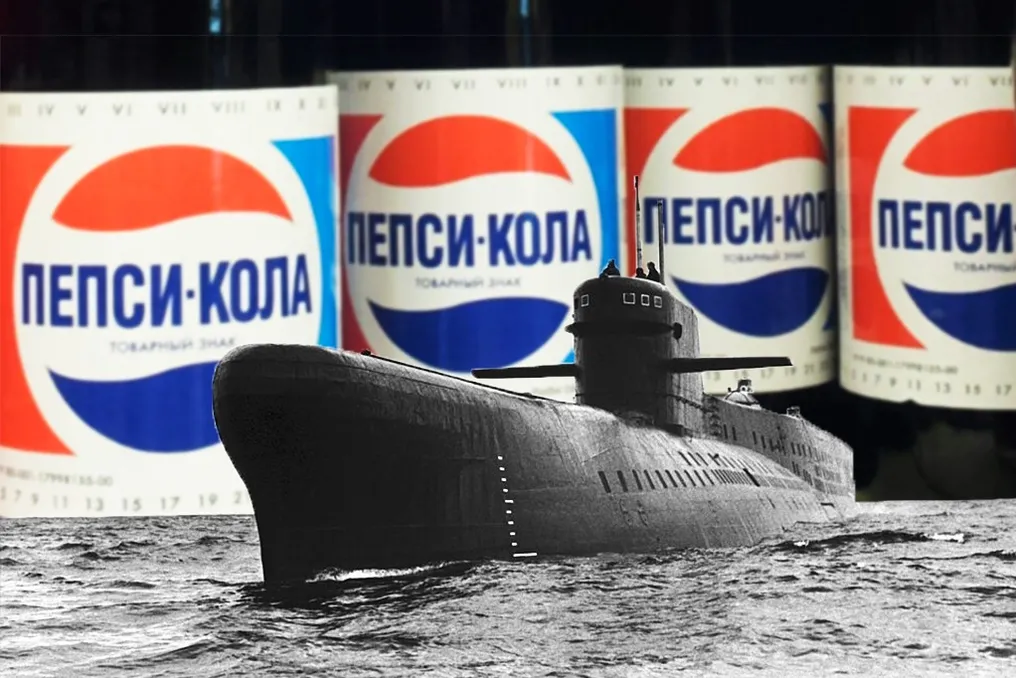
That year, PepsiCo Inc., the manufacturer of Pepsi, actually purchased 17 submarines, along with a cruiser, a frigate, and a destroyer belonging to the Soviet Union. Recently, the internet disclosed this information, suggesting that Pepsi owned the 'sixth largest naval fleet in the world,' which was not entirely accurate. Firstly, the record was for seventh place, and it applied only to submarines, not the entire naval fleet.
Furthermore, Pepsi had no intention of establishing itself as a maritime power; its interest in the ships was solely for scrapping. The fleet was considered useless for any other purpose, given that the boats and submarines were obsolete, rusty, and old, no longer suitable for military use. As soon as the acquisition was completed, Pepsi immediately sent the vessels to a shipyard located in Norway or Sweden (no confirmation) to be dismantled.
Long-standing relations
Although the purchase of military vessels by a beverage company may sound unusual, the company had maintained ties with the Soviet Union since the 1970s. The first collaboration occurred in 1972, involving an exchange of Pepsi products for Russian vodka and the granting of exclusive distribution rights within the Soviet bloc.
For Pepsi, this partnership represented a favorable opportunity, as it gave it access to a vast market where Coca-Cola had not yet operated, allowing its brand to expand internationally. For the Soviets, it was a significant trade agreement during the post-war reconstruction period. From a geopolitical perspective in the United States, the entry of Western products into the USSR was seen as a way to promote local culture and facilitate the transition to a capitalist system.
In 1985, after Mikhail Gorbachev took command of the Soviet Union, Pepsi had already established 16 bottling plants in the territory. Other corporations, such as McDonald's, Pizza Hut, and Baskin-Robbins, also took advantage of this moment, seeking to profit from the Soviet economic renewal.
When the ships were sold to Pepsi in 1989, the company was just one of the buyers, as the USSR was disposing of its old fleet, often for very low prices due to the financial needs of its Navy. In this scenario, exchanging vessels for soft drinks seemed quite logical, given that the ships and submarines were barely worth their weight in scrap. In the same year, the Berlin Wall fell. In 1991, the USSR was dissolved and Gorbachev was forced to resign. Pepsi maintained its investments in the region, registering $3 billion in revenue in Russia in 2020, making it its third-largest market after the US and Mexico. The seventh largest submarine fleet of 1989 eventually became scrap, as Pepsi's sole objective in the bloc was to market its soft drinks.