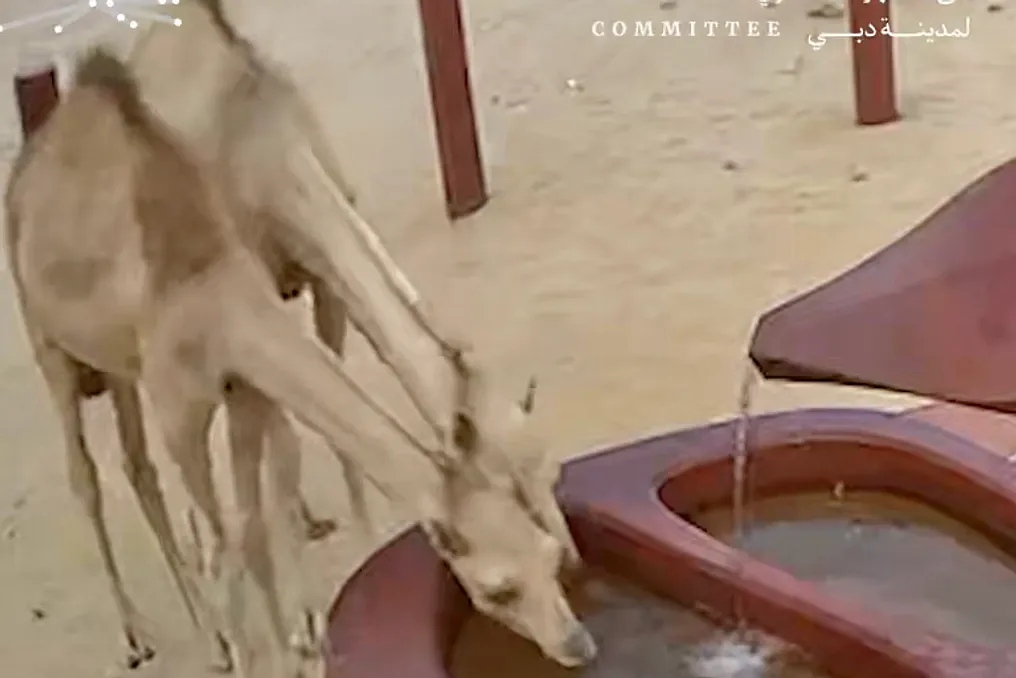
Video footage shows camels gathering around one of the 'Fountains of Mercy' in Dubai, drinking water in the intense summer heat. These fountains were specifically designed so that animals of various sizes can easily access the water.
Video footage shows camels gathering around one of the 'Fountains of Mercy' in Dubai, drinking water in the intense summer heat. These fountains were specifically designed so that animals of various sizes can easily access the water.
The captured scenes show several camels drinking side by side, utilizing the fountain for both smaller and larger animals.
The Dubai Municipality launched the 'Fountains of Mercy' initiative in January 2026, installing 50 special watering stations for birds and wild animals across the emirate. This program reflects Dubai's commitment to biodiversity protection, environmental sustainability, and humane urban development, while promoting values of compassion and coexistence.
Of the total 50 fountains, twenty-five will be placed in urban areas to provide water for birds, and the remaining twenty-five will be located in desert and natural zones to support wildlife in its natural habitat.
The fountain design adheres to best ecological practices, as they are made from durable, high-quality materials, ensuring ease of maintenance and long service life. Furthermore, the fountains will operate on solar energy, which helps reduce their environmental impact while providing efficient and sustainable water supply.
These fountains will function year-round, including Dubai's hot summer months and the cooler winter season, guaranteeing continuous access to drinking water for wild animals. The project is supported by a Dubai philanthropist through a sustainable charitable fund, highlighting the values of generosity and social responsibility in supporting nature conservation and wildlife.
The initiative is part of the Dubai Municipality's broader efforts to create a more balanced and sustainable urban environment and supports the goals of the Dubai Committee for Citizenship. By providing accessible water sources for birds and wild animals, the 'Fountains of Mercy' project aims to foster greater coexistence between people, animals, and the city's natural environment.
Thanks to the announcement of Friday, August 28th, as a public and private holiday in observance of the Prophet Muhammad's Birthday (peace be upon him and blessings of God), residents of the UAE will have a three-day break until August 30th without using annual leave.
Residents can spend these three days by taking a short international trip, crossing the border into Oman, or simply organizing a staycation within the UAE.
Travel websites such as Musafir.com, Holiday Factory, and Travelwings offer short international tours to countries like Georgia, Azerbaijan, Armenia, Kazakhstan, Kyrgyzstan, Uzbekistan, Turkey, and Thailand.
According to Khaleej Times, three-night packages cost from approximately 1,200 to 3,000 dirhams per person, depending on the chosen destination, hotel, and included services. Georgia, Baku, and Armenia are options for those planning to fly in and out before work resumes.
Those willing to take additional leave have more options. For example, a package to Montenegro is available from August 26th to 31st, which would require extending the three-day weekend.
Georgia is gaining popularity among travelers from Gulf countries. According to the National Tourism Administration of Georgia, the country welcomed 145,513 visitors from GCC markets in 2025, a 3.4% increase from the previous year. Due to the approximately four-hour flight time from major Gulf cities, simpler entry options, and a combination of urban, mountain, and natural experiences, Georgia has become a popular destination for a short getaway. Furthermore, Tbilisi was recently added to the list of global trend destinations for 2026.
Salalah in southern Oman presents another option for UAE families who prefer long road trips. Using an approximate distance of about 1,200 km one way from Dubai, the entire route would be between 2,400 and 2,500 km. A family car with an average consumption of 10–12 km per liter would require approximately 200–250 liters of gasoline for the return journey. Depending on the car and refueling stops, families can budget between 600 and 850 dirhams for fuel.
Hotels can cost approximately 200 to 550 dirhams per night, based on analyzed options. Adding two nights of accommodation, food, border crossing expenses, insurance, and entertainment could lead a family of four to spend between 3,000 and 4,500 dirhams on the trip. Families can spend time visiting the Harif attractions in Salalah, including Wadi Darbat and Mughsail, and visit the new Salalah Eye, scheduled to open in the second week of August. Those who do not wish to spend hours driving can find flight and hotel packages to Salalah, some of which start from approximately 1,499 dirhams.
Musandam in Oman, often called the 'Norway of Arabia,' is a much simpler choice for residents wishing to cross the border without undertaking a long trip to Salalah. Online packages to Hasab start from approximately 250 dirhams, and residents can also plan their own trip by personal car.
The three-day break allows residents to leave on Thursday evening, spend one or two nights there, and return on Sunday. Dhow cruises, mountain landscapes, and time by the water make this option suitable for a short road escape.
Residents who do not want to fly or cross the border can turn the weekend into a staycation. The platform Cobone currently offers hotel and resort deals starting from under 200 dirhams. Reviews of travel offers conducted by Khaleej Times show that the average cost of staycation packages is 300 dirhams in Ras Al Khaimah, 375 dirhams in Dubai, 450 dirhams in Abu Dhabi, 495 dirhams in Al Ain, 500 dirhams in Ajman, 590 dirhams in Umm Al Quwain, and 600 dirhams in Fujairah.
The final price will depend on the chosen hotel, room type, meals, and dates. For those looking for something more unusual, Sir Bani Yas Island can also offer island relaxation without leaving the UAE. Regardless of whether residents choose a short flight, a long trip, or a nearby hotel, the break from August 28th to 30th gives them a last chance to relax before returning to the usual routine.
According to astrological knowledge, the planet Venus, which is the source of wealth, luxury, and material comfort, will make a significant movement on August 11, 2026. On this day, Venus will change its position and enter the Hasta nakshatra, which is governed by the Moon. This planetary shift has a profound impact on the lives of all twelve zodiac signs.
However, the rising trends of this transit require special financial caution from representatives of the Aries, Taurus, Leo, and Scorpio signs. It is necessary to understand why these four signs should be vigilant regarding finances and how exactly to do so.
For the sign Aries, there may be a sudden increase in expenses, which could lead to a breach of the monthly budget due to excessive spending on luxuries or ostentation. During this period, it is recommended to refrain from thoughtless investments.
Although Venus rules the sign Taurus, its transit into the Hasta nakshatra may cause certain obstacles in financial matters. It is advisable to avoid taking large risks in business and not lending large sums of money.
Residents of the Leo sign may encounter difficulties with money or a shortage of cash during this period. The return of stuck money may be delayed, and unnecessary spending may increase stress levels.
For Scorpio, the time may be challenging in making financial decisions. There is a risk of losing funds in the stock market or any risky venture, so it is extremely important to exercise maximum prudence in any operations.
To protect against financial losses, it is recommended to worship the goddess Lakshmi on Friday according to established rituals and offer her white items. To maintain financial stability, one should donate white items such as rice, milk, or sugar to people in need. It is also important to control one's anger and speech, as stress can lead to erroneous financial decisions.
During fasting, many delicious dishes are prepared, such as sabudana khichdi, vada, chila, and halwa, which require the use of sabudana atta. Some people buy this flour at the market or prepare it by grinding soaked sabudana in a blender. However, if you have little time, you can prepare and store pure flour at home.
This homemade flour can be used just like store-bought flour, allowing you to easily cook various delicious fasting recipes, including chila, puri, paratha, and halwa. Below is a very simple way to prepare sabudana atta at home.
From ready-made sabudana atta, you can prepare chila, paratha, puri, halwa, and many other delicious fasting dishes in minutes. The main advantage of this flour is that you do not need to wait hours for the sabudana to soak.
You should also pay attention to the ingredients needed for preparation.