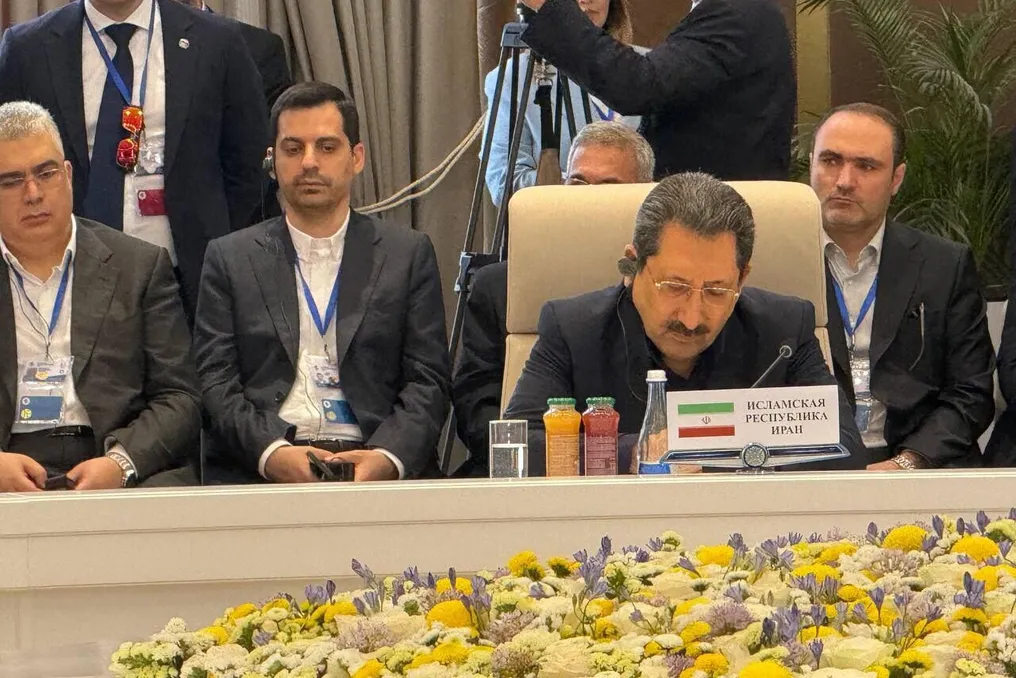
The Iranian Minister of Industry, Mining, and Trade stressed Iran's determination to strengthen economic interaction with the member states of the Eurasian Economic Union (EAEU). He noted the importance of fully implementing the free trade agreement, developing transit corridors, enhancing financial and banking cooperation, and utilizing common opportunities to achieve regional growth and prosperity.
During the second meeting of the EAEU Intergovernmental Council in Cholpon-Ata, Kyrgyz Republic, Seyyed Mohammad Atabak, speaking on behalf of First Vice President Mohammad Reza Aref, highlighted recent events in the region. He stated that Iran had been subjected to aggression from the Zionist regime and the United States over the past months. During this war, the leader of the Islamic Revolution, the supreme political and religious authority of the Islamic Republic of Iran, as well as members of his family, were killed. Furthermore, massacres were committed against numerous political and military officials and thousands of civilians, including 168 innocent students from Minab school.
Atabak continued, pointing out that the recent attacks by the Zionist regime and the US against the Islamic Republic of Iran, as well as the bombing of urban, civilian, educational, medical, and pharmaceutical infrastructure, including targeted and deliberate bombings of vital transport, energy, and industrial infrastructure and its destruction, constitute not only a war crime against the Iranian people but have also disrupted production, exports, and made transit corridors and routes for the movement of goods and energy throughout the region unsafe.
He emphasized that these corridors function as vital arteries of the region, playing a key role in promoting trade, development, and economic growth, job creation, poverty reduction, reducing class inequality, and enhancing the political stability of countries.
According to Atabak, the situation faced by the Islamic Republic of Iran represented not just a threat to national security but also a challenge to the fundamental principles of the international legal system. Therefore, defending these principles means not only defending the Islamic Republic of Iran but also defending collective security, regional stability, and the authority of international law. Nevertheless, the great Iranian nation, demonstrating unprecedented courage and resilience in the face of aggressive onslaughts from enemies and certain conspiracies, has honorably defended its sovereignty, independence, and territorial integrity, and today it is noblely striving to end the war and instability throughout the region through diplomacy and dignified solutions.
Stating that the Islamic Republic of Iran believes in multilateral mechanisms and frameworks for regional cooperation formed by the regional countries themselves without dependence on extra-regional powers, he noted that economic integration and long-term regional partnership are key to sustainable growth and the common prosperity of the region's countries. He added that Iran's efforts have always been aimed at being an effective and reliable member and partner within regional associations and blocs. The active participation of the Islamic Republic of Iran in structures such as the Organisation for Economic Co-operation (OECD), BRICS, the D-8 Economic Cooperation Organization, Asia Dialogue (AD), Association of Indian Ocean States (AIO), and the Shanghai Cooperation Organisation serves as proof of this assertion.
The Minister of Industry, Mining, and Trade specifically highlighted that the Eurasian Economic Union holds a special place in the foreign policy and economic diplomacy of the Islamic Republic of Iran. The free trade agreement between them and obtaining observer status in this union testify to the desire of both parties for effective and productive cooperation in the activities of this important economic body in this geographical space. The active participation of the Islamic Republic of Iran in high-level EAEU meetings demonstrates its determination to expand trade and economic ties with all five member states and observer states.
Referring to Iran's presence at EAEU Intergovernmental Council summits and meetings (Prime Ministers' meeting), he announced that this year the Ministry of Industry, Mining, and Trade of the Islamic Republic of Iran, together with the Eurasian Economic Commission, will hold the second Joint Committee, as well as the second meeting of the Working Group on Technical Barriers to Trade (in accordance with paragraph 10 of Article 4.7 of the agreement) in Tehran. At this event, the current status of the agreement's implementation and existing problems will be discussed.
Atabak recalled that about three months ago, the first anniversary of the implementation of the free trade agreement between the Islamic Republic of Iran and the member states of the Eurasian Union was held. This event was organized by the Ministry of Industry, Mining, and Trade of the Islamic Republic of Iran with the participation of ambassadors of the member states based in Tehran and relevant domestic bodies. He called the aforementioned agreement the most important step in deepening mutual economic relations over the past year, noting that it opens unique opportunities for national economies and serves as a suitable platform for increasing trade volume. Since this agreement has already led to increased trade between the parties, this trend will accelerate by eliminating existing obstacles.
Emphasizing that one of Iran's main directions in economic diplomacy is developing ties with friendly countries, neighbors, and developing nations, he stated that transport cooperation and the activation of transit corridors for goods and passengers are among the priority tasks. Cooperation in transit and economic corridors is considered a necessary condition for facilitating trade, ensuring supply chain and food security, increasing integration, and reducing poverty and economic inequality.
The Minister of Industry, Mining, and Trade also noted that one of the most important tools for pressuring participants adhering to independent policies in the international system is financial and banking mechanisms, as well as control over money transfer channels. He expressed the opinion that the union has reached sufficient maturity regarding the need to create an independent financial and banking system and should transform existing ideas into commercially viable products to ensure its financial security. In this regard, he proposed that the central banks of the member states establish a specialized committee to exchange experiences on launching Central Bank Digital Currencies (CBDCs) in light of global trends in digital currency development, as well as develop an intra-group mechanism for interaction in this area. It would also be appropriate for the organization's members to cooperate and synergize to implement a new and more efficient interbank messaging mechanism as an alternative to SWIFT.
Atabak stated that from the perspective of the Islamic Republic of Iran, cooperation with the EAEU represents a long-term strategy to create a powerful region by strengthening national sovereignty, promoting and developing trade, transport security, energy security, modern technology development, agriculture, and tourism, creating a common financial and banking infrastructure, as well as communication between peoples and other areas of interest. He confirmed Iran's readiness to utilize its national and internal capabilities in the aforementioned areas both bilaterally and within the EAEU, and to discuss its plans through the Ministry of Foreign Affairs with the union's members and commission. He is confident that by relying on cultural and historical commonalities and benefiting from geographical proximity, a successful model of regional integration can be presented.
The Minister of Industry, Mining, and Trade also stated that the Islamic Republic of Iran supports the promotion of the process of creating a common market for oil and petroleum products, accelerating priority measures for the digitalization of transport and transit corridors, and concluding the e-commerce agreement for goods within the EAEU. Achieving these goals will improve supply chain efficiency, reduce transaction costs, and increase trade transparency and predictability, which will be an effective step towards strengthening the region's economic resilience.
In his message, he touched upon Iran's potential, noting that Iran, possessing extensive capabilities in the energy sector, a strategic position connecting international north-south and east-west corridors, and developed customs and digital infrastructure, is ready to provide its experience, capabilities, and expertise to the members and observer states of the EAEU within the framework of scientific cooperation based on mutual interests. The success of these initiatives requires creating a predictable environment free from unnecessary barriers to trade, transport, and economic cooperation so that all members can equally benefit from the advantages of regional integration.