When buying a television, the question often arises: is it worth spending more money on an OLED TV, or is a good QLED or LED television sufficient? In recent months, Mini LED technology TVs have been trying to fill this gap. The Xiaomi S Mini LED TV was introduced with this idea in mind. After two weeks of use, it became clear that Xiaomi aimed to create not just a device with good specifications, but a television that would provide high-quality viewing of any content—be it movies, web series, cricket, or games. I reviewed the 65-inch version, and although this TV is not perfect, its advantages outweigh its disadvantages.
Firstly, the design deserves mention. At first glance, the TV gives the impression of a premium device. Very thin bezels are installed on the sides, making the screen larger and more immersive. If mounted on a wall, the appearance improves even further. The stand supports are sturdy and ensure the stability of the TV. Wall mounting is also possible. However, the installation process caused some difficulties, indicating a need for improvement in after-sales service from the company.
Build quality is one of the main strengths of this TV. Although plastic was used on the back panel, it does not look cheap or weak anywhere. The finishing and surface treatment are excellent. Judging by the appearance, Xiaomi did not try to cut costs in production. In this price segment, its build quality competes with many major brands.
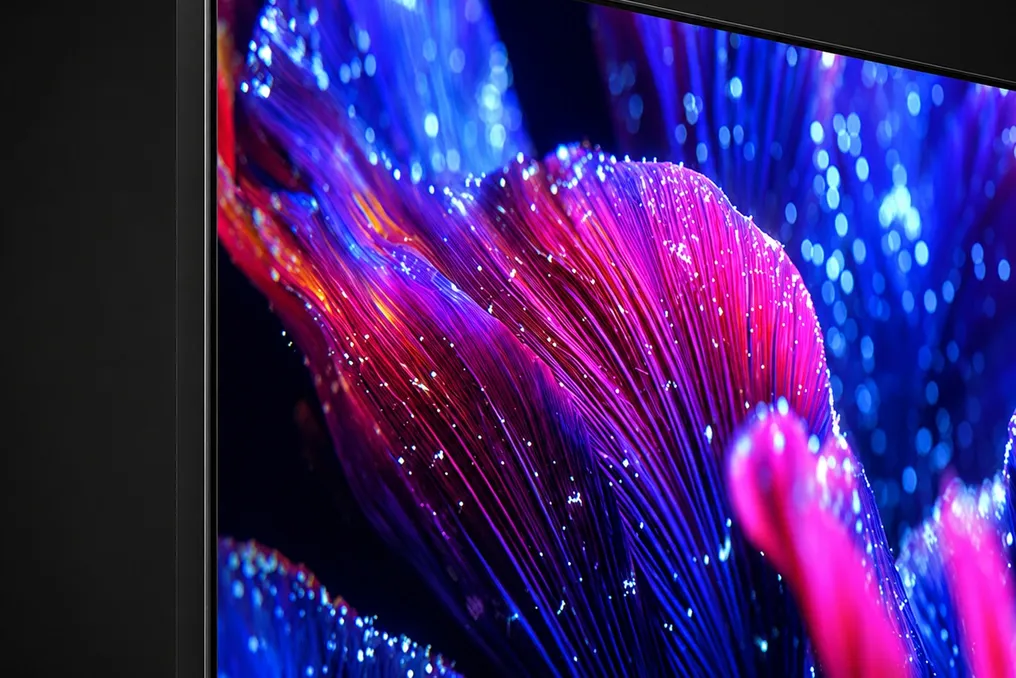
The main advantage of this TV is its QD Mini LED panel. Xiaomi equipped it with hundreds of local dimming zones. The 55-inch model has 308 zones, the 65-inch has 384, and the 75-inch has 512 zones. It is thanks to this that the contrast between dark and bright areas on the screen looks significantly better. Peak brightness reaches 1200 nits, which ensures magnificent display of HDR content.
I tested this TV by playing content from Netflix, Prime Video, YouTube, and local 4K videos. Its performance with Dolby Vision content was the most impressive. Colors look quite natural; they are not oversaturated, and skin tones are rendered correctly. If watching a movie at night with the lights off, you will immediately notice the advantages of Mini LED. Black levels appear much deeper compared to regular LED TVs, and bright areas are more saturated. Although absolutely perfect black, like on OLED, is not achieved, in this price category, this experience approaches OLED. When viewed from a distance, the deep black looks perfect, and many might mistake it for OLED, but upon getting closer, it becomes clear that it is not OLED; however, it surpasses QLED.
Despite having many functions on the remote, it looks outdated. It resembles long remotes from old times, covered with a large number of buttons. Previously, Xiaomi released more elegant and compact remotes that were easy to use and aesthetically pleasing. Now, the company provides long remotes with many buttons, most of which will probably never be used. It is hard to understand why the company releases such remotes if most of the buttons are useless. Nevertheless, the remote's sensitivity is good, and it provides a quick response.