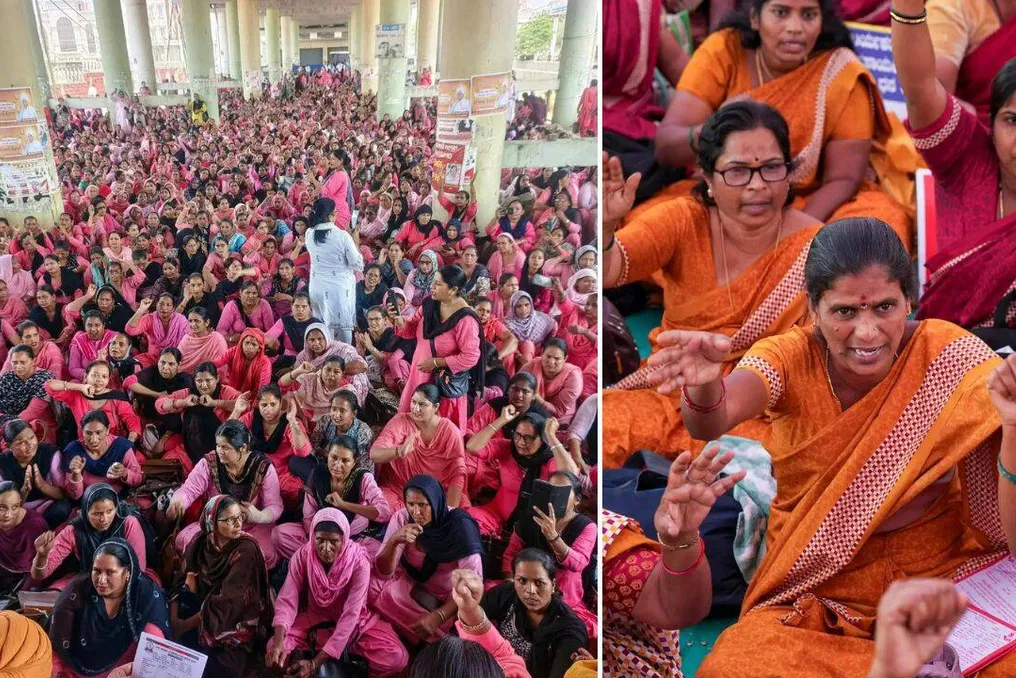
ASHA workers and Anganwadi workers have become the face of governance in India. Their work is aimed at delivering government services to the most remote corners of rural areas, contributing to the transformation of life in rural India.
Even before eight in the morning, Vimla Kumari starts her daily routine. After completing household chores and breakfast, when the children go to school, she leaves with a bag containing registration books, medical records, and a mobile phone. In a day, she might accompany a pregnant woman to a medical center, persuade parents to vaccinate their child, distribute iron tablets, identify malnourished infants, or escort a woman to a hospital several kilometers away for childbirth.
The Anganwadi center begins its work long before the children arrive. The worker cleans the premises, lays out educational materials, checks food supplies, and prepares for a day filled with songs, stories, nutrition counseling, and growth monitoring. By noon, she weighs the children, advises mothers on breastfeeding, updates records, and coordinates with ASHA workers and Auxiliary Nurse Midwives (ANMs) to ensure access to healthcare and nutrition services for all those in need.
Beyond caring for health and nutrition, these women are changing people's behavior, raising awareness, and ensuring that social programs reach those who need them most. Although their work rarely attracts public attention, it quietly fosters healthier mothers, better-nourished children, and strengthens rural communities.
Where India's development begins
When public discussions touch upon India's healthcare system, conversations often dominate around hospitals, doctors, and medical technology. However, in rural India, healthcare often begins much earlier—right in the homes of village residents.
From maternal health to child nutrition—the women transforming life in villages.
According to a study published in European Economic Letters, ASHA workers have gone far beyond their initial role as public health volunteers. They now act as local leaders who connect formal healthcare systems with rural communities, promoting maternal and child health, disease prevention, and public awareness. The study also showed that having more frontline workers is associated with better beneficiary coverage, highlighting the importance of these women in ensuring equitable access to medical services.
More than an Anganwadi center
If ASHA workers deliver medical aid to villages, Anganwadi centers often become the first institution shaping a child's future.
In the daily lives of women connecting villages with government services.
Where policy meets people
The success of India's social welfare programs often depends less on political announcements than on whether the relevant families actually receive their benefits.
Behavior change, one conversation at a time
The greatest contribution of ASHA and Anganwadi workers is often impossible to measure through official reports or government monitoring panels. Their true impact lies in changing people's behavior.
Creating a healthier start
The first thousand days of a child's life are recognized as the most critical period for physical and cognitive development. Across India, Anganwadi centers have become the foundation of these efforts.
Women delivering healthcare, nutrition, and social security to rural India.
Disease prevention before it occurs
Preventive healthcare has always been a central element of the ASHA program. Instead of waiting for illness to strike, ASHA workers spend most of their time identifying beneficiaries, raising awareness, encouraging timely treatment, and linking families with government medical services.
Beyond healthcare: Women leading development
Today, the duties of ASHA and Anganwadi workers extend far beyond health and nutrition. They are increasingly becoming the first point of contact for women seeking information about social programs, financial inclusion, and earning opportunities.
Trust-based leadership
Unlike elected representatives or government officials, ASHA and Anganwadi workers derive their authority not from administrative power but from familiarity and trust. The European Economic Journal describes ASHA workers as local leaders who strengthen community engagement and improve access to healthcare. It found a strong positive correlation between the presence of frontline workers and beneficiary coverage, suggesting that expanding this workforce directly improves equitable healthcare delivery.
Challenges behind the commitment
Despite expanding their responsibilities, frontline workers continue to face significant difficulties.
The foundation of Viksit Bharat
India's ambition to become a developed nation by 2047 relies not only on economic growth but also on healthier mothers, well-nourished children, and strong women. These outcomes are built not just on policies announced in New Delhi, but on countless conversations held in the homes of village residents.