Large-scale reforms aimed at modernizing industrial sectors, developing transport and logistics infrastructure, and increasing the efficiency of major production enterprises are being implemented consistently across the country.
Within the framework of tasks set under the President's leadership for technological renewal of the economy, implementation of modern engineering solutions, and improvement of the internal logistics system, the Navoi Con-Metallurgy Combine is demonstrating practical results.
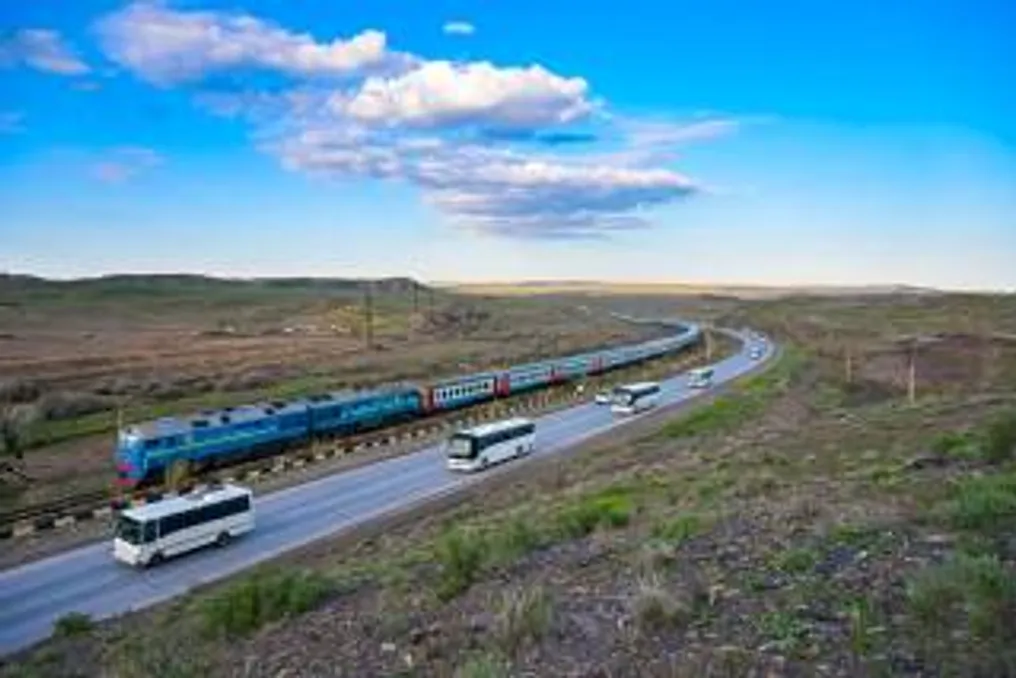
Railway transport is one of the key components ensuring the continuity of the production process at the Navoi Con-Metallurgy Combine. This system plays an important role in delivering ore mined from deposits to hydrometallurgical plants, as well as in the safe and timely transportation of employees to their workplaces and ensuring the stability of the finished product production chain.
Currently, nearly two thousand employees work at the combine across two railway transport departments and one railway workshop. Zafar Saiemov, head of the railway transport department of NKMK AJ, reported that extensive work has been carried out in recent years to modernize the railway infrastructure, create new railway lines, and gradually replace the fleet of locomotives and wagons.
This year, the Central Mining Department, through the railway transport department, constructed over 1.2 kilometers of new railway tracks at the Murunt mine. Additionally, the Shimoli ore loading point was commissioned, capable of delivering about 500 thousand tons of ore monthly to the 2nd hydrometallurgical plant. Another important project is the creation of a new railway line spanning 6.3 kilometers between the 5th hydrometallurgical plant and the Auminzo-Amantoy mine. These infrastructure facilities are becoming an important factor in accelerating transportation processes, reducing fuel and lubricant consumption, and increasing logistical efficiency.
Work on expanding infrastructure and equipping rolling stock with modern equipment continues. Specifically, within the investment project 'Ore Extraction in Qoqpatas and Dovgistov Deposits (Phase III),' new locomotives and self-propelled semi-wagons have been delivered to the railway transport department of the Central Mining Department, meeting high technical and economic indicators.
Thanks to these updates, it is planned to transport over 38 million tons of ore to the hydrometallurgical plants in the first half of 2026, and to reach 75 million tons by the end of the year. This creates a solid foundation for the further expansion of the combine's production capacity and the increase in export volumes.
Special attention is paid to the digitalization of the railway transport system. Digital management of preventive maintenance and traffic control using automated systems allows for increased operational efficiency, prevention of technical malfunctions, and ensuring traffic safety. Simultaneously, training sessions are organized this year for about 300 industry employees, aimed at developing skills in working with modern equipment and technologies.
The modernization of railway infrastructure not only improves the combine's internal logistics but also contributes to increasing the volume of valuable metal production, efficient resource utilization, and making a corresponding contribution to the sustainable development of the country's economy.