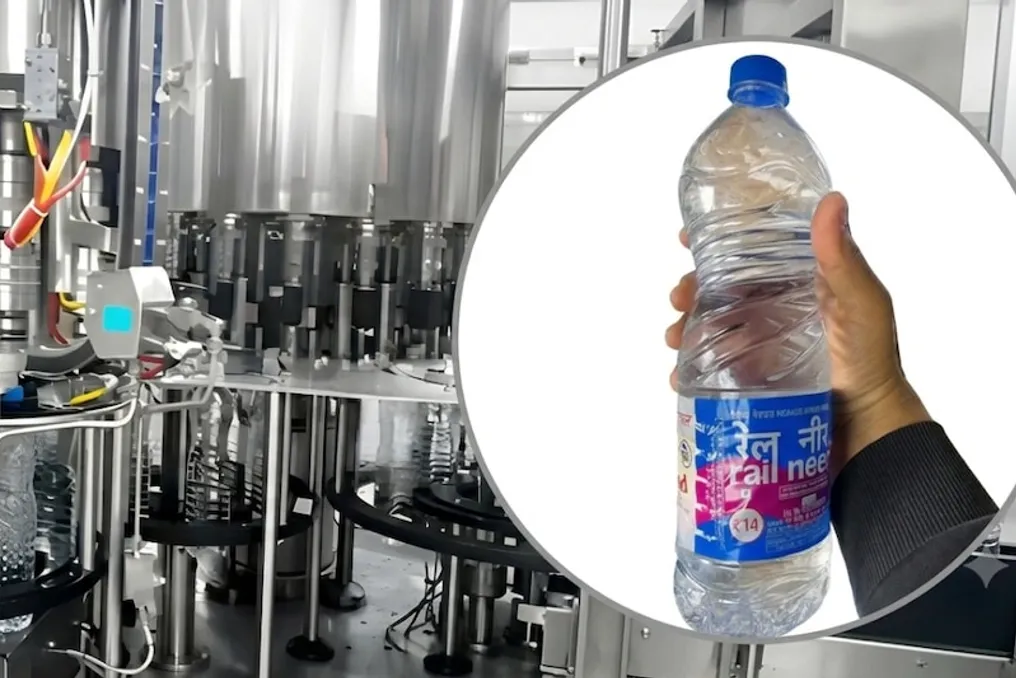
During train journeys across the country, passengers can purchase bottled water from Rail Neer both in carriages and at stations. Currently, one liter of Rail Neer costs 14 rupees. This raises the question of how the railway ensures this water is accessible to every passenger, where the production facilities are located, and what revenue this enterprise generates.
The railway company constantly recommends that passengers choose Rail Neer because this bottled water is pure and safe. In response to a government inquiry regarding the location of Rail Neer's production facilities, Central Minister of Railways Ashwini Vaishnaw stated at the Lok Sabha session that 19 factories producing Rail Neer are currently operating in various states across the country.
IRCTC is responsible for production
The agency IRCTC, which is responsible for the railway's catering, has been tasked with placing Rail Neer production sites in different locations based on needs and demand. Through these 19 factories, bottles of water are delivered to all major trains and large railway stations. Each factory is capable of producing about 100 thousand bottles daily. These enterprises were established under a Public-Private Partnership (PPP Model), where private contractors are responsible for production and bottling, and IRCTC pays them a fixed price per bottle.
According to the Ministry of Railways data, setting up a factory with a capacity of one hundred thousand bottles per day requires investments of approximately 100 million rupees. This amount includes the construction of a shed, high-tech equipment, and other tools, but the cost of the land is not included in these expenses.
The list of 19 Rail Neer production sites includes: Nangloi (Delhi), Danapur (Bihar), Ambernath (Maharashtra), Palur (Tamil Nadu), Maneri (Madhya Pradesh), Amethi (Uttar Pradesh), Nagpur (Maharashtra), Una (Himachal Pradesh), Hapur (Uttar Pradesh), Jagirod (Assam), Sankrail (West Bengal), Kota (Rajasthan), Mandidip (Madhya Pradesh), Sanand (Gujarat), Bhusawal (Maharashtra), Bhubaneswar (Odisha), Bilaspur (Chhattisgarh), Simhadri (Andhra Pradesh), and Vijayawada (Andhra Pradesh).
The railway's main objective in promoting Rail Neer is to provide passengers with clean and safe water at an affordable price. Thanks to modern technologies installed at these factories, IRCTC ensures the water remains completely purified. The presence of these 19 factories in different states has not only eliminated water shortages at stations but has also helped limit the sale of counterfeit or substandard water.
It should be noted that IRCTC is the owner and distributor of the Rail Neer brand. Consequently, IRCTC's revenue model is based on royalties and Earnings Before Interest and Taxes (EBIT Margin). According to official IRCTC financial reports, the operating profit/EBIT Margin for the Rail Neer segment is approximately 8%–9%. At a price of 14 rupees per liter, IRCTC earns a net profit of about 1.10–1.30 rupees per bottle.
Cost of pure water and bottle production
Regarding production costs, for large-scale production, i.e., about 100 thousand bottles per day at an automated plant, the cost of water filtration (RO/UV) and PET bottle manufacturing is approximately 3–4.50 rupees per bottle. Adding the cost of labels, caps, cardboard packaging, and IRCTC royalties brings the ex-warehouse cost to 5–6.50 rupees per bottle; this is only an approximate estimate. After accounting for transportation from the factory to stations, loading/unloading operations, and the commission of licensed sellers, the final price for passengers reaches 14 rupees.
How to open your own factory
To open a Rail Neer factory, one must apply for a franchise or a bottling plant through IRCTC. The candidate must possess a land plot of at least 2000–4000 square meters, a water source, and investments of approximately 4–80 million rupees. For establishing a factory, obtaining certification from the Bureau of Indian Standards (BIS), permission from the Pollution Control Board, and a Food Safety and Standards Authority of India (FSSAI) license are mandatory. More detailed information on this can be found on the official IRCTC website.