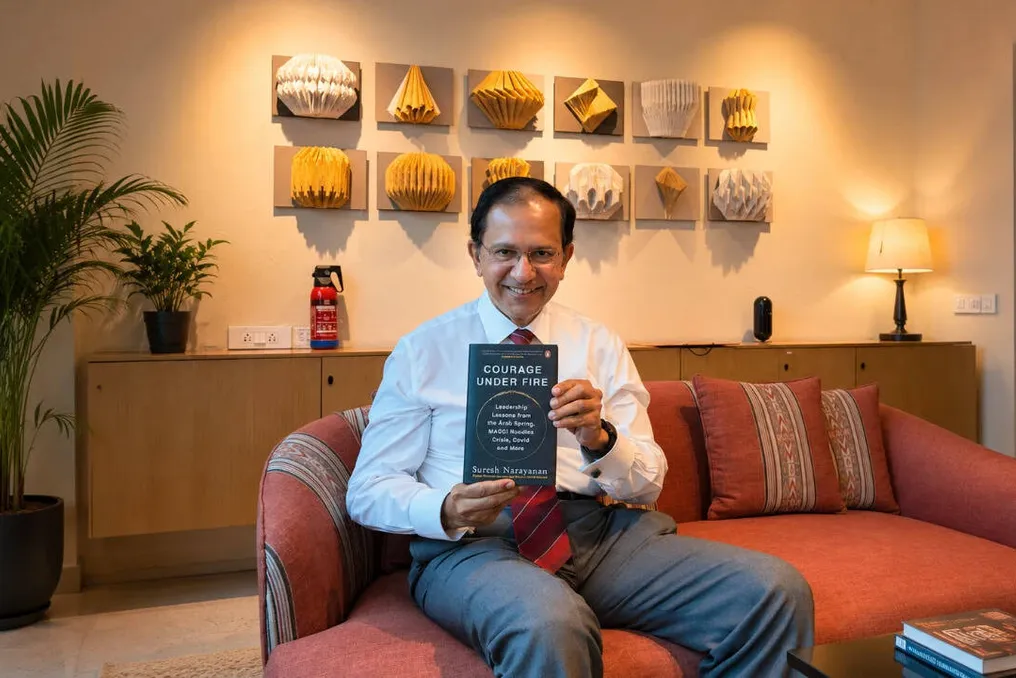
In his new book, 'Courage Under Fire,' former Nestlé Managing Director Suresh Narayanan argues that during crises, people tend to follow those they trust.
For over forty years, Suresh Narayanan has been involved in boardrooms, solving brand issues, and experiencing one of the defining crises in the history of Indian business. In 'Courage Under Fire' (published by Penguin Random House India), the former Chairman and Managing Director of Nestlé India goes beyond standard business strategy to explore what truly shapes leadership qualities.
In an exclusive interview with Lopamudra Ghatak, he posits that clarity of thought matters more than charisma. He also criticizes the obsession within Indian business with lineage, which causes companies to overlook the potential of leaders, and frankly shares lessons learned from the Maggi crisis.
Furthermore, Narayanan explains why the Gen Z approach to work-life balance deserves respect rather than ridicule, recalling how a female boss taught him that empathy is one of the key qualities of a good leader.
In 'Courage Under Fire,' he writes that 'great leadership is not about a position; it is about responsibility, authenticity, and the ability to inspire trust when necessary.' In a world characterized by a deficit of trust and an excess of information, the author examines how a leader can earn trust and how an organization can integrate trust into its DNA. He notes that too much time is spent on superficial trappings instead of sincerity, using the term 'performative' to describe a mask that displays one image while hiding another.
The question of whether leadership can be taught or if it is an innate quality is also discussed. Narayanan mentions visiting second and third-tier colleges where students often show great gratitude, thirst for knowledge, and eagerness to learn, questioning whether they are making better leaders and if the 'label' matters.
Given that the modern workplace has become extremely unstable due to geopolitics and global uncertainty, the author questions whether Indian business has begun to overcome its elitism. He offers advice for executives trying to navigate crisis situations regarding what to say, how to behave, and what tone to set.
The topic of his own reaction to the Maggi crisis is also raised: whether he believes his response was appropriate and if there is anything he would do differently looking back. In the book, he touches upon the emotional impact of losing colleagues during the pandemic. He wonders if business leaders, especially men, are becoming more open to showing their vulnerable side.
Finally, he draws attention to the influence of the new generations—Gen Z and the emerging Gen Alpha—who prioritize work-life balance, purpose, and flexibility, and analyzes how this will affect India's workforce in the coming years.