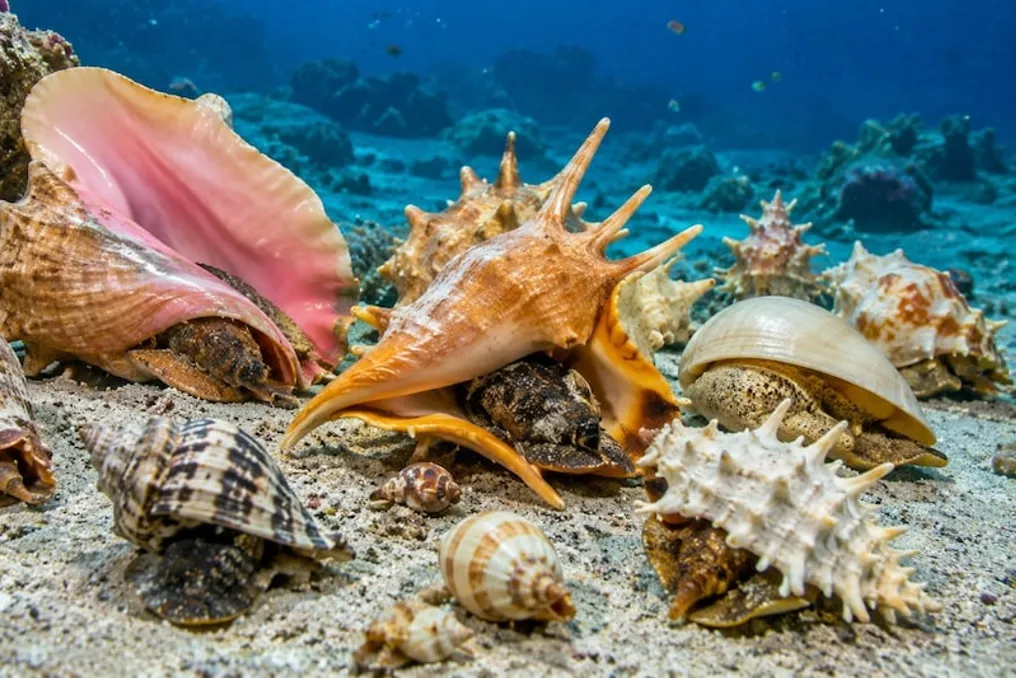
Shells used for home decoration or during religious ceremonies were originally the outer coverings of living marine organisms. In fact, a shell is the external shell of a sea snail belonging to the class Gastropoda and inhabiting warm ocean waters.
When this organism is alive, its soft body is completely protected inside the shell, which we see as a hard casing from the outside. This casing gradually increases in size over time, providing protection against marine predators.
If you have ever seen a live shell, you will notice a soft, fleshy part protruding from its opening. Using this part, the snail slowly moves across sand and rocks in the sea. When sensing a threat, it immediately retracts its entire body into the shell.
Thus, the shell used in worship was the hard outer part of a living marine organism. After the animal dies, its shell remains in the sea, from where people later collect it.
There are many species of shells around the world, but the most famous is the Queen Conch. It can be found in marine areas from Florida, the Bahamas, the Bermuda Islands, and the Caribbean Sea to Brazil. Its shell is quite large and attractive; the mouth of the shell is pink, and its length can reach about 30 centimeters. Some species have protruding spiky parts on the edges, which are called Spider Conchs.
In Caribbean countries, the meat of these shells is eaten with great pleasure. The meat is exported from these countries to America, Europe, and South America. Furthermore, due to their beauty, people all over the world collect their shells.
However, due to overhunting, the population of these species has sharply declined in several areas. This is why efforts are now being made to develop commercial breeding technologies.
Shells are herbivores. They feed on algae growing on the seabed, as well as other small marine plants. Therefore, they are considered an important part of the marine ecosystem.
In the sea, shells are not always safe, as they are preyed upon by various marine animals. Among them are long-headed turtles, nurse sharks, some other types of snails, blue crabs, ospreys, thorny lobsters, and other crustaceans.
Thousands of male and female shells reproduce together. The female lays millions of tiny eggs in the sand once. After about five days, larvae hatch from them, drifting with the current for about a month. Then they settle on the seabed in a suitable location.
The first year after birth, the animal hides under the sand during the day and comes out at night to eat, which helps it avoid predators.
For the shell to become fully mature, it requires at least five years. During this period, the edge of its shell becomes strong and wide. Only after five years does it become capable of reproduction. The average lifespan is about seven years, but under favorable conditions, some shells can live from 20 to 30 years.
Few people know that some species of shells produce natural pearls. These pearls come in different colors: white, brown, orange, and pink. Pink pearls of the Queen Conch are especially valuable, considered among the rarest and most expensive natural pearls in the world.
So, the next time you play a shell during worship, remember that it is not just an empty shell from the sea. Once inside it lived a living marine mollusk that spent years making this shell its home and living a life in the underwater world.