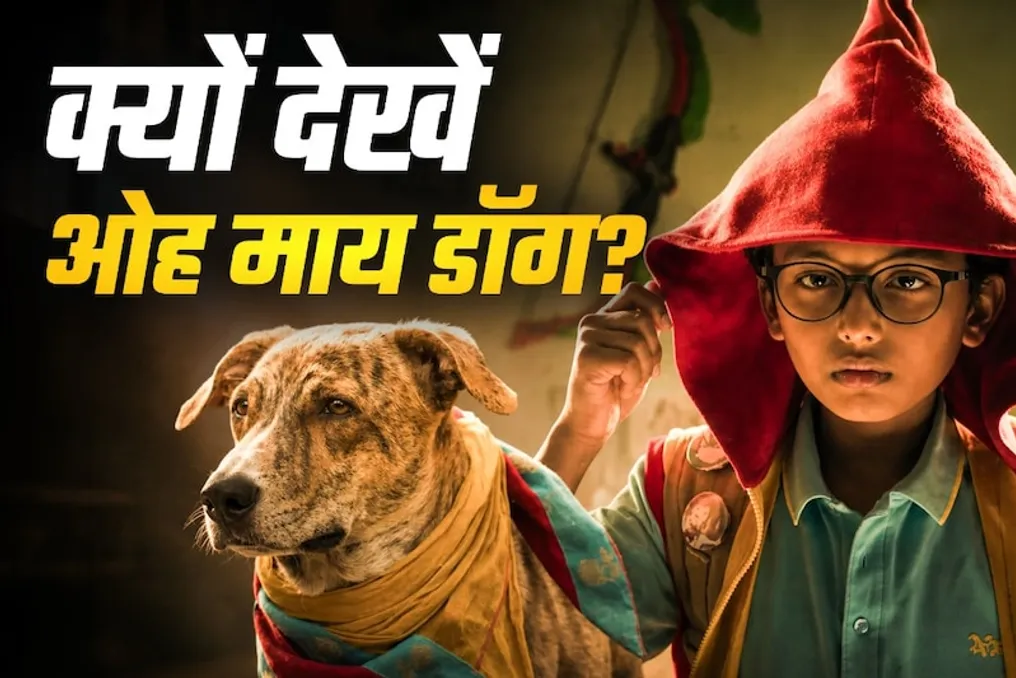
The film 'Ohh My Dog' raises the theme that a dog is not just a pet, but a full member of the family, capable of understanding human joy and sorrow without words, and if necessary—protecting them from the world. Therefore, when a beloved companion runs away, its search becomes not just a hunt for an animal, but a reflection of deep anxiety forcing a person to call their loyal friend's name in the streets.
'Ohh My Dog' presents this bond of warmth, fear, pain, and loyalty in the format of a mystical drama. The story unfolds in two different states—Assam and Bihar—and unites them through the unique connection between man and dog.
In Assam, a beloved Indian dog named Momo suddenly disappears during a ball chase. Appu sets out to find his friend, and his innocent search gradually uncovers a large animal trafficking network.
Meanwhile, in Bihar, a young worker named Prince mysteriously goes missing. His loyal stray dog Oscar begins searching for his owner. However, Oscar's search is not limited to merely trying to find his owner; it slowly reveals a network for illegal kidney trade whose connections stretch far.
Thus, in one part, a child searches for his dog, and in another, a dog searches for its human, which is the most beautiful idea of the film.
Director Amit Rai presented the film in the style of a children's detective story. The plot features clues, suspicious characters, clever police officers, and an innocent child who connects it all. Appu, playing with a Rubik's Cube, demonstrates such a sharp mind that he is able to piece together small details—CCTV footage, online payments, and a packet of treats—to reach the kidnappers. Sometimes his genius seems excessive for a child of his age, and it is hard to believe he can unravel such a complex mystery.
However, this is where the main strength of the film lies—the emotions. Appu's struggle is not only about solving the case; he wants to bring back his friend Momo. When the film involves the viewer in this bond, some convenient plot points begin to be ignored.
For the film's author, the strongest part is Oscar's story. Prince is a poor and marginalized youth. When Prince's father learns that his son might have been kidnapped by organ traffickers, his question causes intense pain: can a person live with only one kidney? The answer turns out to be yes, and the father finds relief.
This small moment exposes the entire social pain of the film. The understanding of the horror of poverty comes when what matters to a person is whether their child can live with one kidney, rather than anything else. Thanks to this, Oscar's story goes beyond a simple search for an owner; layers of poverty, exploitation, crime, and human circumstances are added to it.
The film was shot using hundreds of real dogs and real locations, which gives it a raw and alive feel. Mate Herbai's cinematography looks incredibly beautiful in several places. Oscar's bark looking at the moon during a full moon is particularly memorable, resembling a panel from a graphic novel, as if he is calling upon the power of his ancient predatory ancestor.
Another beautiful visual image is Oscar sitting on a round, desolate clearing while the camera slowly transforms this circular frame into a white circle of the moon. Suvir Nath's editing also supports the film, although it could have been clearer. The transitions between Appu's story in Assam and Oscar's in Bihar are executed very skillfully.
But the most important thing is the performance of Oscar. His innocence in his eyes, his anxiety for help, his growling, showing teeth, and persistence in searching for his owner make him not just a dog, but a full-fledged protagonist of the film.
Despite the film being driven by the child and the dog, actors like Pankaj Tripathi, Pawan Malhotra, and Rajesh Sharma provide support. Pawan's character, working in the PTO of Punjab, brings a certain lightness through his irritable yet funny manner. Pankaj plays a teacher who helps Prince's friends in the search. Although his role is quite limited and resembles his old light comedic roles, young actress Mahi Rai also handled her role excellently with complete confidence.
The weakest point of the film is the pacing and logic. The story drags on in some places so much that, despite the tense drama, the entertainment effect somewhat decreases. If the film were more concise in certain moments, its impact could have been much stronger. For example, the sudden gathering of an entire army of stray dogs after one dog barks seems somewhat cinematic. Similarly...