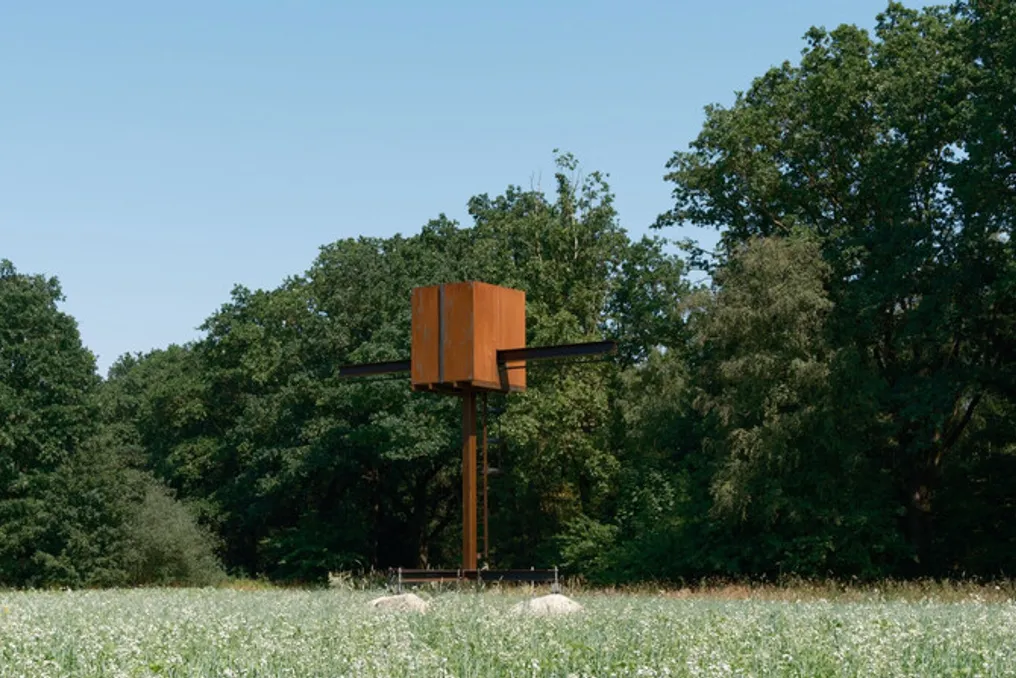
De-Vice, a kinetic meditation space seven meters high, was conceived to allow participants to gradually open a closed environment towards the landscape through their own movements.
De-Vice, a kinetic meditation space seven meters high, was conceived to allow participants to gradually open a closed environment towards the landscape through their own movements.
Caspar Schols, a Dutch artist and designer, dedicates his work to exploring the intersection between architecture, ritual, and the experience of presence. One of his previous projects, Cabana ANNA, received attention in The New York Times in 2025. This kinetic sliding structure, initially conceived as a garden house for his mother, redefined the concept of a wooden cabin.
De-Vice follows this line of inquiry, transforming ideas into a sculptural structure where the separation between interior and exterior is not instantly abolished, but progressively shifted. As a meditation space, the project aims to reconnect individuals to the essence of being and the feeling of belonging to the universe.
To begin the experience, the participant operates a pedal system that slowly opens the enclosure in opposite directions. This gradual transition alters the perception of the finite limit toward the infinite. Although participants operate the pedals expecting a destination, they remain in the same place, being reminded that they are already at the necessary point.
The work is based on principles of embodied cognition, where perception is influenced by physical action. By giving control to the participant's body, De-Vice treats movement as a cognitive act. Through rhythm, duration, and effort, it functions as a tool to renew the vision of the universe, allowing, according to Schols, participants to reach and return from the infinite.
Schols built the project entirely by hand, considering the manufacturing process inseparable from the final work. Applying approximately 3,000 sheets of 8x8 cm gold required total concentration, as any carelessness could damage the delicate material, forcing the restart of the work. For the designer, manual construction constitutes, in itself, a way to connect with the present moment, justifying the creation of these small cosmic chapels.
The installation includes a steel structure and staircase leading to a metallic volume situated six meters above the ground, whose interior is lined with gold leaf. Before accessing the chamber, visitors leave the firmness of the ground. Ascending six meters above the landscape represents a literal act of detachment before reintegrating into a distinct consciousness.
The structure is firmly anchored by large rocks reminiscent of Dutch hunebeds—prehistoric megalithic stone monuments erected between 3350 and 3050 BC. These are often considered collective burial chambers or ritual sites, among the oldest preserved structures in the Netherlands. By making this allusion to such ancient landmarks, De-Vice establishes a link between a modern contemplation space and a much more ancestral tradition.
The internal gold lining continuously absorbs and modifies the variable light, lending distinct characteristics to the experience throughout the day. At night, De-Vice assumes the appearance of a seven-meter-high lantern in the landscape.
Olhar Digital's Cinema and Streaming newsletter, aimed at subscribers of the Olhar Digital Club, discusses the redemption of House of the Dragon and the box office records of the new Spider-Man film.
Even though the second season of House of the Dragon generated dissatisfaction, it is recommended to watch the end of the third season, scheduled for the 9th, as the series has shown a change of direction. This shift transcends the elements of fire and dragons.
In cinema, the latest Spider-Man film achieved tremendous success, breaking revenue records. The movie presents a humanized view of Peter Parker, a solitary individual facing major transformations, while also establishing the elements for the future of the Marvel Universe on the big screen.
When the second season ended, much of the discussion focused on the pacing, with the feeling that the series had dedicated eight episodes to preparing a war that was slow to begin. However, with only one chapter remaining in the third year, the debate changed drastically. The initial perception was that the production had found balance again, as if the second season had only ended at the beginning of the third.
One of the main reasons is that the plot finally fulfills what it promised from the beginning of the conflict between the Targaryen family factions. However, the change is not just in increasing visual battles; what has changed is the way they occur. The fights have become direct consequences of the characters' political and personal decisions, a point frequently highlighted by critics: the conflict stopped being merely anticipated and started being felt.
Curiously, the dragons, which have always been the focus of promotional campaigns, are not the main reason for the praise. Variety points out that it is the people who give value to House of the Dragon, classifying the dragons as mere 'CGI flying lizards' that complement the spectacle. Critics emphasize the return to the franchise's basics, valuing scenes of negotiation, fragile alliances, betrayals, and private conversations as much as action sequences.
This evolution is noticeable in the protagonists. Emma D’Arcy seems to be in her best performance as Rhaenyra Targaryen, overcoming previous hesitation and dealing with increasingly difficult choices while maintaining her moral complexity. Her interaction with Alicent Hightower (Olivia Cooke) is seen by many as the emotional core of the series, as both remain connected by a common history, making every choice more painful.
Matt Smith also gains prominence as Daemon. After spending part of the second season away from the central group, he regains relevance by confronting Rhaenyra and his own ambitions. Furthermore, the series makes room to strengthen secondary and new characters, such as Ormund Hightower (James Norton), considered one of the best additions of the season. Westeros finally seems to be bigger than the dispute among some members of the Targaryen family.
There was no total consensus. The Hollywood Reporter, for example, continues to point out known flaws, such as the excess of characters and moments where the visual aspect outweighs what is necessary. The publication itself mentioned that its favorite episodes are those that reduce the scale and prioritize more intimate and insightful dialogues. Criticism has not disappeared, but rather redirected its focus.
The greatest virtue of the third season may be understanding what made Game of Thrones work, instead of just meeting criticism by increasing battles or adding more dragons. The war is impressive, but it is the characters that make it interesting. The final test remains: turning this recovery into a memorable final episode.
Meanwhile, Peter Parker (Tom Holland) lives a period of isolation at work. After a spell cast by Doctor Strange (Benedict Cumberbatch) at the end of No Way Home (2021), which made everyone forget Peter and his secret identity, the young man spends four years being more Spider than Parker, without a support network. He observes, through social media, his old friend Ned Leeds (Jacob Batalon) and ex-girlfriend MJ (Zendaya) realizing the dreams they planned together.
This weight marks the beginning of A New Day. During the narrative, Parker realizes that isolation is not the answer and decides to seek reconnection with those he loves, even if his memories have been erased. The film's message is that maturing does not mean suffering alone, a relevant theme in times of loneliness and depression. However, the script stumbles in simplifying this approach through narrative conveniences.
Spider-Man: A New Day strives to reestablish, visually and thematically, the hero at the street level after a long journey through the multiverse. Destin Daniel Cretton's direction (Shang-Chi and the Legend of the Ten Rings) focuses the camera on the protagonist, reviving the first-person perspective (GoPro style) popularized by Marc Webb in The Amazing Spider-Man, and pays homage to the Insomniac games with inspired choreographies.
In parallel, the film explores Parker's mind without using narration, which is considered a success. Intimacy arises in the exploration of everyday dilemmas, such as anxiety about body changes or the symbolic surrender to a free fall after seeing MJ with another boyfriend. The merit of the execution lies in the rhythm, which accelerates in actions and slows down in dialogues, without polluting the drama with inappropriate humor or artificial fan service. This recalls the Netflix era of the Daredevil series.
The central conflict relies on the figure of Jean Grey (Sadie Sink), whose outburst after Damage Control experiments functions as a reflection of Peter's psychological deterioration. By witnessing the mutant succumb to trauma and the burden of imposed solitude, the film connects its discussion on mental health. The threat becomes the risk of carrying burdens without support. Thus, the direction uses Jean's pain to drive the hero toward balance. Only after resolving crucial internal issues does the script allow Peter to help the mutant, which is another success of the plot. Upon finding peace with what happened, Jean reciprocates, saving Peter.
However, the script wavers in executing this narrative turn. Peter's decision to seek out Ned and MJ represents authentic maturation, but the story opts for convenience over a rigorous ending. The gradual recovery of friends' memories, facilitated by Jean's telepathic impact on those affected by Doctor Strange's spell, acts as a deus ex machina. Instead of requiring Peter to rebuild his bonds, the plot relies on magical artifices to restore the status quo, weakening the protagonist's maturation.
In summary, Spider-Man: A New Day offers one of the most human and mature portraits of Peter Parker in the MCU to date. The film succeeds in the tone of urban chronicle, the sincere approach to grief, and the dynamic (surprisingly comical) between Holland and Jon Bernthal, who plays Frank Castle (The Punisher). However, it stumbles in the script's hesitation to sustain its most difficult choices, resorting to Marvel universe shortcuts to organize the Avengers' next steps, scheduled for December 17th. Despite this, it is a chapter that returns emotional density to the hero associated with the Sam Raimi era (Tobey Maguire) and sustained by Webb (Andrew Garfield), before the MCU once again demands Holland's presence in a global and multiversal story.
Although it remains focused on an urban narrative contained in New York, Spider-Man: A New Day plays a strategic role in setting the stage for Avengers: Doctor Doom. The main driver of this expansion is the official introduction of Jean Grey as a native mutant of Earth-616. With the confirmation of the X-Men's presence in the next franchise event, the mutant's arc creates the link to integrate the team into the multiversal conflict against Victor Von Doom (Robert Downey Jr.).
The hook for this new dimension comes in the post-credits scene. In it, the tracking app created by Ned Leeds locates Spider-Man outside of Earth, deep in space. The most likely theory is the Post-Incursion Battleworld Theory. If the destruction of the multiverse and the collapse of realities are confirmed, the missing terrestrial signal suggests that Earth-616 may have been destroyed or merged with colonies of cosmic fragments under the dominion of Doctor Doom, throwing the hero directly into the epicenter of chaos.
}} , {The game The Green Light utilizes elements of exploration and puzzles to build tension. Thanks to its unsettling visual style and smooth gameplay mechanics, the indie project is capable of being frightening, although it suffers from a lack of variety throughout the entire gameplay experience.
It is recommended for those who prefer first-person psychological horror, exploration, and puzzle-solving. The Green Light manages to build suspense even when the player anticipates an upcoming scare, although it could offer a wider range of situations and mechanics.
The main character, Fred, is going through a difficult period in his life, trapped in unpromising work and a routine that causes dissatisfaction. He begins to suffer from hallucinations while trying to find a way out of his existence.
Everything changes during a night shift when a voice comes over the radio talking about a mysterious green light. According to this voice, the freedom Fred seeks awaits him at a distant lighthouse.
From this moment on, the protagonist begins a journey that mixes reality, hallucinations, and psychological horror, trying to understand the meaning of the green light and resist the increasingly disturbing manifestations of his own mind. The official concept presents this journey as a story of human self-discovery, willing to seek freedom even at the cost of one's own life.
The Green Light is an independent first-person psychological horror game developed and published by waleedzo. The game was released on January 29, 2026, for PC via the Steam platform. The experience combines exploration, narrative, and puzzle-solving. Despite having traits of a 'walking simulator,' the game features more interaction than just moving through the environment while waiting for the next event.
A significant part of the game is dedicated to exploring locations, finding items, and understanding the relationship between different areas. This is where The Green Light demonstrates one of its best features. Puzzles are one of the most interesting aspects of the game. Instead of being a set of isolated tasks, the game uses puzzles as a stimulus for exploring the surroundings. Players must carefully examine scenes, look for paths, and understand where specific information or items can be used. Essentially, solving puzzles also means studying the map.
This approach works particularly well in a horror game. Over time, the player begins to recognize certain places and understand where they need to return. However, familiarity with the environment does not necessarily mean a sense of safety. On the contrary, the game uses this familiarity to create anticipation of what might await the player upon revisiting a corridor or returning to a known area. This might have been the biggest surprise during playthrough.
The Green Light does not hide that something bad is about to happen. There are moments when the atmosphere almost warns of an approaching fright. Nevertheless, the author experienced a significant amount of fear. Partly this is because the game creates truly disturbing images. The creatures and appearances are intentionally unpleasant; their appearance perfectly matches the psychological horror concept. There is an important difference between surprising the player and causing them discomfort. The Green Light achieves both. At times you know something is going to appear, but the problem is that you don't know exactly what, when, or where.
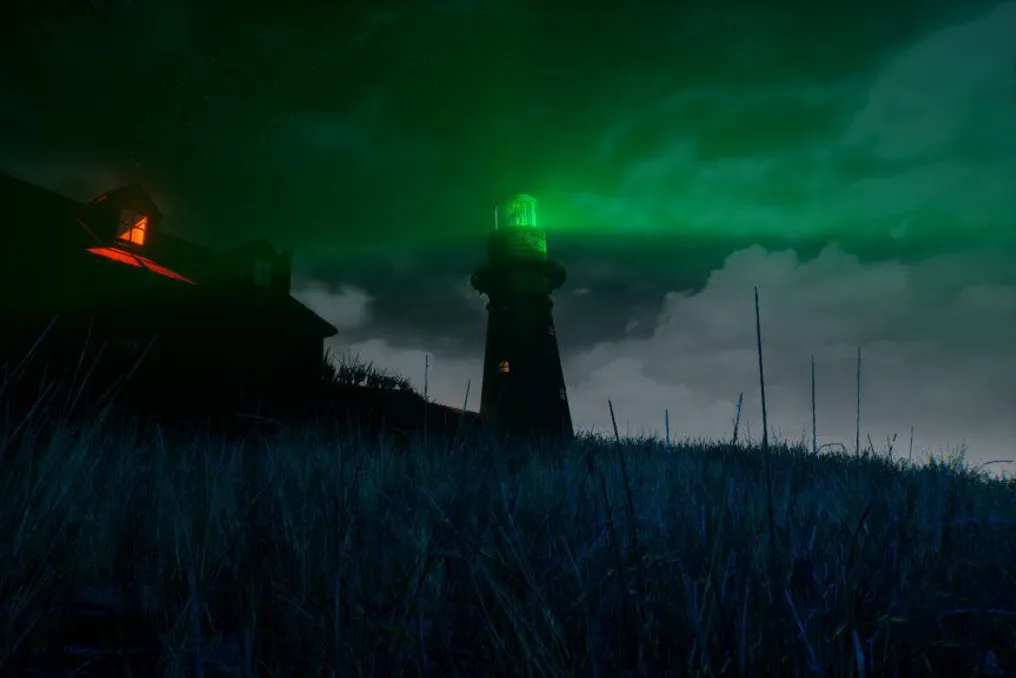
This anticipation is as important as the scare itself. The visuals also deserve attention. The Green Light relies on dark locations, greenish lighting, and unsettling imagery to maintain the atmosphere. The result depends not only on the sudden appearance of creatures on screen. Efforts are made to make the scenery itself uncomfortable. The visual direction blends well with the psychological concept of the story, especially when reality and hallucinations begin to merge. This is when the game works best: when you are not just waiting for a monster to appear, but trying to understand whether what you see is part of the environment or Fred's mind.
Another positive point is the gameplay. The controls are simple, and movement is fluid, which is especially important for an exploration-based experience. At no point did I feel like I had to struggle with commands to explore the environment or find a puzzle solution. This significantly helps the pacing. In similar games, any overly heavy or complicated movement mechanic can turn exploration into a tedious task. Here, simplicity plays to the advantage of the experience.
The official system requirements are also relatively modest for a game created on Unreal Engine. The minimum configuration requires an Intel Core i5-4400 or AMD Ryzen 5 1600 processor, 4 GB of RAM, a GTX 1060 3GB graphics card, and 15 GB of disk space. The main negative aspect appears as the experience develops: the lack of variety. Individually, the elements work well: exploration is interesting, puzzles are good, and scares fulfill their function. The problem is that The Green Light does not find many different ways to combine these ideas. After understanding the game's logic, some situations start to feel familiar. This doesn't mean the game stops functioning, as the atmosphere continues to maintain most of the tension, but there is a feeling that its good ideas could have been realized more diversely. New types of interaction, different creature encounters, or greater diversity in exploration could help avoid this repetition. This limitation is especially noticeable since the developer's base is well-made. The issue is not necessarily the available mechanics, but the number of ways they are used.
An important point for Brazilian players is that The Green Light has an interface and subtitles in Brazilian Portuguese. Voices, however, are only available in English. This matters in a game where narrative and atmosphere carry great weight. Unlike other indie horrors that are only released in English, here you can follow the story without relying on advanced language knowledge, making the experience more accessible to the Brazilian audience.
The Green Light is one of those indie projects that achieves a lot with a relatively simple concept. The puzzles are probably its greatest success. They exist not just as obstacles between scare and scare; they force the player to explore, understand the environment, and get accustomed to the map. In horror, this is used against you. The visuals are also very good. The images are unsettling, and even when it was relatively easy to tell that something was about to happen, I still got many scares. Smooth gameplay helps maintain a pleasant experience, especially during exploration and puzzle-solving. The biggest problem is the lack of variety. After the game presents its core ideas, it doesn't always find new ways to develop them. This can lead to a sense of repetition that prevents the experience from growing as it could.